
Introduction: Why AI Use Cases Must Differ by Business Model
Many businesses adopt AI marketing tools expecting instant results—only to be disappointed. The problem isn’t AI itself but using the same AI strategy for both B2B and B2C marketing.
I’ve witnessed this firsthand: a SaaS company tried using B2C-style chatbots for enterprise sales, resulting in frustrated prospects and a 40% drop in qualified leads. Meanwhile, an e-commerce brand implemented B2B-style lead scoring on its consumer site, creating unnecessary friction that killed conversions.
In 2026, effective AI adoption depends on understanding how AI use cases in marketing differ between B2B and B2C. Sales cycles, decision-making processes, data volume, and buyer intent all influence how AI should be applied for real impact.
What Are AI Use Cases in Marketing?
AI use cases in marketing refer to specific ways artificial intelligence is applied to improve targeting, personalisation, automation, and performance across marketing channels.
According to KEO Marketing’s 2026 AI Adoption Report, AI delivers the most value when aligned with business goals—whether that’s nurturing long-term B2B relationships or driving high-volume B2C conversions. Their research found that companies with business-model-specific AI strategies achieve 3.2x higher ROI than those using generic implementations.
AI Use Cases in B2B Marketing
B2B marketing focuses on long sales cycles, multiple decision-makers, and high-value conversions. AI is best used to support insight, efficiency, and personalisation at scale.
Common B2B AI Use Cases
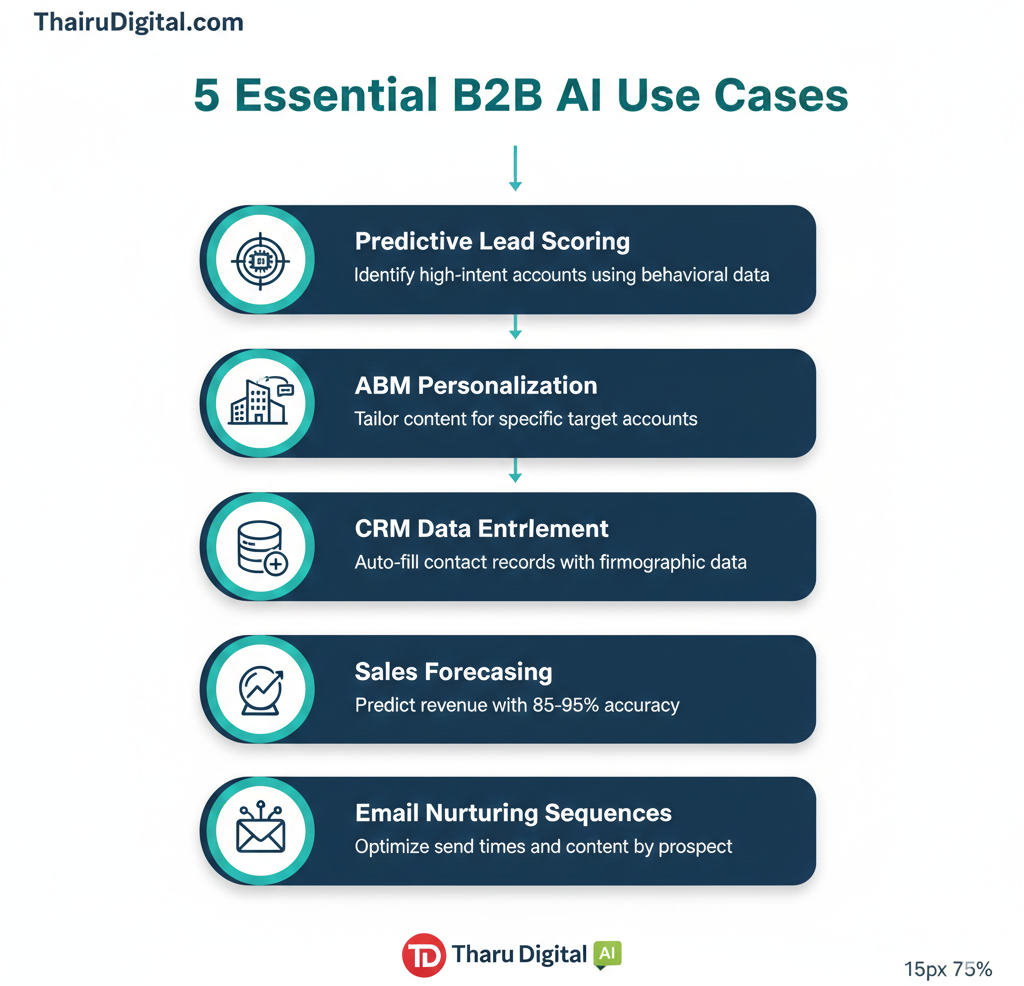
1. Predictive Lead Scoring and Qualification
Tools like HubSpot Score, Salesforce Einstein, and 6sense analyse behavioural data, firmographic information, and engagement patterns to identify which leads are most likely to convert. This prevents sales teams from wasting time on low-intent prospects.
In our experience, predictive lead scoring can increase sales productivity by 30-50% by focusing efforts on accounts showing genuine buying signals.
2. Account-Based Marketing (ABM) Personalisation
Platforms such as Demandbase, Terminus, and Adobe Marketo use AI to customise content, messaging, and outreach for specific target accounts. AI analyses company size, industry, tech stack, and recent activities to determine which content resonates best.
For example, when targeting CFOs at mid-market companies, AI can surface ROI-focused case studies rather than product feature lists.
3. CRM Automation and Data Enrichment
AI tools like Clearbit, ZoomInfo, and Clay automatically enrich contact records with job titles, company information, technologies used, and social profiles. This eliminates manual data entry and ensures sales teams have complete context before reaching out.
We’ve seen CRM enrichment reduce data entry time by 60% while improving targeting accuracy.
4. Sales Forecasting and Pipeline Analysis
AI-powered forecasting in Salesforce, Clari, and Gong analyses historical win rates, deal velocity, and conversation sentiment to predict quarterly revenue with 85-95% accuracy. This helps marketing teams allocate budgets to the most promising channels and campaigns.
5. Personalised Email Nurturing Sequences
Platforms like Outreach.io, SalesLoft, and Drift use AI to determine optimal send times, subject lines, and content for each prospect based on their engagement history and profile. AI can also identify when prospects go cold and trigger re-engagement campaigns automatically.
KEO Marketing’s research highlights that AI helps B2B teams prioritise the right accounts and tailor messaging based on intent and behaviour—not guesswork. Their data shows personalised AI-driven outreach achieves 2.5x higher response rates than generic campaigns.
AI Use Cases in B2C Marketing
B2C marketing emphasises speed, volume, and personalisation. AI shines where large datasets and rapid decision-making are required
Effective B2C AI Use Cases
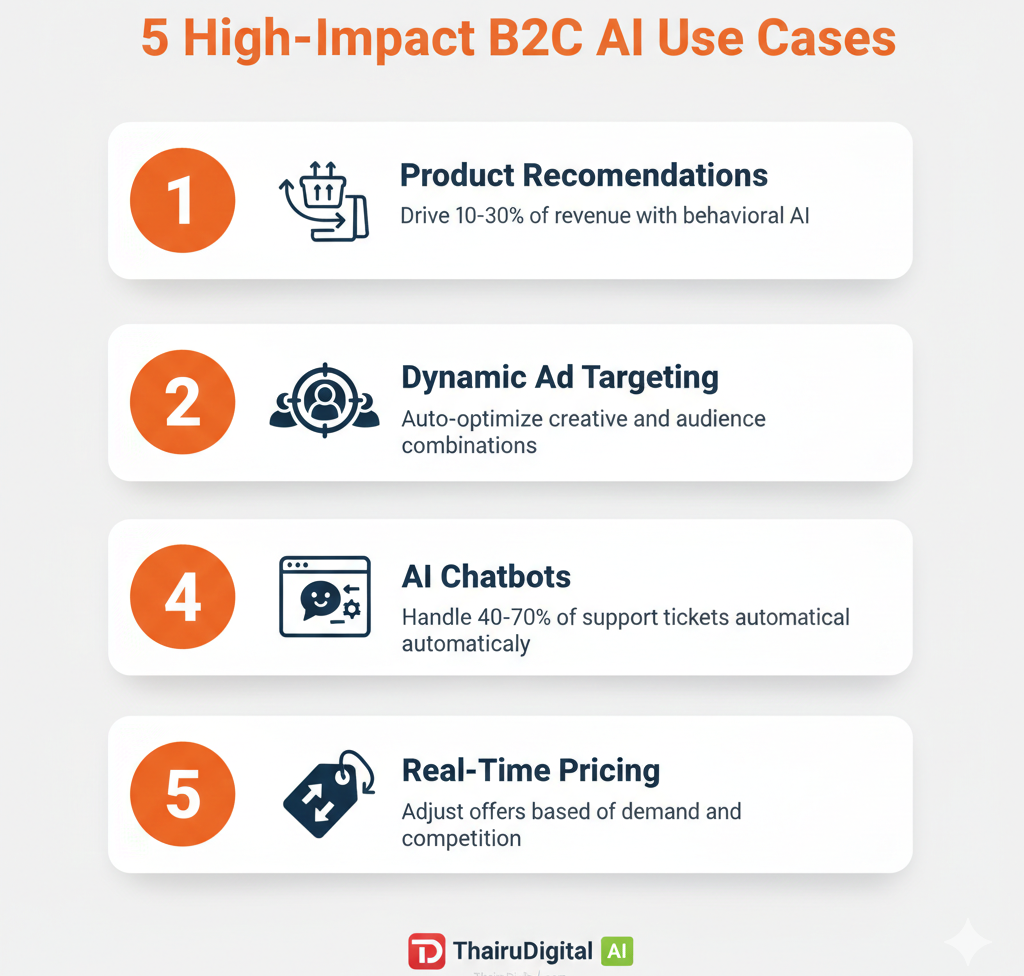
1. Product Recommendations Based on Behaviour
Amazon’s recommendation engine is the gold standard, but tools like Nosto, Dynamic Yield, and Bloomreach make this accessible to smaller retailers. AI analyses browsing history, purchase patterns, and similar customer behaviours to suggest products in real-time.
According to industry benchmarks, AI-powered recommendations can drive 10-30% of total e-commerce revenue.
2. Dynamic Ad Targeting and Retargeting
Meta Advantage+, Google Performance Max, and TikTok Smart Performance campaigns use AI to automatically test creative variations, audience segments, and bid strategies. The AI learns which combinations drive the best cost-per-acquisition and reallocates budget accordingly.
In our campaigns, we’ve seen AI-driven ad optimisation reduce customer acquisition costs by 25-40% compared to manual management.
3. Chatbots and AI-Powered Customer Support
Intercom, Zendesk Answer Bot, and Ada use natural language processing to handle common customer questions 24/7. For B2C brands with high inquiry volumes, this can deflect 40-70% of support tickets while maintaining customer satisfaction.
More advanced implementations use sentiment analysis to escalate frustrated customers to human agents before issues escalate.
4. Personalised Website and App Experiences
Tools like Optimizely, VWO, and AB Tasty use AI to dynamically adjust homepage layouts, product displays, and messaging based on visitor behaviour and demographics. A returning customer might see previously viewed items, while a first-time visitor sees best-sellers
5. Real-Time Pricing and Offer Optimisation
Retail AI platforms like Revionics and Competera analyse competitor pricing, inventory levels, and demand patterns to adjust prices dynamically. Airlines and hotels have used this for years, but it’s now accessible to e-commerce brands of all sizes.
In B2C, AI enhances customer experience by delivering the right message at the right moment—automatically and at scale.
Real-World Case Study: B2B SaaS Company
The Challenge: A project management software company was struggling to convert free trial users to paid plans. Their marketing team was treating all trial users the same way, regardless of company size or use case.
The AI Solution: We implemented a multi-pronged AI strategy:
- Predictive scoring using Clearbit and HubSpot to identify high-value accounts (500+ employees in tech/consulting)
- Behavioural segmentation in Segment to track feature usage patterns
- Personalised nurturing with Braze, sending different content to individual users vs. team administrators
- AI-powered chat using Drift to answer technical questions during business hours
Results After 4 Months:
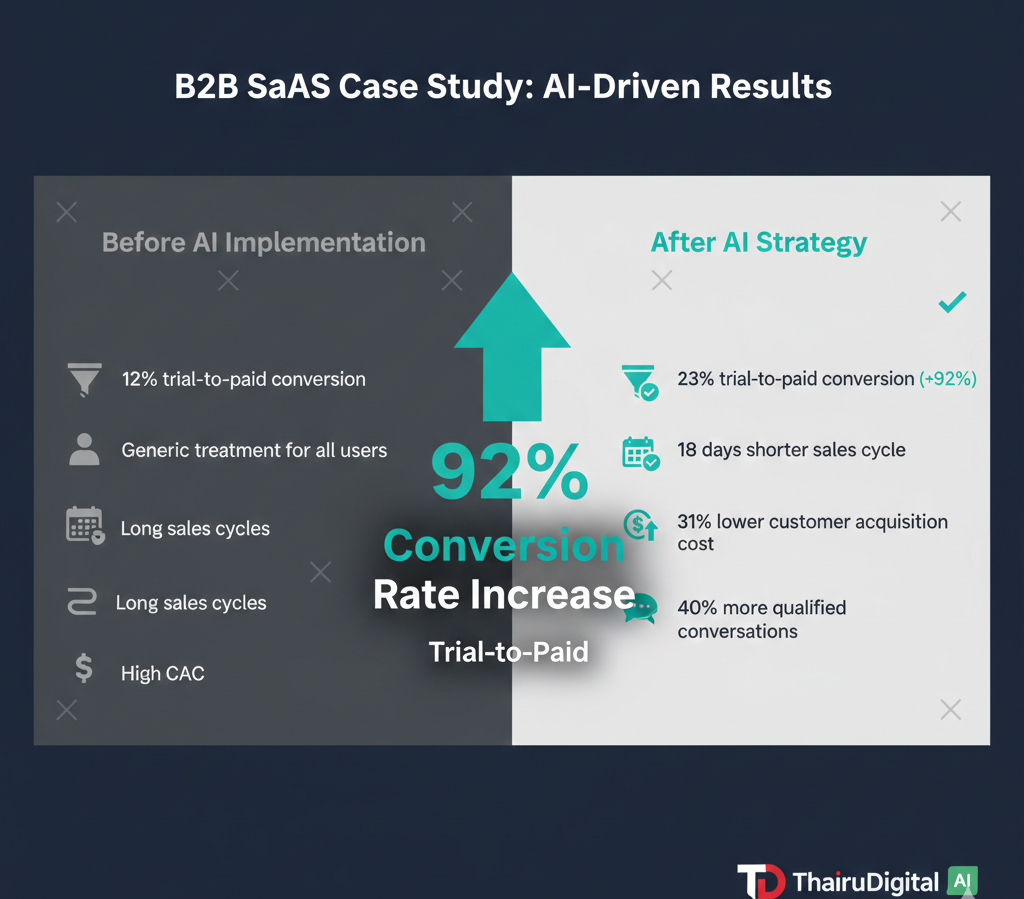
- Trial-to-paid conversion rate increased from 12% to 23%
- Sales cycle shortened by 18 days on average
- Customer acquisition cost decreased by 31%
- The sales team reported 40% more qualified conversations
Key Insight: The breakthrough came from recognising that B2B buyers need proof, not pressure. AI helped us identify buying intent signals (team invites, integration usage, admin dashboard views) and trigger relevant case studies and ROI calculators at exactly the right moment.
Real-World Case Study: B2C Fashion Retailer
The Challenge: An online fashion brand had solid traffic but struggled with cart abandonment (68%) and low repeat purchase rates (22%).
The AI Solution: We deployed consumer-focused AI across the customer journey:
- Visual search with Syte.ai to help customers find similar items from uploaded photos
- Size recommendations using True Fit to reduce returns
- Personalised email through Klaviyo with AI-generated product recommendations
- Dynamic retargeting on Meta using Advantage+ Shopping campaigns
- Chatbot via Gorgias to handle sizing, shipping, and styling questions
Results After 3 Months:
- Cart abandonment dropped from 68% to 51%
- Repeat purchase rate increased from 22% to 38%
- Email revenue per recipient grew 127%
- Return rate decreased by 19%
- Customer lifetime value increased 43%
Key Insight: B2C success came from removing friction at every micro-decision. AI helped customers find what they wanted faster, feel confident in their choices, and get instant answers—without ever talking to a human unless they wanted to.
How Thairu Digital Implements AI for B2B and B2C Brands
At Thairu Digital, we design AI strategies based on business models—not hype.
We:
- Map AI use cases to customer journeys
- Tailor AI tools for B2B or B2C needs
- Maintain human control and ethical oversight
- Optimise campaigns for both performance and trust
Explore our B2B Digital https://thairudigital.com/?p=3656&preview=trueMarketing Services
Learn about our B2C Marketing & AI Solutions
Key Differences Between B2B and B2C AI Marketing
Understanding these differences prevents wasted budgets and misaligned strategies.
| Factor | B2B AI Marketing | B2C AI Marketing |
| Decision Cycle | Long (weeks to months) | Short (minutes to days) |
| Decision Makers | Multiple stakeholders | Individual consumers |
| Relationship Focus | Relationship-driven partnerships | Transaction-driven purchases |
| Data Volume | Smaller datasets, deeper profiles | Massive datasets, behavioural signals |
| Priority | Precision over speed | Speed and scale |
| AI Goal | Identify intent, enable conversations | Automate conversions, reduce friction |
AI strategies must reflect these realities to succeed. A common mistake is applying B2C-style automation to B2B contexts where relationship building matters more than conversion speed.
Common AI Marketing Mistakes to Avoid
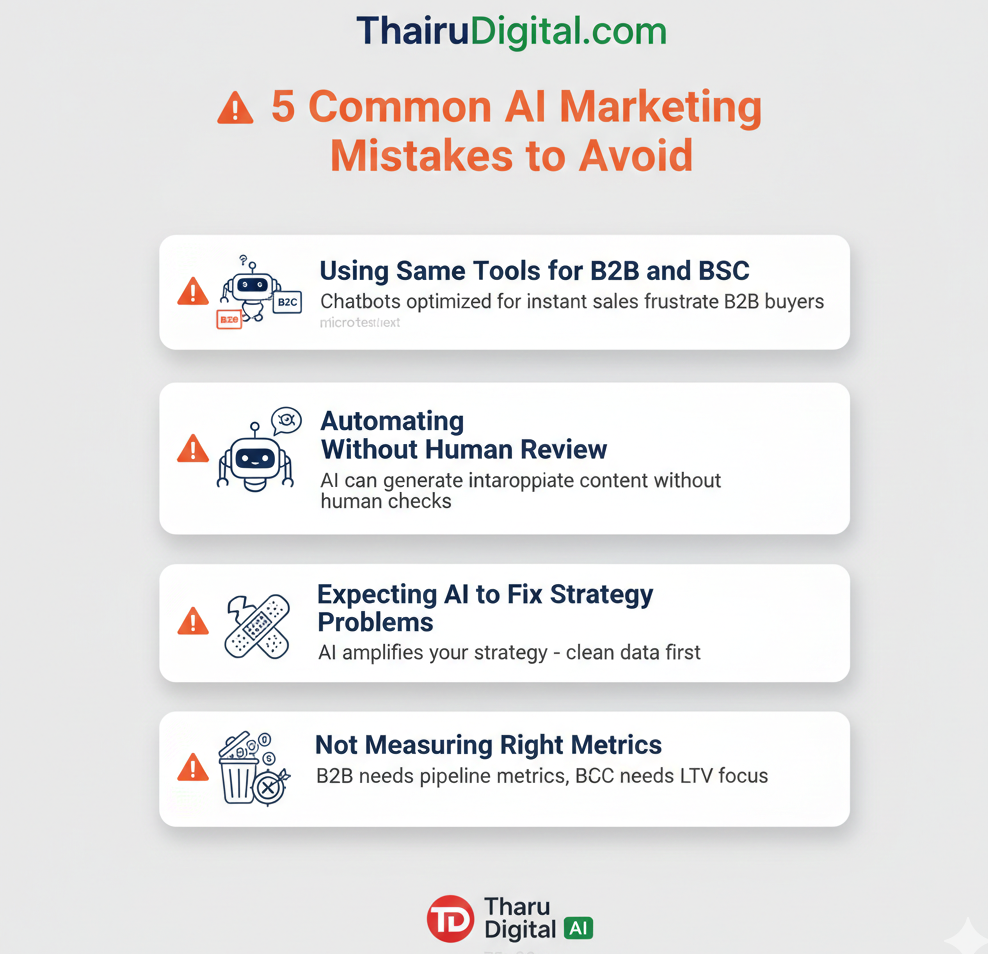
1. Using the Same AI Tools for B2B and B2C
A conversational AI chatbot optimised for instant e-commerce purchases will frustrate B2B buyers who want to schedule demos and talk to experts. Conversely, enterprise lead scoring makes no sense for individual consumers to buy a $30 product.
2. Automating Without Human Review
We’ve seen AI generate email subject lines that were technically accurate but totally inappropriate. Always have humans review AI outputs, especially in B2B, where relationships are fragile
3. Expecting AI to Fix Strategy Problems
AI amplifies your existing strategy. If your messaging is unclear or your targeting is off, AI will just make those problems faster and more expensive
4. Ignoring Data Quality
AI is only as good as the data it learns from. Garbage in, garbage out. Before implementing AI, clean up your CRM, establish data governance, and ensure first-party data collection is working properly.
5. Not Measuring the Right Metrics
B2B should track pipeline influence, sales cycle length, and deal size—not just marketing qualified leads (MQLs). B2C should focus on customer lifetime value and repeat purchase rate, not just first-purchase conversion.
Frequently Asked Questions
What’s the biggest difference between B2B and B2C AI marketing?
The fundamental difference is relationship complexity versus transaction volume. B2B AI should facilitate multi-stakeholder conversations and long-term relationships with smaller numbers of high-value accounts. B2C AI should optimise individual transactions and experiences at a massive scale.
Which AI tools should B2B marketers prioritise?
Start with predictive lead scoring integrated into your CRM (HubSpot, Salesforce), followed by account-based marketing platforms (Demandbase, 6sense) if you’re targeting enterprise accounts. The third priority is usually conversation intelligence (Gong, Chorus.ai) to analyse sales calls.
Which AI tools work best for B2C brands?
For e-commerce, prioritise product recommendation engines (Nosto, Dynamic Yield) and email personalisation (Klaviyo, Braze). For customer support, conversational AI (Intercom, Zendesk) can handle high volumes efficiently.
How much does AI marketing cost?
Costs vary dramatically. Basic CRM AI features start around $800-2,000/month. Specialised B2B tools like 6sense can run $30,000-100,000+ annually. B2C tools are often priced at transaction volume. Budget 20-30% of tool costs for implementation and training.
Can AI replace human marketers?
No—and that’s not the goal. AI handles repetitive analysis and optimisation at scale, but human marketers make strategic decisions, create compelling narratives, understand cultural context, and build genuine relationships. B2B especially requires human judgment for complex sales situations.
Final Thoughts: AI Works Best When Strategy Comes First
In 2026, AI is not a shortcut—it’s a multiplier. Businesses that align AI use cases with their B2B or B2C reality gain efficiency, clarity, and trust. Those that don’t risk wasting spend, frustrated customers, and poor results.
The winners aren’t those with the most AI tools, but those who implement the right AI for their specific business model, customer journey, and strategic goals.
AI succeeds when strategy leads—and automation follows.