
Engine Optimisation is the process of structuring and optimising content so that answer engines such as search engines, voice assistants, and AI-powered knowledge systems can easily extract and present precise answers to user queries.
Answer Engine Optimisation, or AEO, has rapidly gained significant traction in search engine marketing. With the shift in the way people use traditional search keywords to more conversationally framed question-based search processes, the primary aim of AEO is to structure content in such a manner as to answer the searcher’s question in a straightforward way without clicking on multiple obsolete results.
In 2026, Answer Engine Optimisation is no longer optional. It is a core strategy for brands, publishers, educators, and businesses that want visibility in modern search environments powered by intelligent answer systems.
Understanding Answer Engine Optimisation (AEO)
Engine Optimisation is the process of maximising the searchability of information to enable easy extraction of the exact answers to user queries, e.g. voice assistants.
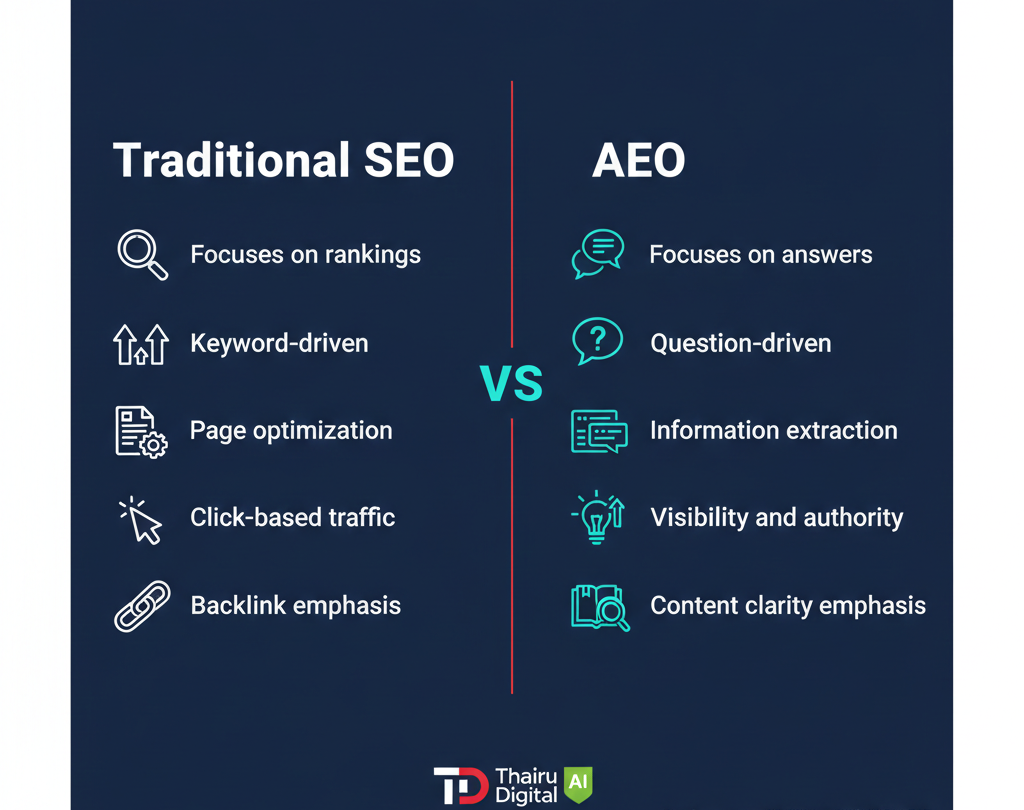
In contrast to more traditional Search Engine Optimisation (SEO) ideas that aim primarily to optimise Web pages for ranking purposes, AEO emphasises the following:
- Answer accuracy
- Contextual relevance
- Structured information
- Authority and trustworthiness
The goal is to become the best possible answer, not just the highest-ranking page.
How Answer Engines Differ from Traditional Search Engines
Conventional search engines yield a list of links in an ordered list according to their relevance. Answer engines search for a direct answer to the questions you ask.
The response you get is based on the following criteria:
- How you ask: conversational, natural-language queries
- What you get: direct answers, summaries, quotes, or verbal responses
- What you’re seeking: Immediate Information Without Juggling Multiple Sources. Results from the answer engine will appear as feature snippets, knowledge panels, voice responses, and instant answers.
Why Answer Engine Optimisation Matters in 2026
1. The Rise of Zero-Click Searches
A lot of the searches nowadays resolve without a click through to a website. The answer will appear directly on the search results page or be delivered by voice assistants. According to studies, more than half of all searches don’t produce any clicks because users get what they need on that page. AEO keeps your content visible and properly credited as the source.
2. Growth of Voice Search and Conversational Queries
Voice searches tend to come out either like this:
“What is Answer Engine Optimisation?”
“Why is AEO significant to businesses in 2026?”
As the number of individuals using voice search grows, the role of intelligent speakers and mobile voice assistants is set to become the primary method by which millions of users search for information. AEO is an integral part of this process.
3. Changes in User Expectations
Modern readers expect fast, accurate, and direct responses. Content that feels vague, overly promotional, or fragmented is less likely to be selected by answer engines. Today’s users want results in seconds, not minutes.
4. Authority and Brand Trust
Being consistently selected as a direct answer builds credibility. Users associate your brand with expertise, reliability, and leadership in your niche. This visibility can lead to increased brand recognition even without direct website visits
5. AI-Powered Search Evolution
With systems such as ChatGPT, Google’s SGE (Search Generative Experience), and other large language models that have entered search, search results and information retrieval have changed. These systems also prefer their search results to be well-structured, accurate, and easy to understand.
How Answer Engine Optimisation Works
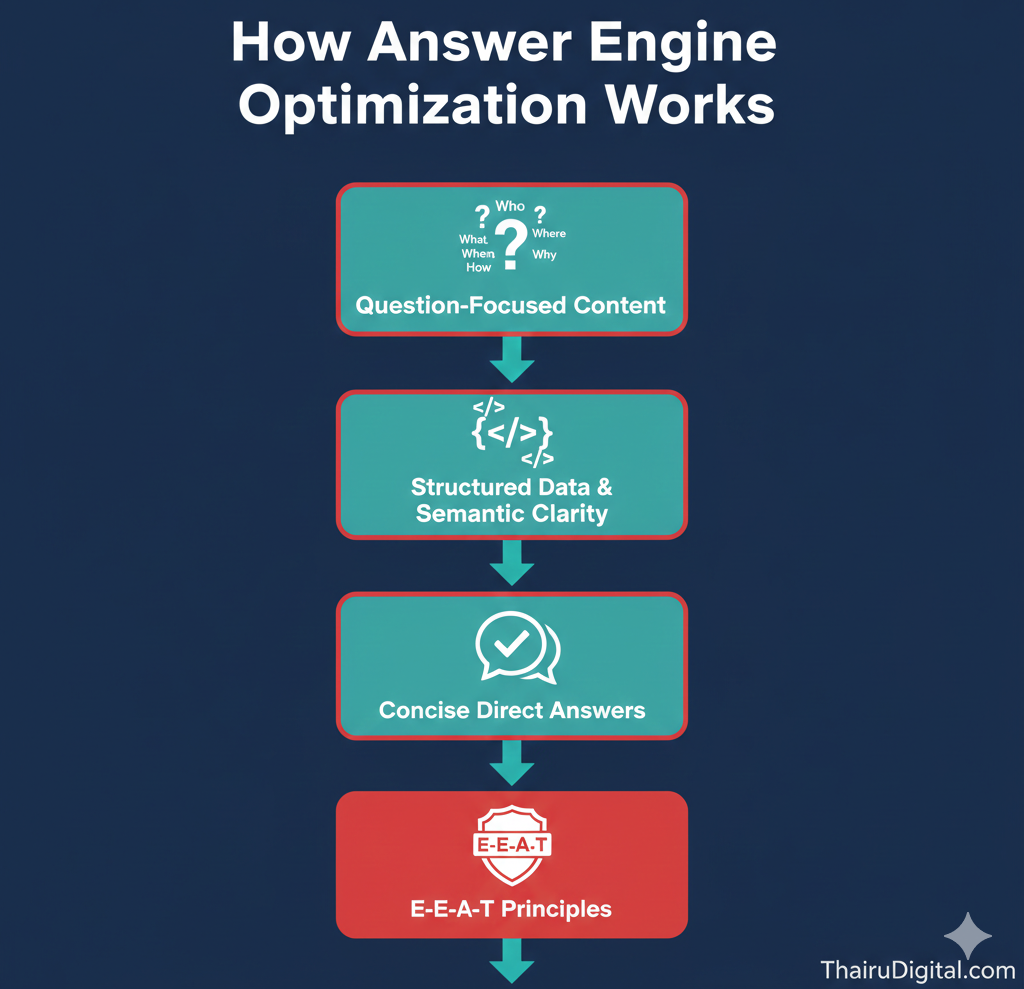
Question-Focused Content
AEO starts by identifying real questions users ask. These are often:
- Who
- What
- When
- Where
- Why
- How
Content should answer these questions clearly and early, preferably within the first few paragraphs. Use tools like AnswerThePublic, Google’s “People Also Ask” feature, and keyword research platforms to identify common questions in your niche.
Structured Data and Semantic Clarity
Using clear headings, bullet points, tables, and schema markup helps search engines understand your content’s meaning and context. Implement:
- FAQ Schema: For question-and-answer format content
- How-To Schema: For instructional content
- Article Schema: For news and editorial content
- Organisation Schema: For brand entity recognition
Concise, Direct Answers
Top AEO content does start with a concise, precise answer, usually about 40-60 words-but go on to provide fuller explanations for readers who need/want more depth. This inverted pyramid structure works well for both answer engines and human users.
Contextual Depth
While answers should be concise, supporting context is essential. This includes definitions, examples, comparisons, statistics, and up-to-date explanations. Aim for comprehensive coverage that establishes topical authority.
E-E-A-T Principles
Answer engines prioritise content that demonstrates:
- Experience: First-hand knowledge and practical insights
- Expertise: Qualified authors and subject matter experts
- Authoritativeness: Recognition and citations from trusted sources
Trustworthiness: Accuracy, transparency, and credible references
Answer Engine Optimisation vs. Traditional SEO
| SEO | AEO |
| Focuses on rankings | Focuses on answers |
| Keyword-driven | Question-driven |
| Page optimization | Information extraction |
| Click-based traffic | Visibility and authority |
| Backlink emphasis | Content clarity emphasis |
In 2026, the most effective digital strategies combine both approaches. As it’s in the article https://www.beyond.agency/blog/what–is–answer–engine–optimization–dominate–ai–search?
Explains how AEO complements SEO and why brands should focus on both.
Key Benefits of Answer Engine Optimisation
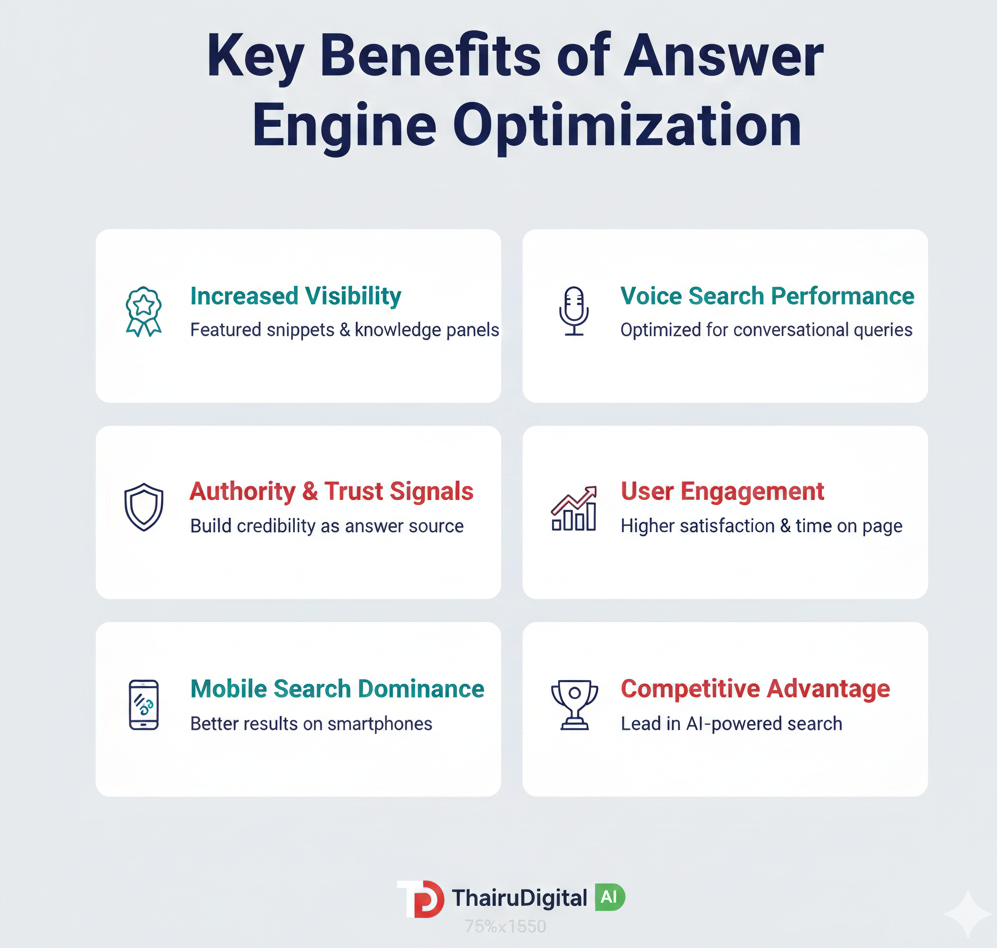
- Increasing visibility in featured snippets and knowledge panels
- Improved performance in voice search results
- Increased Content Authority and Trust Signals
- Increased user satisfaction and engagement
- More robustness to changes in algorithms over time
- Increased brand awareness and perceived thought leadership
- More accurate mobile search results
- Competitive advantage in new and innovative forms of searching
Industries That Benefit Most from AEO
Answer Engine Optimisation shows its effectiveness in the following industries: Answer Engine Optimisation.
- Educational & e-learning platforms
- Websites for news and information
- Health and wellness services
- Technology and software companies
- E-commerce Product Guides and FAQs
- Government and community services
- Financial services and investment advice
- Legal advice & documentation – Real Estate & Property Information
Any industry where users ask questions can benefit from AEO.
AEO Implementation Checklist
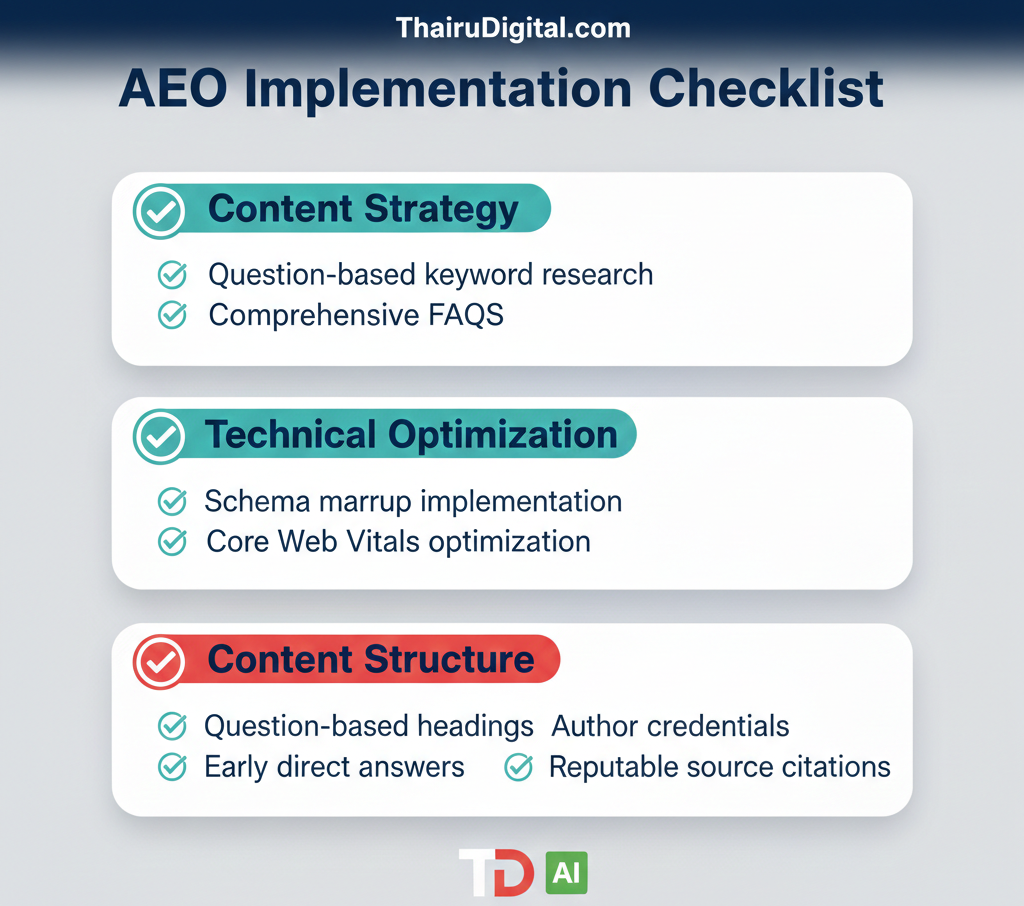
Content Strategy
It is important to begin with question-based keyword research, followed by creating a content calendar based on what users are asking. Subsequent steps entail creating comprehensive FAQs and upgrading existing content by including answers.
Technical Optimization
- Adding/schema markup to assist the search engines in understanding the pages.
- Optimise page loading speed & Core Web Vitals.
- That the website should be optimised for accessibility on all devices.
Develop the use of XML sitemaps to increase search engine crawlability.
Content Structure
- Use descriptive, question-based headings
- Place direct answers early in the content.
- Include tables, lists, and visual elements
- Add a table of contents for long-form content
Authority Building
- Include author bios with credentials
- Cite reputable sources and statistics
- Update content regularly with current information
- Build relationships with authoritative sites
Common AEO Mistakes to Avoid
- Overly Promotional Content: Answer engines favour neutral, informative content over sales-heavy material
- Buried Answers: Don’t make users scroll endlessly to find the answer
- Outdated Information: Regularly update content to maintain accuracy
- Ignoring Long-Tail Questions: These often have less competition and higher conversion rates
- Poor Mobile Experience: Most voice searches occur on mobile devices
- Lack of Context: Single-sentence answers without supporting information may not satisfy users
- Keyword Stuffing: Natural language is more important than exact-match keywords
Measuring AEO Success
- Monitor these variables to assess your performance for AEO:
- Featured Snippet presence: monitor how many times you appear in position zero
- Voice search rankings should use tracking tools for the purpose of gaining knowledge about the
- Zero-click impressions: views are measurable despite a lack of clicks
- Average position: better positions improve the probability of your response being selected
- Brand mention growth: look for occurrences when your brand is referred to as a source
- Engagement metrics: Think about time spent on the page, scroll through, and return visits.
Tools for Answer Engine Optimisation
- Google Search Console: track opportunities for featured snippets
- AnswerThePublic: reveal questions-driven searches
- SEMrush/Ahrefs: monitor your Featured Snippets rankings
- Schema Markup Validators: for checking proper usage of schema data
- Page Speed Insights: improve page load time.
- AlsoAsked: list the questions that users might also ask
Best Practices for Answer Engine Optimisation in 2026
- Write content to directly address the actual questions your target audience is asking.
- Use a structure for your writing that has headings and a flow.
- Maintain information as factual, objective, and updated.
- Use natural-sounding phrases rather than keyword stuffing.
- To demonstrate expertise by extreme accuracy and detail.
- Make sure there is consistency and clarity throughout.
- Add multimedia such as photographs, videos, or graphs to enhance learning.
- Position yourself to become the primary source and authority on the topic.
- It emphasises user experience and accessibility for all users.
Be aware of changes to algorithms and adjust the approaches accordingly.
The Future of Answer EngineOptimisationn

As intelligent systems continue to improve, answer engines will rely more on context, credibility, and clarity than on simple keyword matches. Content that prioritises user understanding will outperform content designed purely for rankings.
Emerging trends include:
- Multimodal search: Integration of text, voice, image, and video queries
- Personalized answers: Context-aware responses based on user history and preferences
- Real-time information: Dynamic answers that update with current events
- Interactive answers: Calculators, tools, and widgets within search results
- Source transparency: Clear attribution and fact-checking mechanisms
In the coming years, AEO will play a central role in digital visibility, knowledge discovery, and online authority.
Conclusion
Answer Engine Optimisation represents the future of search. In the year 2026, the internet isn’t just about search visibility; it is about trust and authority. When the aim is made clear to focus on accuracy, relevance, and the answer that is really needed, the use of AEO will ensure that answer engine optimisation remains relevant in a world that wants fast, reliable answers. The early adopters will set the tone, while the laggards will become invisible in the answer engine world. Ready to optimise your content for answer engines? Start by auditing your existing content, identifying key questions in your niche, and restructuring your information to provide clear, authoritative answers.
Frequently Asked Questions About AEO
Q: Is AEO the same thing as SEO? A: Not really. While it is similar, AEO is a process that tries to be ranked as the “answer” to a question, whereas SEO is interested in being ranked generally.
Q: When should I expect to see results from using AEO? A: This will take time, but generally, you should start to see featured snippets appear on your website around 2-4 months after you implement the best practices for using AEO.
Q: Does AEO have benefits for small businesses? A: Yes. AEO enables the field to be made level because the emphasis is on the quality of the answers instead of the authority of the domains.
Q: Do I need to know how to code for AEO? A: Good content habits are enough to get you started, maybe advanced techniques, like schema markup, too.