
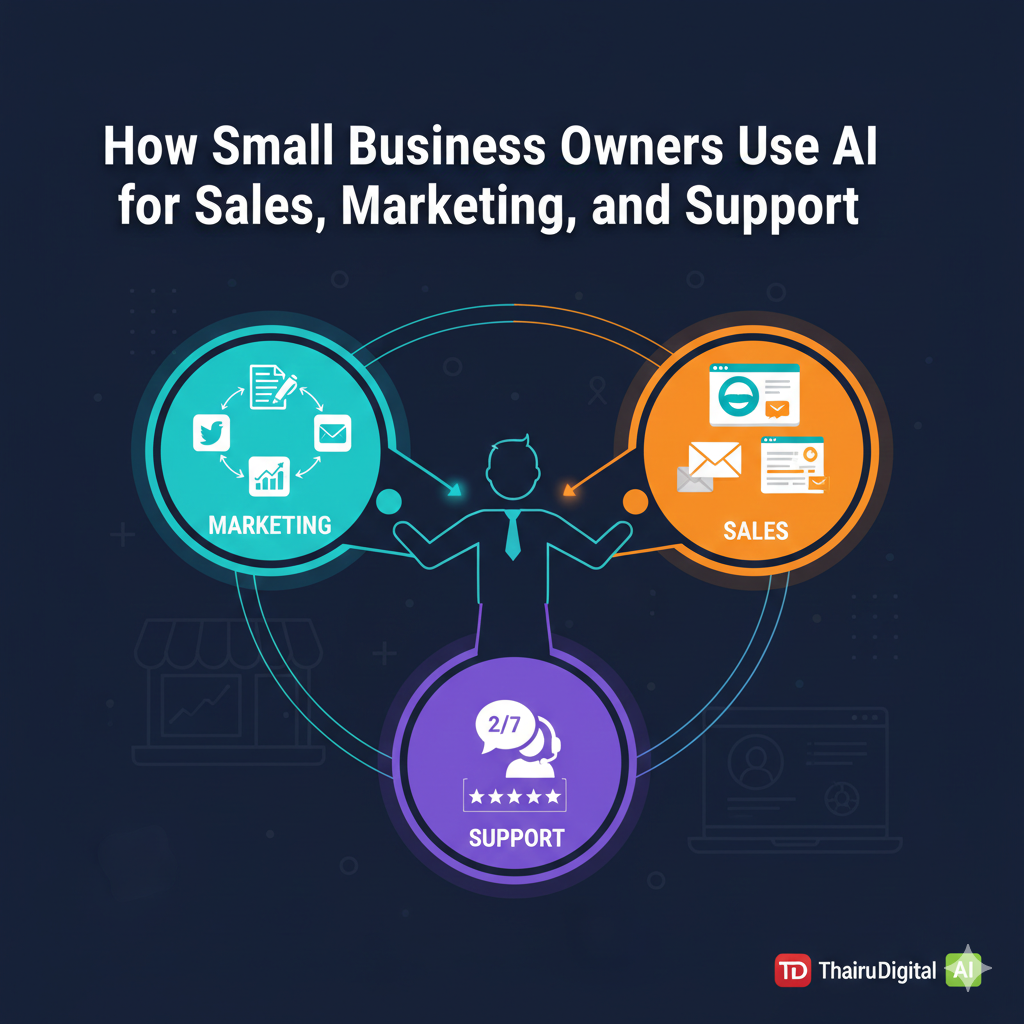
Introduction
Running a small business in 2026 is no longer just about hard work — it’s about working smart. Customers expect fast responses, personalised offers, and seamless experiences across every digital touchpoint. For many small business owners, meeting those expectations used to require large teams and big budgets.
Today, artificial intelligence makes that possible without scaling costs.
AI is transforming how small businesses handle sales, marketing, and customer support. From automating conversations to predicting what customers want next, AI allows entrepreneurs to compete with larger brands while saving time and money.
In this guide, you’ll learn how small business owners use AI to grow revenue, attract customers, and deliver better support — all with practical, real-world applications.
Why AI Matters for Small Businesses in 2026
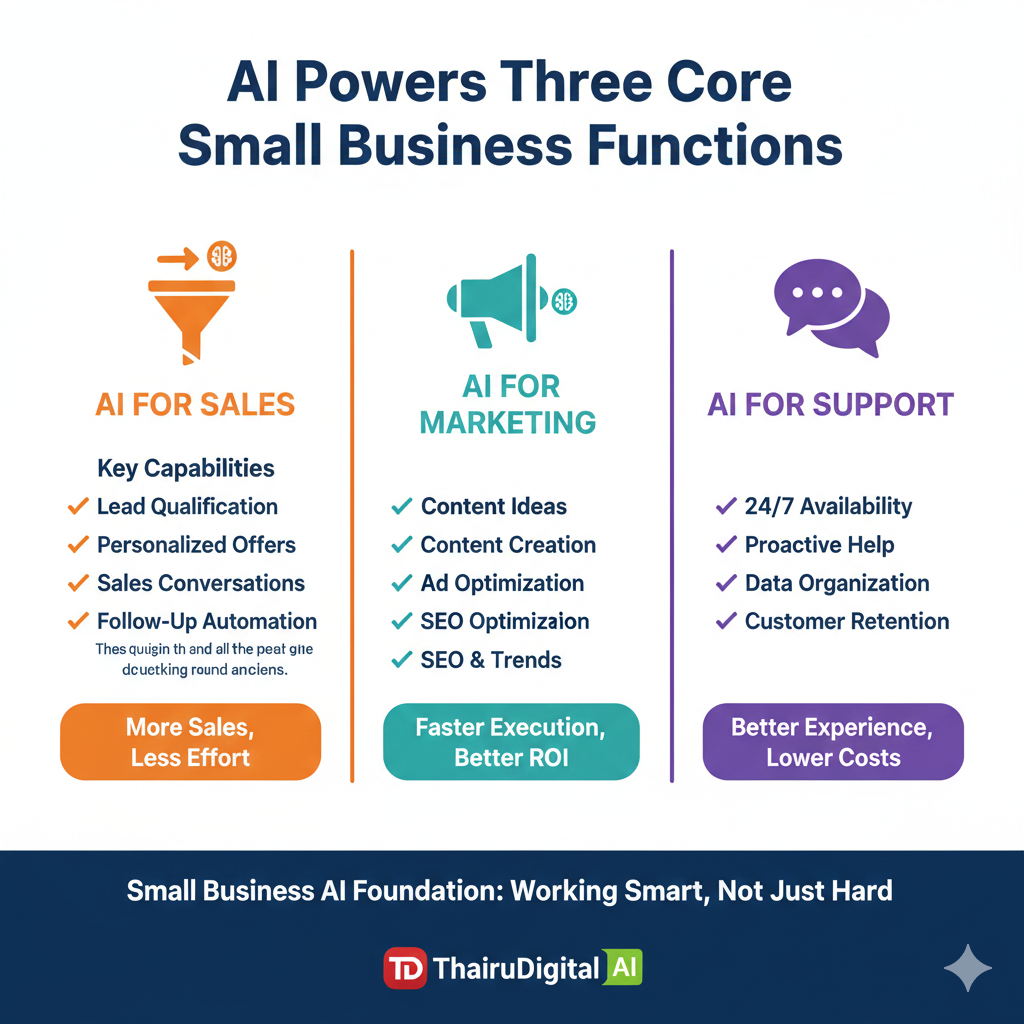
Small businesses face three major challenges:
- Limited staff
- Tight budgets
- Growing customer expectations
AI solves these by automating routine work and improving decision-making.
Instead of hiring multiple specialists, business owners use AI to:
- Analyse customer behaviour
- Personalize marketing
- Automate sales follow-ups
- Provide 24/7 customer support.t
AI becomes a digital assistant that works nonstop.
How Small Businesses Use AI for Sales
1. AI Automates Lead Qualification
Not every lead is ready to buy. AI tools analyse user behaviour such as:
- Page visits
- Click patterns
- Form submissions
- Email engagement
This helps businesses identify high-intent customers and focus on those most likely to convert.
Instead of chasing everyone, small businesses prioritise the right prospects automatically.
2. AI Personalizes Sales Offers
AI studies customer history to recommend:
- Products
- Services
- Discounts
- Timing for follow-ups
For example, an online shop can automatically show different offers based on what each visitor browses before.
This increases conversion rates without extra manual work.
3. AI Handles Sales Conversations
AI chatbots answer questions, book appointments, and even guide users to purchase.
They work:
- On websites
- Facebook Messenger
That means your business sells even when you’re offline.
How Small Businesses Use AI for Marketing
4. AI Finds Winning Content Ideas
Instead of guessing what to post, AI analyses:
- Search intent
- Social trends
- Competitor content
- Audience behavior
This helps small business owners create content people actually want, improving reach and SEO rankings.
AI removes the guesswork from marketing.
5. AI Creates and Optimises Content
AI assists with:
- Blog writing
- Ad copy
- Social captions
- Email campaigns
More importantly, it optimises content for:
- Keywords
- Readability
- Engagement
- Conversion
Small businesses can now publish faster and smarter without hiring large teams.
6. AI Improves Ad Performance
AI tracks advertising performance in real time and automatically adjusts:
- Target audiences
- Budgets
- Headlines
- Visual formats
This allows small businesses to get better results from Facebook, Google, and TikTok ads while spending less.
How Small Businesses Use AI for Customer Support
7. AI Provides 24/7 Customer Service
Customers want instant answers. AI chat systems respond immediately to:
- FAQs
- Order tracking
- Booking requests
- Basic troubleshooting
This keeps customers satisfied without hiring full-time support staff.
8. AI Predicts Customer Problems
AI monitors user behaviour to detect:
- Abandoned carts
- Repeated questions
- Drop-off points
It then triggers proactive messages to help customers before they leave, improving retention and loyalty.
9. AI Organises Customer Data
AI automatically categorises:
- Messages
- Reviews
- Feedback
- Support tickets
This allows business owners to understand customer needs and improve services faster.
Better data leads to better decisions.
Real Benefits of Using AI in Small Businesses
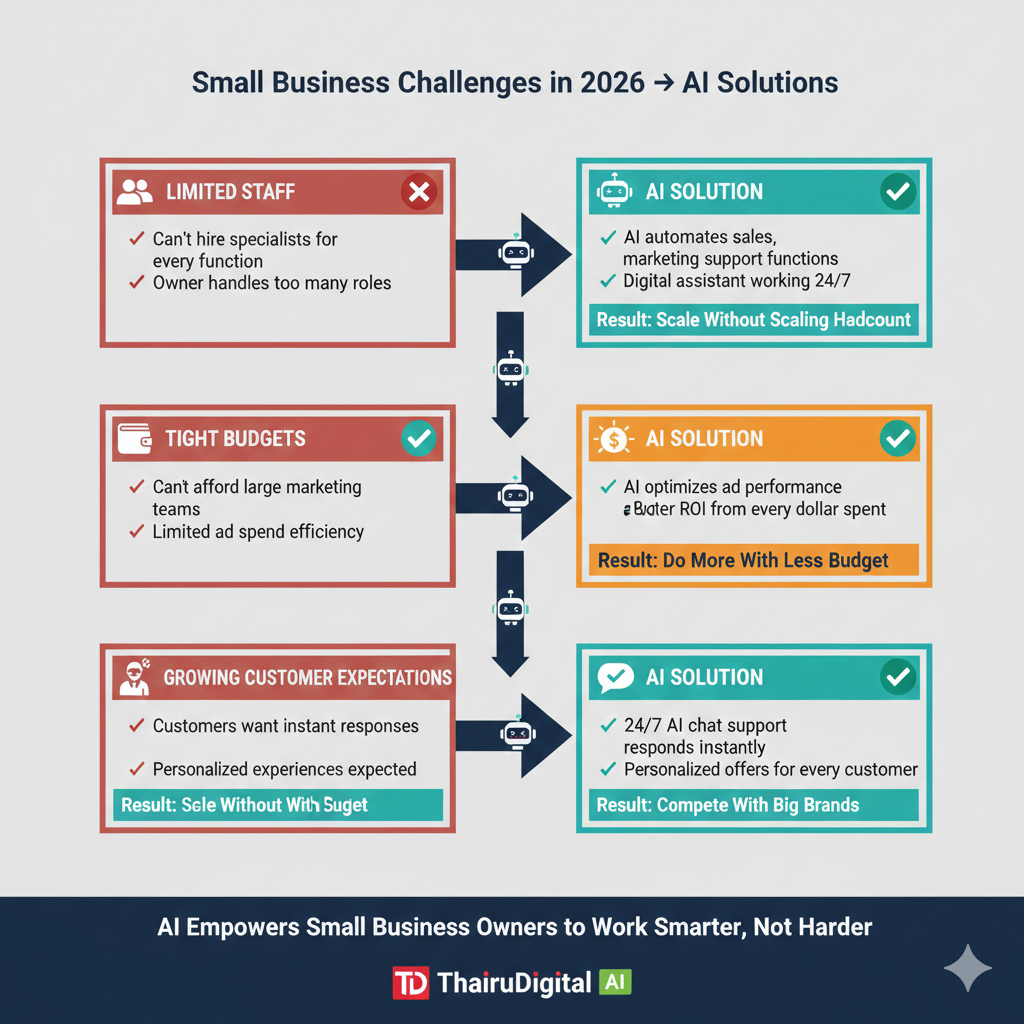
When small business owners use AI, they gain:
✅ More sales with less effort
✅ Faster marketing execution
✅ Better customer experiences
✅ Lower operational costs
✅ Competitive advantage against big brands
AI doesn’t replace business owners — it empowers them.
How to Start Using AI in Your Business
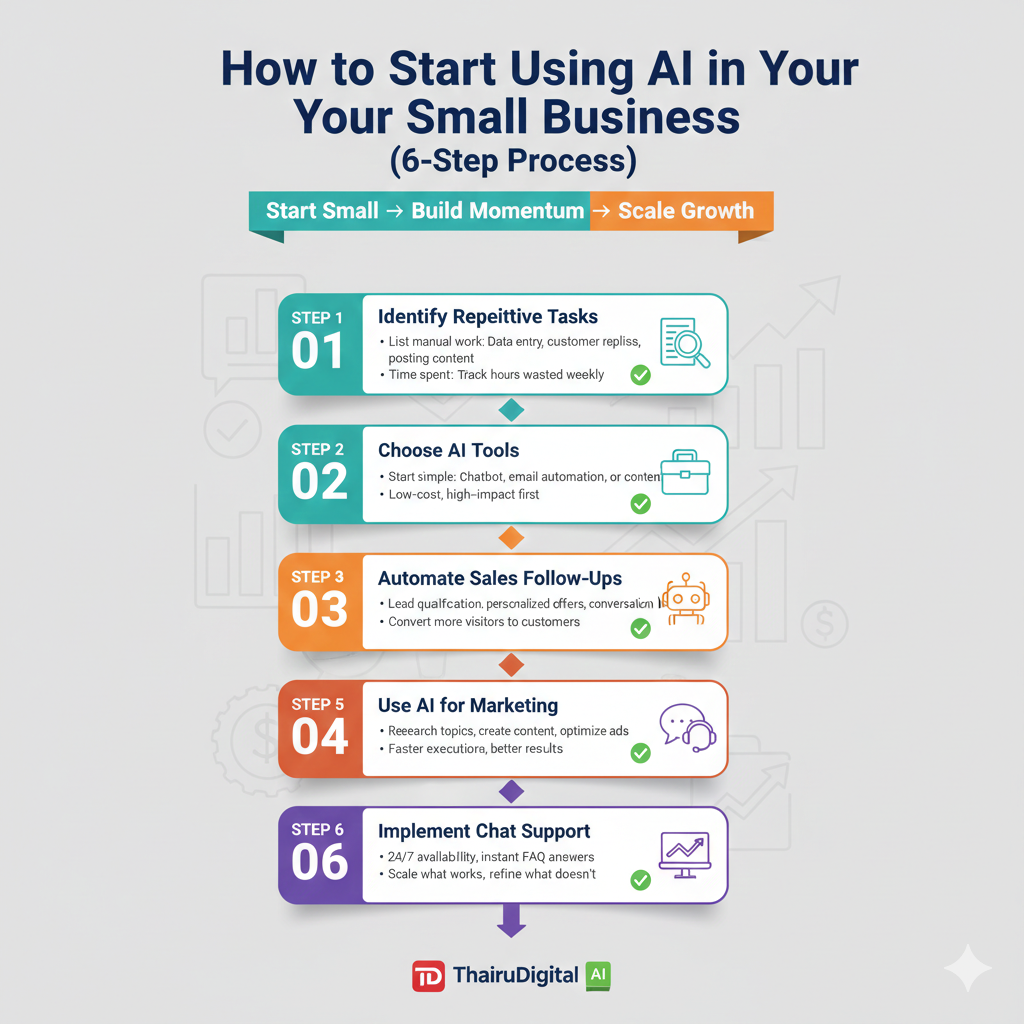
Here’s a simple starting process:
- Identify repetitive tasks
- Apply AI automation
- Use AI for marketing research.
- Implement AI chat support.t
- Track performance
- Improve continuously
Start small, then scale your AI strategy as your business grows.
Final Thoughts
AI is no longer a luxury tool for large corporations. In 2026, it’s a necessity for small business growth.
From sales automation to smart marketing and 24/7 support, AI allows small business owners to operate faster, smarter, and more competitively than ever before.
Those who adopt AI early build stronger brands, happier customers, and sustainable growth
Want to use AI to grow your small business faster?
�� ThairuDigital helps entrepreneurs integrate AI into sales, marketing, and customer support for real business results. We design smart systems that attract customers, convert leads, and improve engagement automatically
nvert leads, and improve engagement automatically.
�� Visit ThairuDigital today and start scaling your business with AI-powered strategies.
FAQs
1. What is AI for small businesses?
AI for small businesses means using artificial intelligence tools to automate sales, marketing, and customer support tasks, such as chatbots, email marketing, data analysis, and customer personalisation.
2. Is AI expensive for small businesses?
Not anymore. Many AI tools are affordable and scalable. Small business owners can start with simple automations and expand as revenue grows.
3. How does AI increase small business sales?
AI qualifies leads, personalises offers, automates follow-ups, and handles customer conversations, helping businesses convert more visitors into paying customers.
4. Can AI replace human customer support?
AI supports humans, not replaces them. It handles common questions and routine tasks, while complex issues are passed to human agents for better service.
5. What is the first AI tool a small business should use?
Most businesses start with an AI chatbot, email automation, or AI content planning tool because they deliver fast results with minimal setup.