
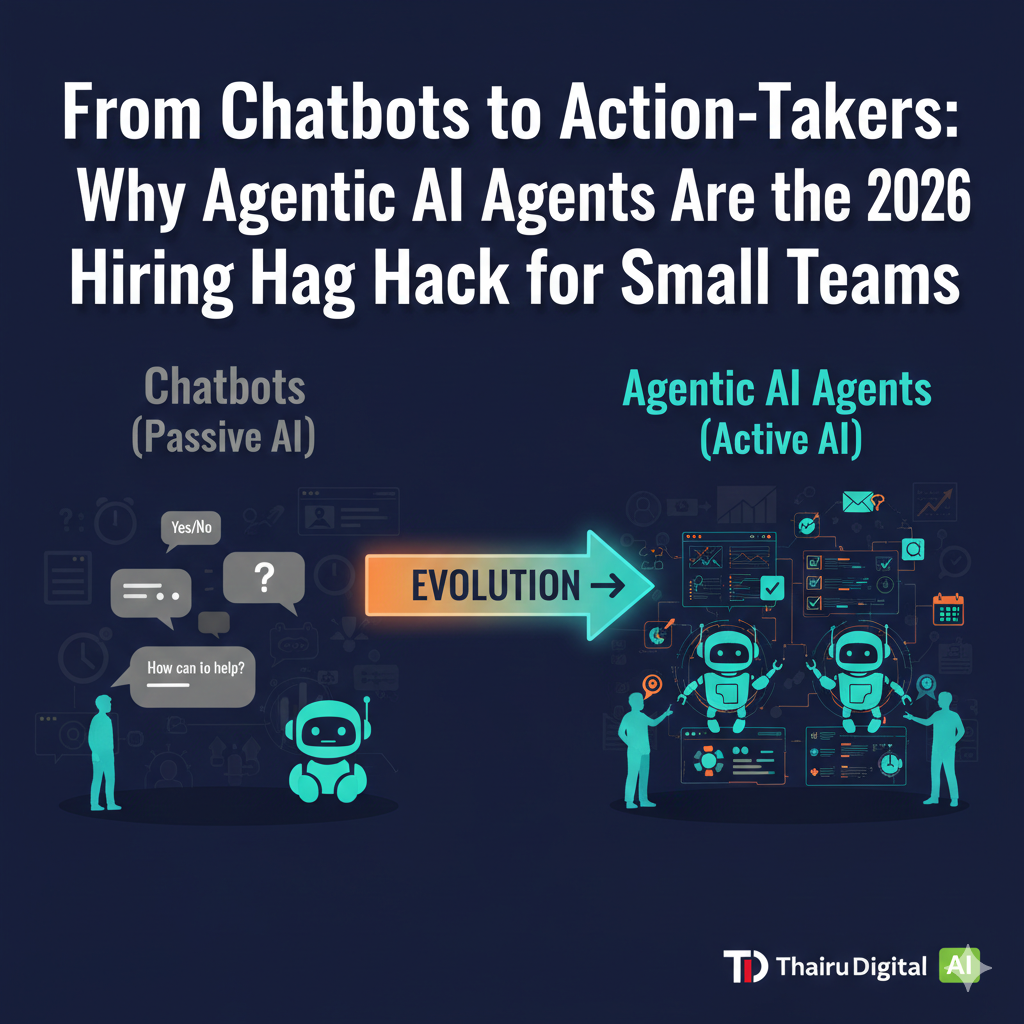
Agentic AI agents are transforming small teams in 2026 by moving beyond traditional chatbots to autonomous, action-taking AI. These tools can handle tasks across operations, marketing, customer support, and project workflows without a technical team. Multi-agent systems allow SMBs to scale efficiently, freeing up founders to focus on strategy while AI agents execute day-to-day operations. For small teams, agentic AI is becoming the ultimate productivity and hiring hack.
What Are Agentic AI Agents and Why Are They Buzzing in 2026?
Agentic AI agents are autonomous AI tools designed to take action on behalf of users, rather than just providing responses like traditional chatbots. In 2026, they are gaining traction among small teams because they combine intelligence, context-awareness, and task execution into a single platform. These agents can make decisions, coordinate workflows, and even collaborate with other AI agents — effectively functioning as a virtual workforce for SMBs.
Evolution from Chatbots to Autonomous Action-Takers
While early chatbots were reactive, agentic AI agents act proactively. They can:
- Handle multi-step processes
- Make context-based decisions
- Trigger subsequent tasks automatically
This evolution allows small teams to scale operations without increasing headcount.
How Agentic AI Differs from Traditional AI Assistants
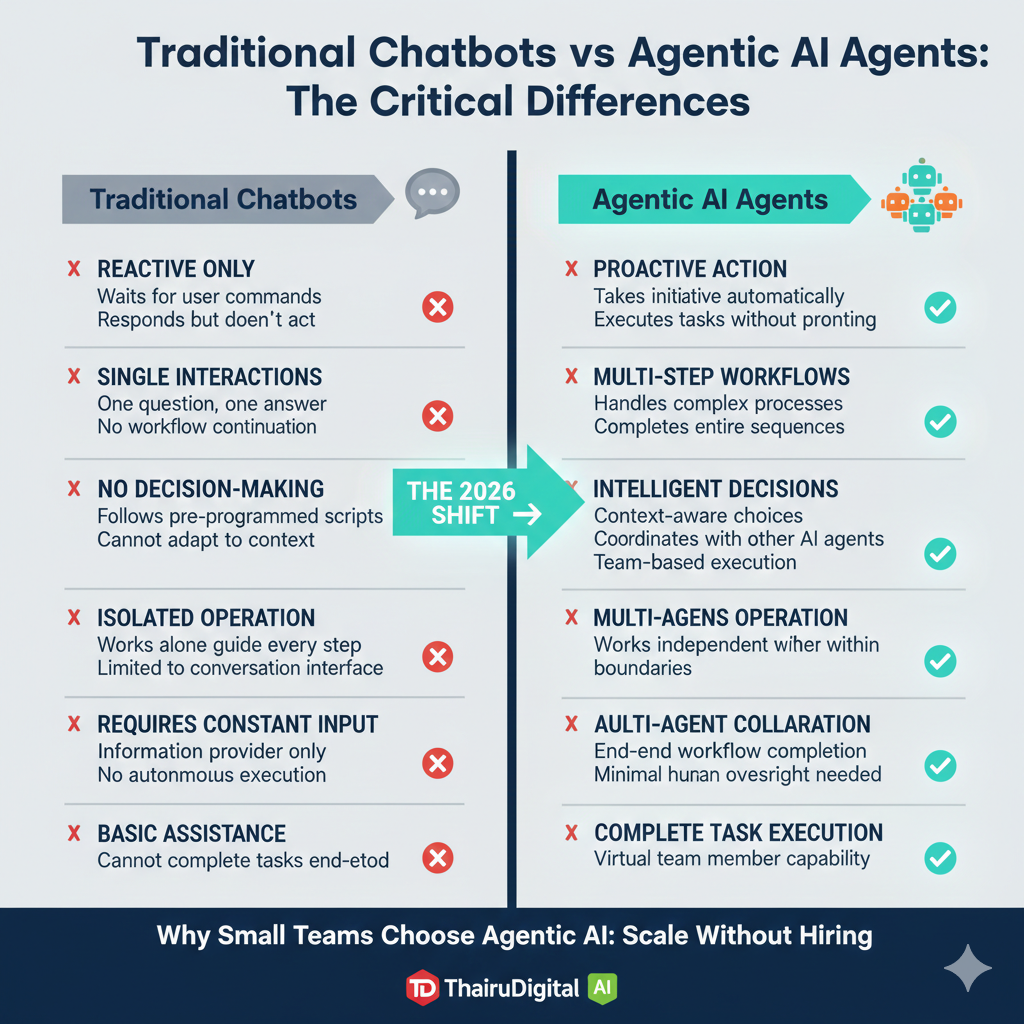
Unlike simple AI assistants that only respond to commands, agentic AI agents:
- Learn and adapt from workflow patterns
- Collaborate with other agents in multi-agent systems
- Reduce repetitive decision-making for human team members
This shift is why founders are treating agentic AI as a productivity and hiring hack.
Why Small Teams Are Adopting Agentic AI Agents
Small teams adopt agentic AI agents to:
- Free up founder and employee bandwidth
- Reduce operational bottlenecks
- Execute tasks with minimal oversight
- Maintain agility as they scale
For SMB leaders, these agents are not just tools — they are strategic enablers for efficiency and growth.
Key Benefits for SMB Productivity
Agentic AI agents offer measurable advantages:
- Time Saved: Automate repetitive tasks like emails, scheduling, and reporting
- Consistency: Reduce errors and maintain quality across processes
- Scalability: Handle more operations without increasing headcount
- Strategic Focus: Allow founders to prioritize high-value decisions
How Multi-Agent Systems Enable Small Teams to Scale Like Big Companies
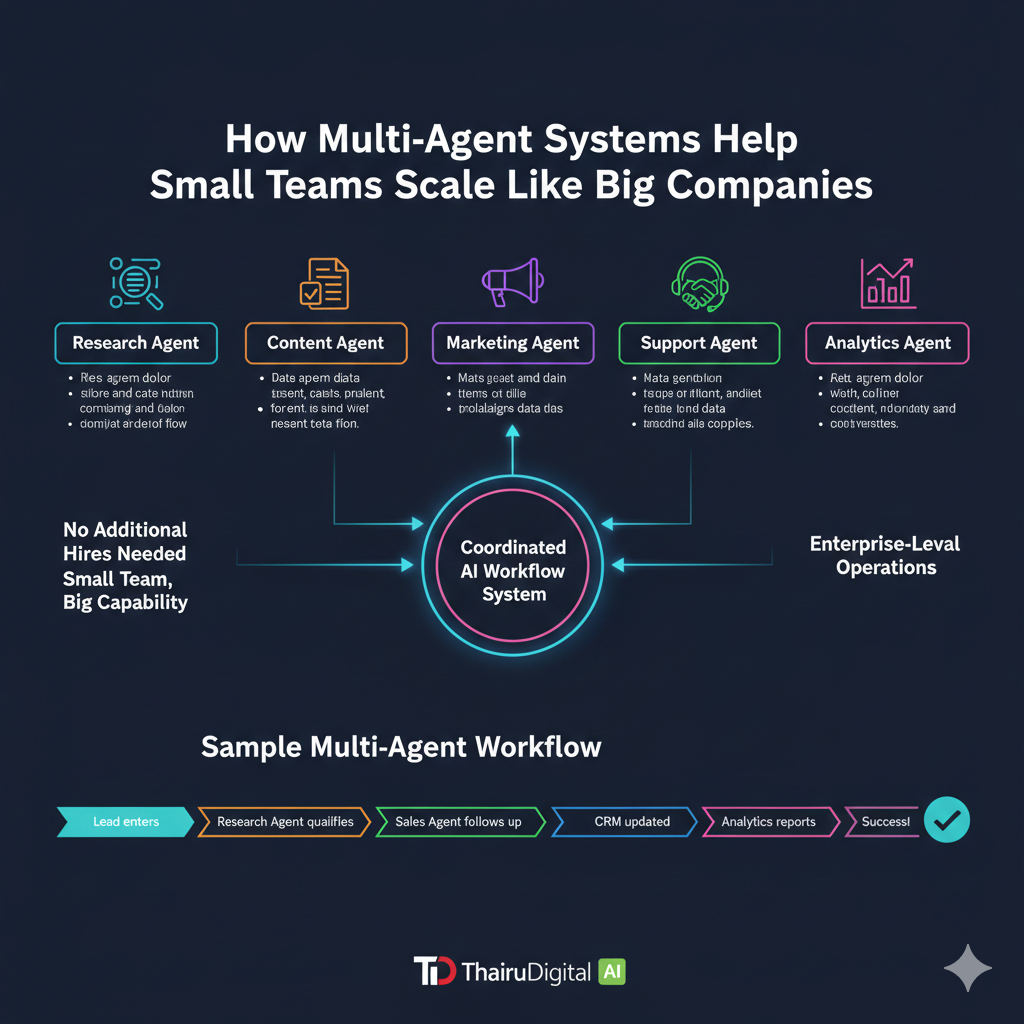
Multi-agent systems take agentic AI a step further by allowing multiple AI agents to collaborate and execute workflows in a coordinated manner. For small teams, this means even without additional hires, businesses can run complex operations efficiently. Each AI agent is specialized for a specific function, yet they communicate with each other to complete multi-step processes.
Coordinated AI Workflows Across Operations
Instead of a single AI performing isolated tasks, multi-agent systems handle end-to-end workflows, such as:
- Lead capture → qualification → CRM update
- Content research → creation → publishing
- Customer support triage → follow-up → reporting
This coordination ensures tasks flow seamlessly without human micromanagement.
Role Specialization Within AI Teams
Each agent in a multi-agent system has a defined role, creating efficiency and clarity:
| Agent Role | Function / Benefit |
| Research Agent | Gathers market, competitor, and trend data |
| Content Agent | Creates blog posts, social media content, and copy |
| Operations Agent | Manages internal workflows, approvals, and task tracking |
| Customer Support Agent | Handles inquiries, follow-ups, and automated responses |
| Data Analysis Agent | Generates reports, insights, and predictive metrics |
This structure allows SMBs to achieve enterprise-level operational capability with a small team.
Delegating Repetitive Tasks to AI Agents
Multi-agent systems excel at removing repetitive work from human teams:
- Automating administrative tasks
- Generating routine reports
- Handling customer follow-ups
- Coordinating cross-functional workflows
Founders can focus on strategy while agents handle execution.
Using Multi-Agent Systems Without a Technical Team
No-code platforms like CrewAI make multi-agent deployment accessible to non-technical founders. With visual workflow builders and natural language setup, SMB leaders can:
- Assign roles to agents
- Define step-by-step workflows
- Monitor outputs without coding
This democratization of AI allows small teams to leverage complex systems without technical overhead.
What Are the Real-World Use Cases of Agentic AI Agents for Small Teams?
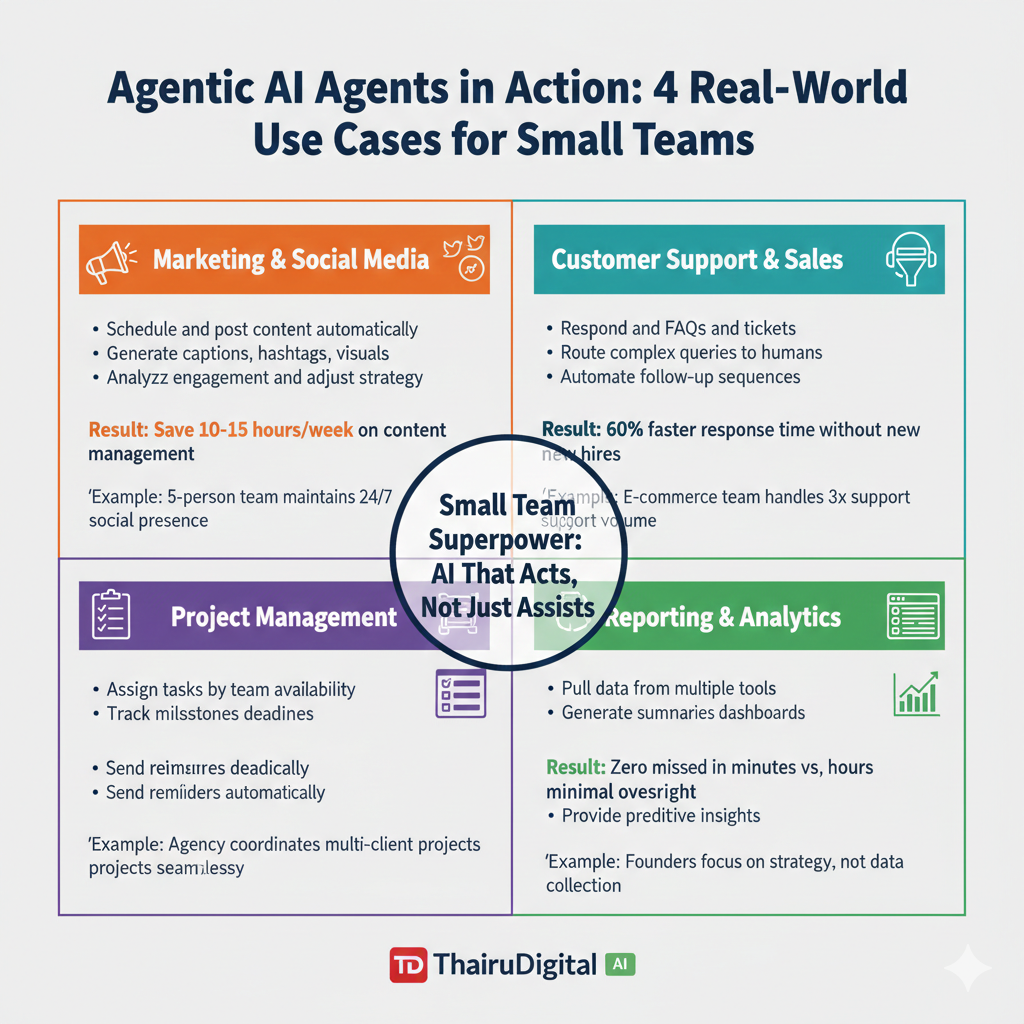
Agentic AI agents are not just theoretical tools—they are already transforming small team operations across marketing, sales, support, and project management. By automating repetitive tasks and collaborating in multi-agent systems, SMBs can achieve efficiency that previously required larger teams.
Marketing and Social Media Automation
AI agents can handle end-to-end marketing workflows:
- Schedule and post content automatically
- Generate captions, hashtags, and visuals
- Analyze engagement metrics and adjust strategies
Example: Thairu Digital uses AI-driven agents to automate social media posting for SMB clients, saving hours each week while maintaining high engagement rates.
Customer Support and Sales Follow-Ups
Agents can:
- Respond to FAQs and support tickets
- Route complex queries to humans when needed
- Send automated follow-up emails to leads or customers
Use Case: A 5-person e-commerce team implemented multi-agent workflows for order queries, reducing response time by 60% without hiring additional staff.
Project Management and Task Coordination
AI agents can manage internal workflows by:
- Assigning tasks based on team availability
- Tracking project milestones
- Sending reminders and updates automatically
Use Case: Small agencies use AI agents to coordinate content production projects, ensuring deadlines are met with minimal manual oversight.
Reporting, Data Analysis, and Insights
Agents can:
- Pull data from multiple tools (CRM, social, email)
- Generate summaries and dashboards
- Provide predictive insights for decision-making
Example: SMB founders use AI agents to automatically generate weekly performance reports, freeing them to focus on strategy rather than data collection.
How Can Non-Tech Founders Strategically Implement Agentic AI Agents?
Non-technical founders can successfully adopt agentic AI agents by focusing on high-impact tasks, structured workflows, and monitoring outputs without needing coding expertise. The key is to implement AI strategically, ensuring it complements human efforts rather than replacing critical thinking.
Identifying High-Impact Tasks to Automate
Start by analyzing workflows and pinpointing tasks that are:
- Repetitive and time-consuming
- Rules-based and structured
- Important but not strategy-critical
Example: Scheduling social media posts, sending follow-up emails, and generating weekly reports are ideal tasks for agentic AI in small teams
Combining Single-Agent and Multi-Agent Workflows
Founders should leverage both types of agents:
- Single-agent systems for personal productivity (e.g., Lindy for emails or meetings)
- Multi-agent systems for team-level workflows (e.g., CrewAI for operations or marketing)
This hybrid approach maximizes efficiency without overwhelming non-technical users.
Monitoring AI Outputs Without Micromanaging
AI agents require oversight to ensure quality:
- Review outputs periodically
- Set clear objectives for tasks
- Adjust workflows based on agent performance
Tip: Thairu Digital emphasizes “supervised autonomy,” allowing AI to act while humans guide strategic priorities.
Avoiding Over-Automation Pitfalls
Non-tech founders should avoid:
- Automating tasks that require nuanced judgment
- Over-relying on AI without human validation
- Deploying agents in mission-critical processes without testing
Balanced implementation ensures agents support productivity without introducing errors.
What Is the Future of Agentic AI Agents for Small Teams in 2026?
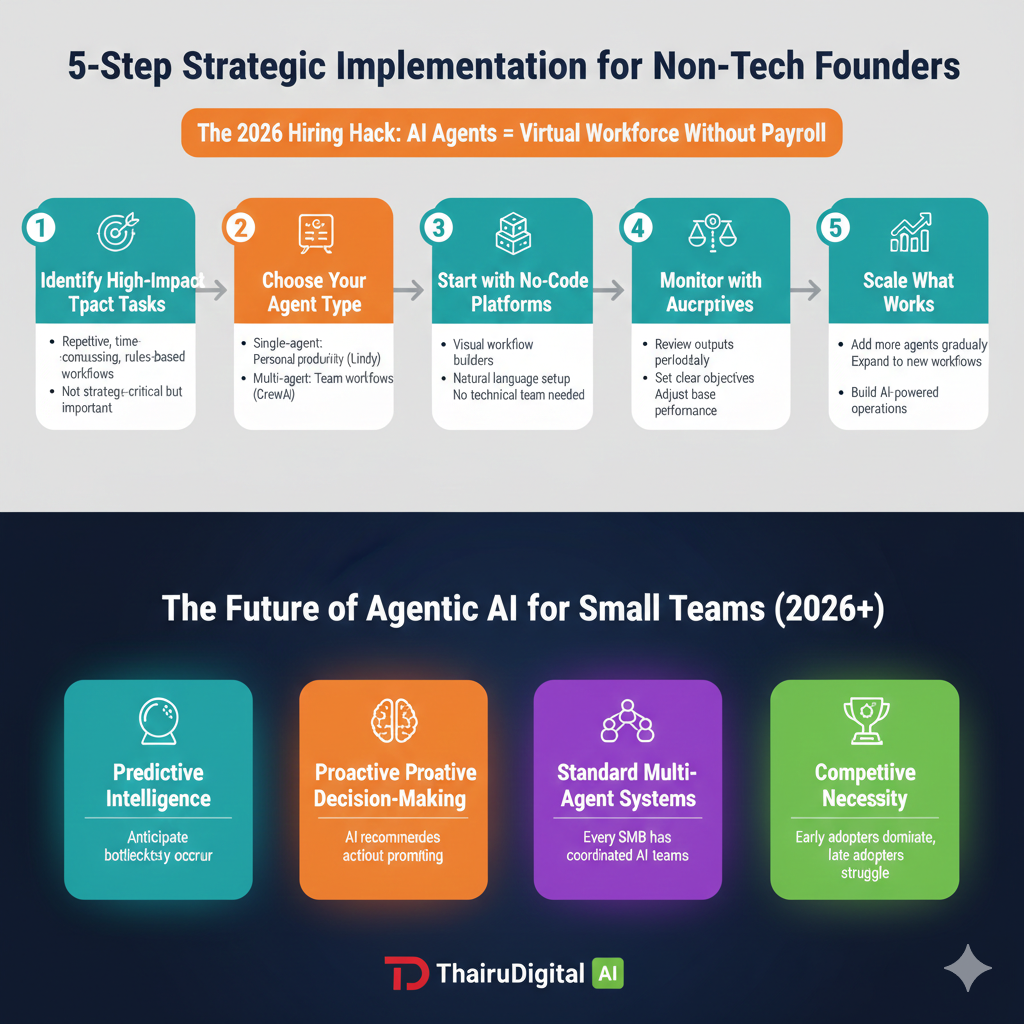
The future of agentic AI agents is rapidly evolving, moving beyond simple automation toward autonomous decision-making and multi-agent collaboration. Small teams that adopt these tools early will gain strategic advantages, leveraging AI to execute tasks, coordinate workflows, and provide actionable insights with minimal human intervention.
Increasing Autonomy with Human Oversight
Future agentic AI agents will act proactively:
- Anticipate workflow bottlenecks
- Make multi-step decisions without constant input
- Recommend solutions based on context
Key Insight: SMB leaders will shift from manual execution to supervisory roles, guiding objectives while agents handle operations.
Predictive and Proactive AI Capabilities
Next-generation agents will incorporate predictive intelligence:
- Forecast task outcomes and potential delays
- Optimize schedules and resource allocation
- Suggest strategic actions based on historical and real-time data
This allows small teams to plan better and reduce reactive decision-making.
Multi-Agent Systems Becoming Standard in SMBs
Coordinated AI teams will become common in small businesses:
- Agents with specialized roles collaborating seamlessly
- End-to-end workflows managed without additional hires
- Reduced operational friction across departments
Example: Multi-agent systems can manage marketing campaigns, sales pipelines, and customer support simultaneously for SMBs, creating enterprise-level efficiency.
Competitive Advantage for Early Adopters
Small teams adopting agentic AI agents now can:
- Increase productivity without hiring additional staff
- Reduce errors in repetitive processes
- Focus human effort on strategy and growth
Strategic Note: Early adoption positions SMBs to scale faster and more efficiently than competitors who rely solely on manual process
Final Thoughts
Agentic AI agents are redefining how small teams operate in 2026. By moving from reactive chatbots to proactive, autonomous action-takers, these tools help SMBs scale without additional hires. Multi-agent systems, predictive workflows, and context-aware automation allow non-technical founders to focus on strategy while AI handles execution. Early adoption of agentic AI is not just about efficiency—it’s a competitive edge for small teams ready to thrive in the era of autonomous work.
Frequently Asked Questions (FAQs)
1. What are agentic AI agents, and how do they differ from traditional chatbots?
Agentic AI agents are autonomous AI tools that execute tasks, make decisions, and coordinate workflows on behalf of users. Unlike traditional chatbots, they proactively perform actions rather than just responding to inputs, acting as virtual team members for small teams.
2. How can small teams implement agentic AI without technical expertise?
Non-technical founders can use no-code platforms like Lindy or CrewAI, which provide visual workflow builders and natural language commands. These platforms allow small teams to deploy both single-agent and multi-agent systems without coding knowledge.
3. What tasks are best suited for agentic AI agents in SMBs?
Ideal tasks include repetitive and structured activities such as scheduling, email follow-ups, social media posting, reporting, data analysis, and workflow coordination. These are tasks that free human team members to focus on strategic work.
4. How do multi-agent systems improve small team productivity?
Multi-agent systems allow specialized AI agents to collaborate on complex workflows, coordinating marketing, operations, customer support, and analytics simultaneously. This reduces bottlenecks, speeds up task execution, and enables SMBs to operate like larger organizations.
5. Why is early adoption of agentic AI agents a competitive advantage?
Founders who implement agentic AI agents early gain operational efficiency, time savings, and better scalability. Early adopters can allocate human resources to high-value strategy while AI handles execution, giving them an edge over competitors relying solely on manual workflows.