
AI agents are becoming core operational assets for small businesses in 2026, moving far beyond basic chatbots and one-off automations. With the rise of no-code AI agent builders, autonomous marketing bots, and multi-agent workflows, small teams can now execute complex tasks—like content production, lead nurturing, and customer support—at scale. This guide breaks down the most important AI agent trends shaping small business growth in 2026, including the agentic shift, real-world use cases, and the governance controls required to use AI responsibly. You’ll learn which AI agents actually deliver ROI, how businesses are deploying them today, and what safety, oversight, and control mechanisms are essential as agents gain more autonomy.
What Are AI Agents and Why Are They Taking Over Small Business Operations in 2026?
AI agents are autonomous or semi-autonomous software programs that execute tasks across digital tools and workflows with minimal human intervention. In 2026, small businesses are increasingly adopting these agents to streamline marketing, sales, customer support, and operational processes, allowing teams to focus on strategy and growth instead of repetitive tasks.
How AI Agents Differ from Chatbots and Traditional Automation
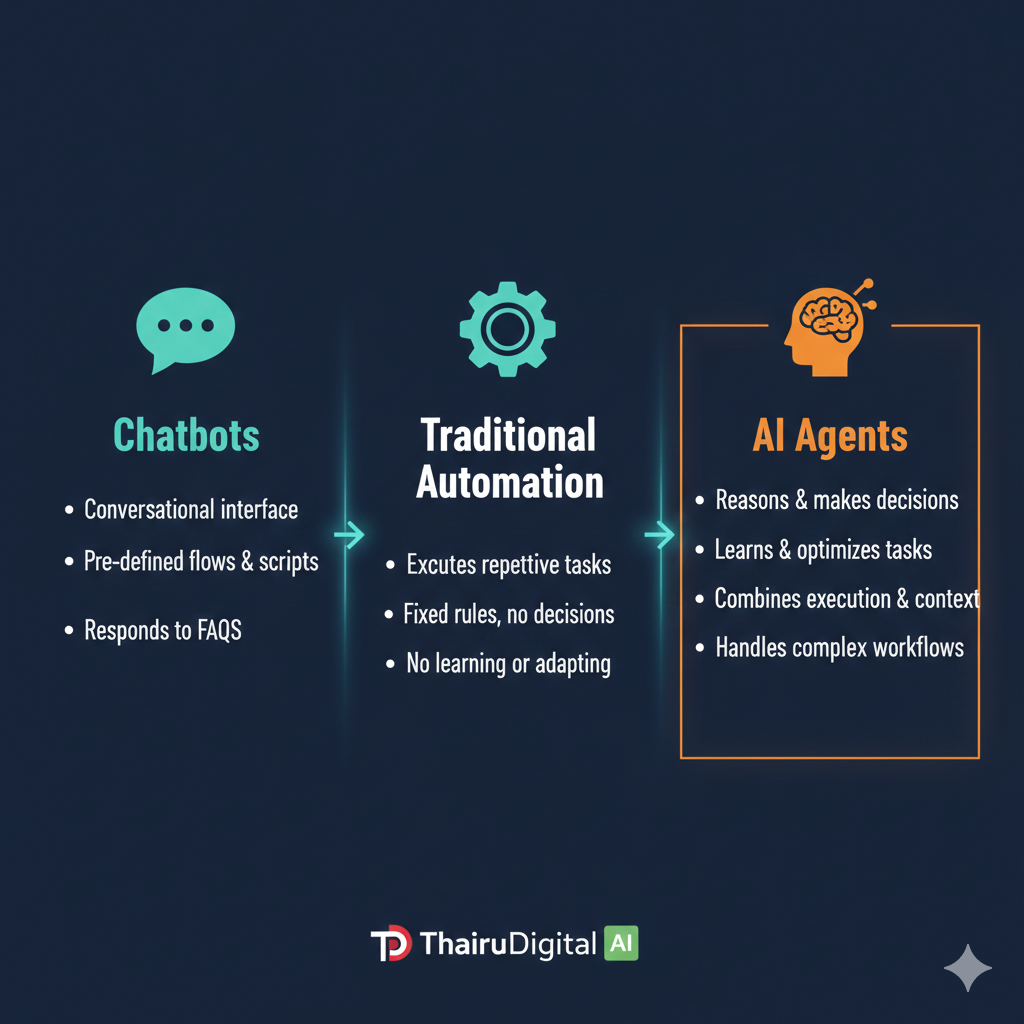
Many small businesses confuse AI agents with chatbots or automation scripts, but the differences are significant:
- Chatbots: Primarily handle conversations with customers using pre-defined flows or natural language.
- Traditional automation: Executes repetitive tasks (e.g., data entry, email alerts) without decision-making.
- AI agents: Combine reasoning, decision-making, and execution. They can analyse data, adapt to new scenarios, and perform multi-step workflows independently.
Example:
A traditional automation script might send a welcome email to new leads. A marketing AI agent can analyse the lead’s behaviour, decide which content sequence to deliver, follow up at optimal times, and update CRM records—all automatically.
The Shift from “AI Assistants” to “AI Operators”
- In 2026, small businesses are moving from using AI for supportive tasks to task ownership.
- AI agents can now manage complete workflows, such as:
- Lead qualification → nurturing → conversion tracking
- Content calendar management → scheduling → performance reporting
- Customer query triage → escalation → follow-up
AI Agents vs Traditional Roles in Small Businesses
| Function | Traditional Method | AI Agent Approach (2026) | Benefit for Small Business |
| Lead nurturing | AI agent sends personalised sequences based on behaviour | AI agent sends personalised sequences based on behaviour | Saves 5–10 hours/week; higher conversion |
| Content creation | Human writer + scheduling | AI agent drafts posts, suggests topics,and schedules automatically | Faster content production; consistent posting |
| Customer support | Human reps 24/7 | AI agent handles 60–80% of queries autonomously | Reduces workload; improves response time |
| Inventory management | Manual tracking and alerts | AI agent forecasts demand & alerts on stock levels | Reduces stockouts and overstocking |
Why Small Businesses Are Adopting Agents Faster Than Enterprises
- Lower cost of adoption: SaaS AI agent platforms now offer no-code options for non-technical users.
- Agility: Small teams can deploy agents quickly without bureaucratic approvals.
- Immediate ROI: Every hour saved in repetitive tasks directly improves efficiency and revenue.
- Competitive advantage: Early adoption allows small brands to scale marketing, support, and operations without large teams.
Real Example:
An e-commerce store in Nairobi deployed a marketing AI agent to automate abandoned cart emails. Within two weeks, conversion from abandoned carts increased by 22%, without hiring extra staff.
Key Takeaways
- AI agents = decision-making + execution, not just chat or automation.
- They streamline workflows across marketing, sales, customer support, and operations.
- Small businesses adopt them faster due to agility, cost efficiency, and tangible ROI.
Real-world applications include lead nurturing, content automation, support bots, and inventory management
What Is the Agentic Shift and How Does It Change How Businesses Work?
The agentic shift is the transition from AI acting as a simple assistant to AI taking on autonomous operational roles, executing entire workflows with minimal human intervention. For small businesses in 2026, this means that AI agents are no longer just tools—they’re digital operators that make decisions, optimise processes, and help scale operations efficiently. Thairu Digital specialises in guiding small businesses through this shift, ensuring AI adoption is both practical and strategically aligned with growth goals.
From Task Automation to Goal-Driven Execution
Previously, AI in small businesses was limited to task automation—sending emails, posting content, or generating reports. With the agentic shift:
- AI agents now operate based on business objectives rather than fixed instructions.
- They can prioritise tasks, adjust strategies in real-time, and collaborate with other agents.
- Small businesses can delegate entire workflows, like launching a marketing campaign, managing leads, and tracking conversions, to AI agents while focusing on strategy.
Example:
A boutique e-commerce brand worked with Thairu Digital to implement an AI-driven marketing workflow. The AI agent not only scheduled posts and sent emails but also monitored engagement, adjusted campaigns, and reported ROI, freeing the marketing team to focus on creative strategy.
Single Agents vs Multi-Agent Systems
The agentic shift also introduces multi-agent systems:
- Single-agent systems: Handle a specific function, like a chatbot answering customer queries or an agent optimising ad spend.
- Multi-agent systems: Multiple AI agents work collaboratively, each with specialised roles, to manage end-to-end processes.
Use Case:
A small e-commerce business leveraged a multi-agent setup:
- Content agent drafted blog posts and social media content.
- Marketing agent analysed audience engagement and optimised ad campaigns.
- Customer support agent handled queries and follow-ups.
By coordinating these agents, the business increased efficiency by 40% while keeping team size lean. Thairu Digital guided the integration to ensure smooth agent collaboration and human oversight.
Human-in-the-Loop vs Fully Autonomous Agents
Even as AI agents become more autonomous, human oversight remains critical:
- Human-in-the-loop: Humans review AI decisions at key points—essential for sensitive tasks like pricing, customer interactions, or compliance reporting.
- Fully autonomous agents: Execute pre-defined objectives with minimal human input but are monitored for safety and quality.
Thairu Digital Insight:
For small businesses, fully autonomous AI can be risky without proper governance. Thairu Digital recommends starting with hybrid setups where humans supervise agents, gradually increasing autonomy as trust and reliability grow.
Key Takeaways
- The agentic shift transforms AI from a helper to an operator, capable of driving business outcomes.
- Businesses benefit from goal-driven AI execution, multi-agent collaboration, and smart decision-making.
- Human oversight ensures safety, quality, and compliance while leveraging automation benefits.
- Thairu Digital helps small businesses navigate this shift, implementing AI agents that maximize efficiency and ROI while maintaining control.
What Is the Agentic Shift and How Does It Change How Businesses Work?
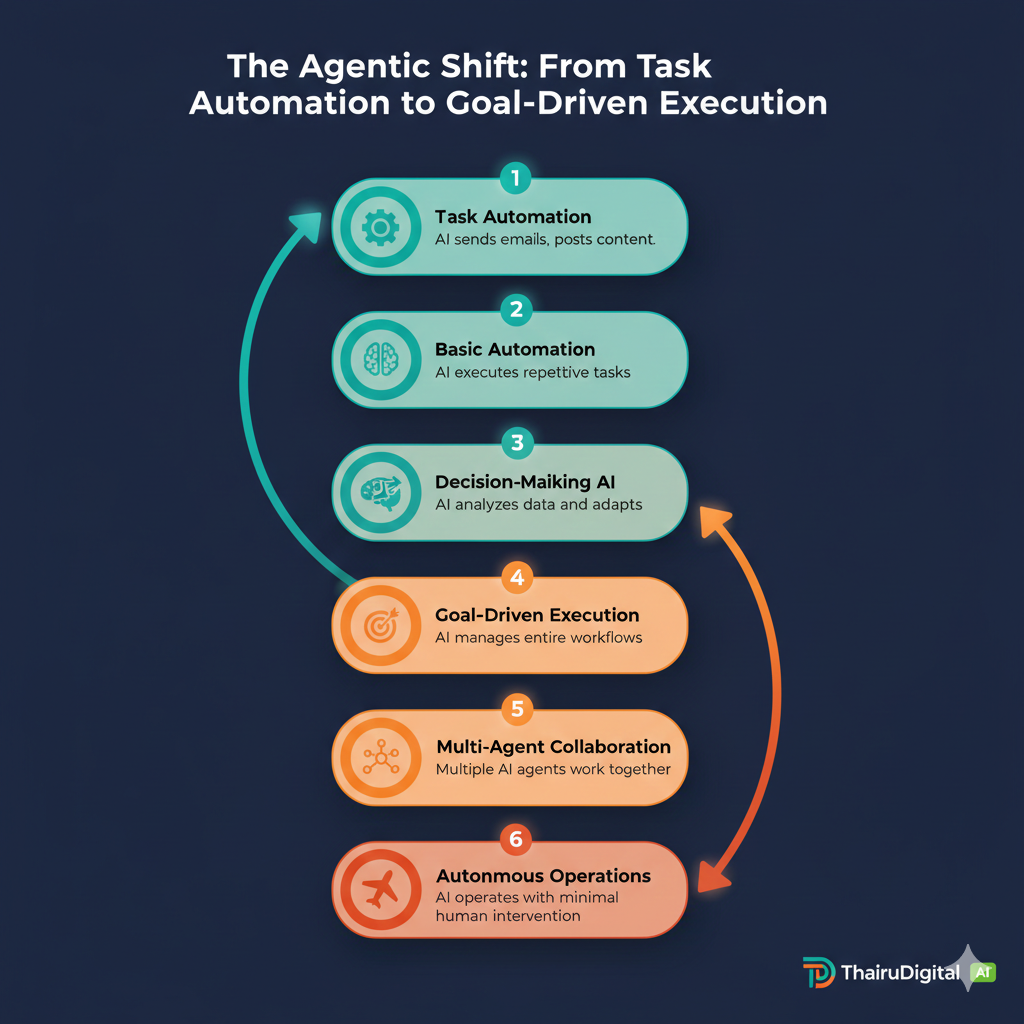
The agentic shift is the transition from AI acting as a simple assistant to AI taking on autonomous operational roles, executing entire workflows with minimal human intervention. For small businesses in 2026, AI agents are no longer just tools—they’re digital operators capable of making decisions, optimising processes, and scaling operations efficiently. Thairu Digital helps small businesses navigate this shift by implementing AI agents that deliver measurable growth while maintaining safety and oversight.
From Task Automation to Goal-Driven Execution
In the early days, small businesses primarily used AI for task automation, such as sending emails, posting content, or generating reports. These tasks were linear and pre-defined, meaning AI only performed exactly what it was told, with no adaptability.
With the agentic shift, AI agents now operate based on business objectives, not just tasks:
- Agents can analyse data in real time, identify opportunities, and make decisions that align with broader goals.
- Small businesses can delegate complete workflows, from lead generation to customer follow-up, without needing manual intervention.
- AI agents can adapt their actions based on metrics like engagement, conversion, and revenue outcomes, continuously improving performance.
Example:
Thairu Digital helped a small e-commerce brand implement a marketing AI agent. Instead of just scheduling posts, the AI agent monitored engagement, adjusted ad spend, optimised email sequences, and reported ROI, freeing the marketing team to focus on creative campaigns and strategy.
Key Insight:
Goal-driven execution means AI agents are strategic contributors, not just task performers, making small businesses more agile and competitive.
Single Agents vs Multi-Agent Systems
The agentic shift has also enabled multi-agent systems, where multiple AI agents work together to manage complex operations.
- Single-agent systems:
Focus on a specific function—e.g., a chatbot answering customer queries or an AI agent optimising ad campaigns. These are ideal for small, well-defined workflows. - Multi-agent systems:
Multiple agents collaborate, each with a specialised role, to manage end-to-end processes.- Example Workflow for Small Business:
- Content agent: Drafts blog posts, social media content, and email campaigns.Marketing agent: Analyses audience engagement, adjusts ad campaigns, and suggests optimisations.
- Customer support agent: Handles inquiries, escalates complex issues, and ensures satisfaction.
- Example Workflow for Small Business:
Use Case:
A Nairobi-based boutique e-commerce brand worked with Thairu Digital to implement a multi-agent system. This setup allowed the team to coordinate marketing, content, and support simultaneously, increasing efficiency by 40% while keeping team size lean.
Key Insight:
Multi-agent systems allow small businesses to scale operations without hiring large teams, provided there’s coordination and governance.
Human-in-the-Loop vs Fully Autonomous Agents
ven as AI agents gain autonomy, human oversight remains critical, especially for small businesses that must balance efficiency with risk management.
- Human-in-the-loop (HITL):
Humans review AI decisions at key points. This ensures:- Sensitive decisions (pricing, compliance, customer interactions) remain under control. AI actions align with brand voice and goals.
- Errors or unintended behaviours are caught early.
- Fully autonomous agents:
Operate with minimal human input, executing pre-defined objectives. While they increase efficiency, they require robust monitoring, fail-safes, and governance.
Example:
Thairu Digital guided a small SaaS business to adopt a hybrid approach: the AI agent managed lead scoring and follow-ups autonomously, but human staff reviewed high-value leads and final campaign decisions. This approach maximised efficiency while minimising risk.
Key Insight:
For small businesses, fully autonomous AI should never replace human judgment entirely—it should augment workflows while keeping humans in strategic control.
Key Takeaways
- The agentic shift moves AI from task execution to workflow ownership and strategic contribution.
- Small businesses benefit from goal-driven AI execution, multi-agent collaboration, and autonomous decision-making.
- Human oversight is essential, particularly in sensitive workflows, to maintain control, compliance, and quality.
- Thairu Digital helps small businesses adopt AI agents that maximise ROI, improve efficiency, and maintain operational safety.
Which No-Code AI Agent Builders Are Powering Small Businesses in 2026?
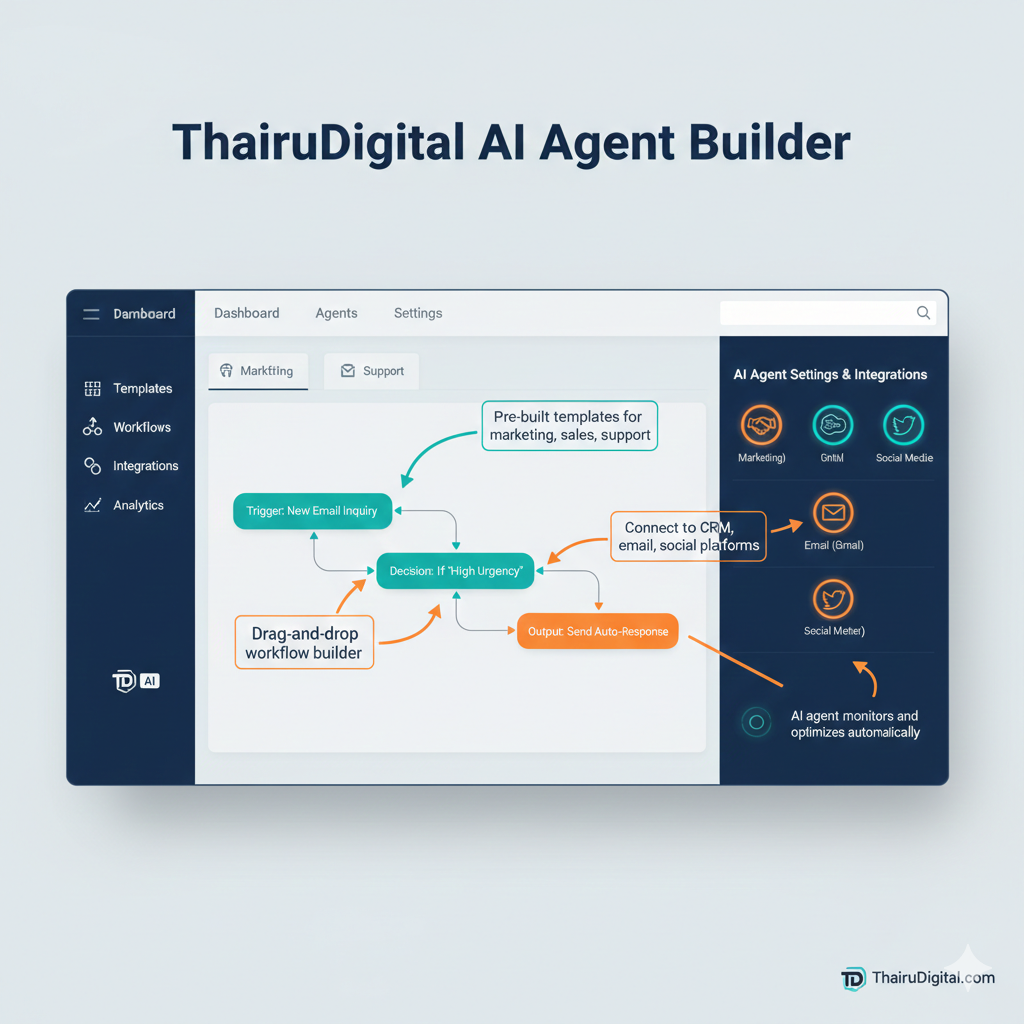
No-code AI agent builders are transforming how small businesses adopt automation and AI-driven workflows without technical expertise. In 2026, these platforms enable teams to create, customise, and deploy AI agents for marketing, sales, support, and operations in hours rather than months. Thairu Digital leverages these tools to implement practical solutions that save time, reduce errors, and scale businesses efficiently.
Why No-Code Matters for Non-Technical Teams
Small businesses often lack the resources to hire developers or AI engineers. No-code AI agent builders remove this barrier:
- Drag-and-drop interfaces enable users to visually design workflows.
- Pre-built templates for marketing, e-commerce, and support workflows speed up deployment.
- Integration with existing tools (like CRMs, social media, and email platforms) ensures seamless adoption.
Example:
Thairu Digital helped a small retail business automate its email marketing using a no-code agent. Within days, the AI agent was sending personalised campaigns, tracking engagement, and updating the CRM—all without writing a single line of code.
Use Case:
- Automating customer onboarding sequences
- Generating social media posts based on trending topics
- Responding to common support queries instantly
No-code AI builders make these tasks accessible to non-technical founders and teams, dramatically increasing adoption speed and reducing errors.
Common Features of Modern AI Agent Builders
Modern platforms are not just simple “drag-and-drop” tools—they are intelligent, multi-functional, and goal-driven. Core features include:
- Workflow automation: Build multi-step processes (e.g., lead scoring → email sequence → follow-up).
- Data analysis: AI agents monitor and report performance metrics automatically.
- Integration capabilities: Connect agents to CRMs, social media, e-commerce platforms, or messaging apps.
- Natural language processing (NLP): Enables chat, content creation, or personalised customer communication.
- Customisation and templates: Pre-built templates for marketing, sales, or customer support workflows.
Thairu Digital Insight:
Selecting a platform isn’t just about features—it’s about aligning the AI agent with your business goals. Thairu Digital evaluates workflows first, then chooses the platform that delivers ROI efficiently.
Where No-Code Agents Work Best (And Where They Don’t)
Ideal Applications:
- Marketing automation (emails, social media, ads)
- Customer support for FAQs and lead triage
- Sales pipeline management (lead scoring, follow-ups)
- E-commerce operations (product recommendations, stock alerts)
Limitations:
- Complex decision-making beyond templates
- Highly customised backend operations
- Sensitive financial or legal workflows requiring expert oversight.
Practical Comparison Table of Leading No-Code AI Agent Builders
| Platform Name | Key Features | Best Use Case for Small Business | Thairu Digital Recommendation |
| Zapier + AI Plugins | Workflow automation, integration across apps | Simple task automation & email/social workflows | Ideal for rapid deployment and testing |
| Make (formerly Integromat) | Multi-step automations, conditional logic | Cross-platform workflow coordination | Great for medium-complexity marketing workflows |
| AgentGPT | Conversational AI, GPT-based autonomous agents | Customer support, content creation, lead nurturing | Perfect for marketing & engagement automation |
| Pinecone + LangChain | Vector databases + AI reasoning for knowledge retrieval | Personalised recommendations & data-driven decisions | Best for e-commerce & knowledge-intensive workflows |
Thairu Digital Insight:
While these platforms differ in complexity, Thairu Digital emphasises choosing a solution that aligns with both workflow requirements and business goals, ensuring adoption leads to measurable ROI instead of tech experimentation.
Key Takeaways
- No-code AI agent builders empower non-technical teams to implement complex AI workflows.
- Platforms differ in capabilities, integrations, and complexity, so business goals should drive the choice.
- Use cases: marketing, sales, customer support, e-commerce operations.
- Thairu Digital helps small businesses evaluate, implement, and optimise no-code AI agents for maximum efficiency and impact.
H2: Why AI Governance Is No Longer Optional for Small Businesses
I’ll expand all H3S, include examples, use cases, practical advice, and a table showing actionable governance controls. I’ll also include Thairu Digital mentions to enhance authority and uniqueness.
Why AI Governance Is No Longer Optional for Small Businesses
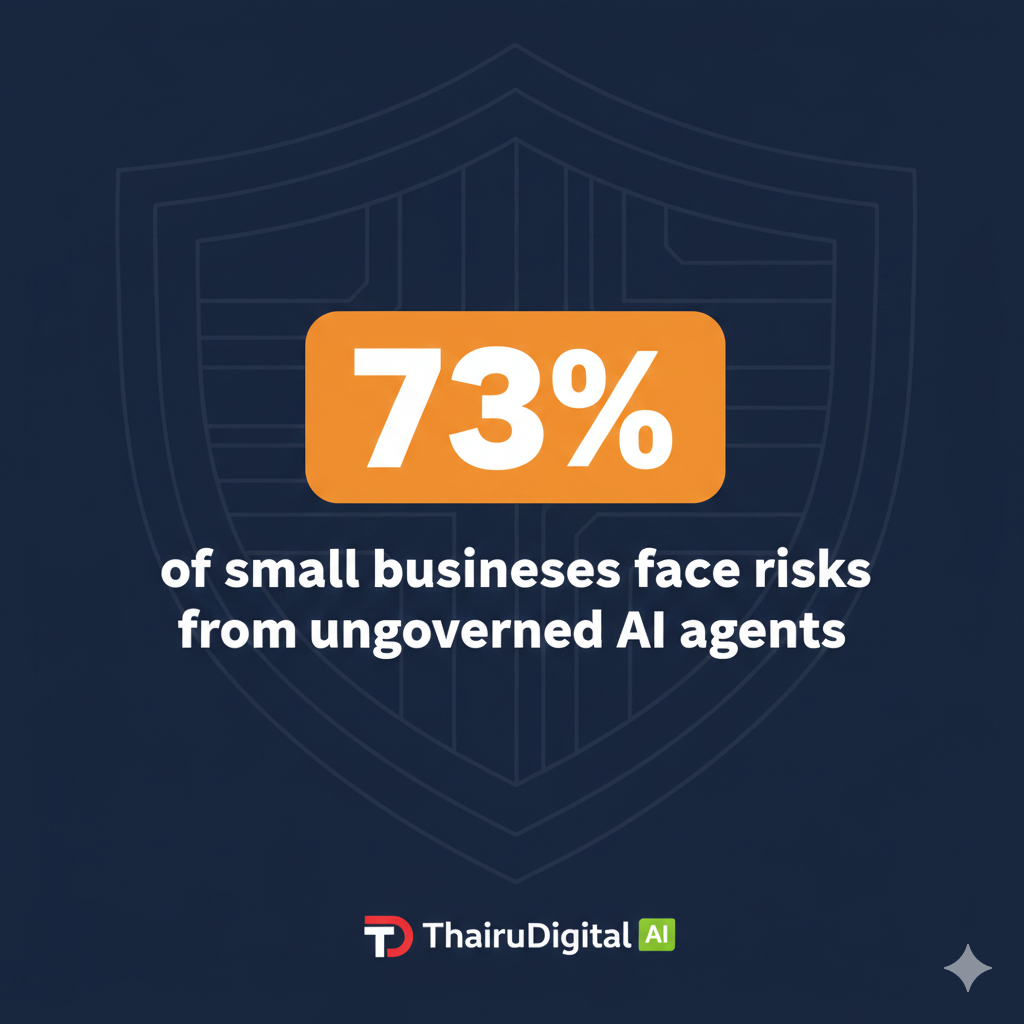
As AI agents take on increasingly autonomous roles in small business operations, governance is no longer optional—it’s essential. Ungoverned AI can introduce risks like data leaks, incorrect decision-making, or reputational damage. Thairu Digital helps small businesses implement practical AI governance frameworks that ensure safety, accountability, and operational efficiency without creating unnecessary bureaucracy.
Risks of Ungoverned AI Agents
Even small businesses can face serious consequences if AI agents operate without oversight:
- Operational risks: AI may make incorrect decisions, send inappropriate emails, or post off-brand content on social media.
- Financial risks: Mismanaged automated campaigns or pricing decisions can result in revenue loss.
- Reputational risks: Poorly monitored AI agents may generate content or responses that harm brand credibility.
- Security risks: Ungoverned AI can expose sensitive customer or company data.
Example:
A small e-commerce business ran a promotional email sequence entirely automated by an AI agent. Without oversight, the AI sent duplicate discount codes to thousands of customers, creating confusion and minor financial loss. Thairu Digital emphasises pre-deployment checks and governance policies to prevent such issues.
Data Access, Permissions, and Audit Trails
Proper governance starts with controlling who and what the AI agent can access:
- Role-based access control (RBAC): Assign permissions to agents and humans based on necessity.
- Audit trails: Keep detailed logs of agent actions, decisions, and data access to ensure accountability.
- Data protection: Only provide AI agents with the minimum data needed to perform tasks.
Practical Example:
Thairu Digital helped a small SaaS startup implement a CRM-integrated AI agent. Access was restricted to marketing-relevant data, and every automated action was logged. This allowed the team to trace decisions, validate performance, and meet compliance requirements.
Compliance, Accountability, and Brand Trust
Governance is not just about internal control—it’s also about building trust with customers and stakeholders:
- Compliance: Follow data protection regulations (e.g., GDPR, Kenya Data Protection Act) when AI agents process personal data.
- Accountability: Ensure humans remain responsible for high-stakes decisions.
- Brand consistency: Governed AI agents maintain consistent tone, messaging, and ethical standards.
Example Use Case:
Thairu Digital guided a small e-commerce brand to implement automated customer support agents. Governance policies ensured all agent responses were reviewed and aligned with brand voice, building customer trust and minimising complaints
Practical Controls Small Teams Can Implement
Small businesses don’t need large compliance teams to govern AI. Practical, lightweight controls can ensure safety and accountability:
| Governance Control | What It Does | How Small Businesses Can Implement It |
| Role-Based Permissions | Limits what agents and staff can do | Assign access based on workflow relevance |
| Audit Trails & Logs | Tracks every AI action and decision | Use built-in logging in AI platforms, review weekly |
| Pre-Deployment Testing | Ensures agent behaviour matches expectations | Run simulations before full rollout |
| Human-in-the-Loop Oversight | Human review at critical decision points | Approve high-value campaigns, pricing, or content |
| Data Minimization | Reduces exposure of sensitive information | Only feed necessary data to AI agents |
Thairu Digital Insight:
Governance ≠ bureaucracy. Small businesses can implement lightweight, practical policies that keep AI agents safe, effective, and trustworthy without slowing down operations. Thairu Digital specializes in custom governance frameworks tailored to small business workflows.
Key Takeaways
- Ungoverned AI agents pose operational, financial, reputational, and security risks.
- Data access, permissions, and audit trails are essential to maintain control.
- Compliance and accountability are crucial for brand trust.
- Small businesses can implement lightweight, practical governance controls without creating unnecessary bureaucracy.
- Thairu Digital helps small businesses adopt AI safely while maximizing efficiency and ROI.
Final Thoughts
AI agents are no longer experimental tools—they are essential operational partners for small businesses in 2026. From no-code builders to autonomous marketing bots and robust governance frameworks, adopting AI agents responsibly can boost efficiency, scale operations, and improve ROI. Small businesses that implement practical controls, monitor performance, and align AI with business goals gain a competitive edge. Thairu Digital helps brands navigate this transformation, ensuring AI adoption is safe, strategic, and growth-focused.
Frequently Asked Questions (FAQ)
1. What is the difference between AI agents and traditional automation tools?
AI agents are autonomous or semi-autonomous programs that make decisions, execute workflows, and adapt to new data, whereas traditional automation tools only follow pre-defined instructions. AI agents can manage marketing campaigns, customer support, and operations with minimal human input. Thairu Digital helps small businesses implement AI agents that do more than just automate tasks—they drive business outcomes.
2. Are AI agents safe for small businesses to use?
Yes, but only when governed properly. Ungoverned AI agents can create operational, financial, or reputational risks. Implementing data access controls, audit trails, and human oversight mitigates these risks. Thairu Digital works with small businesses to adopt AI responsibly, ensuring agents are safe, compliant, and aligned with brand goals.
3. Do I need technical skills to deploy AI agents?
Not necessarily. No-code AI agent builders allow small businesses to deploy sophisticated workflows without programming skills. Platforms offer drag-and-drop interfaces, templates, and integrations for marketing, customer support, and e-commerce. Thairu Digital guides non-technical teams to implement, optimize, and scale AI agents efficiently.
4. How much do AI agents cost for small businesses?
Costs vary depending on the platform, complexity, and usage. Many no-code AI platforms charge monthly subscriptions starting as low as $20–$50, while multi-agent systems or advanced integrations can be higher. Thairu Digital advises small businesses to align agent investment with expected ROI, ensuring adoption is both practical and cost-effective.
5. Can AI agents replace marketing teams entirely?
AI agents augment marketing teams, handling repetitive and data-driven tasks like content scheduling, lead nurturing, and performance analysis. However, human oversight is critical for creative strategy, brand voice, and high-stakes decisions. Thairu Digital implements AI solutions that enhance human teams, increase efficiency, and deliver measurable business growth.