
AI customer support agents for businesses are autonomous AI systems designed to handle, resolve, and manage customer support interactions across channels without constant human involvement. Unlike basic chatbots, these agents can understand context, access multiple systems, make decisions, and learn from past interactions.
In this guide, business owners will learn how AI customer support agents work, how they differ from traditional automation and chatbots, real-world use cases across industries, and the measurable benefits they deliver—such as faster response times, lower support costs, and improved customer satisfaction. The article also covers risks, implementation best practices, and what the future of AI-powered customer support looks like in 2025 and beyond.
What Are AI Customer Support Agents for Businesses?
AI customer support agents for businesses are autonomous AI systems that can handle customer inquiries, resolve issues, and manage support workflows across multiple platforms with minimal human intervention. Unlike traditional chatbots or rule-based automation, AI agents can understand context, make decisions, access internal systems, and learn from past interactions to improve over time.
For business owners, this means customer support can scale without hiring large teams, while still maintaining fast response times and consistent service quality.
How AI Customer Support Agents Work Across Support Systems
AI customer support agents operate as connected problem-solvers, not isolated chat tools. They integrate with existing support infrastructure, such as:
- Helpdesk platforms (Zendesk, Freshdesk, Intercom)
- CRM systems (HubSpot, Salesforce)
- Knowledge bases and FAQs
- Billing, order management, and account systems
When a customer submits a request, the AI agent can:
- Identify the issue using natural language understanding
- Retrieve customer context (history, plan, previous tickets)
- Take action—such as issuing a refund, updating an account, or escalating the case
- Follow up automatically until the issue is resolved
Example:
An e-commerce business uses an AI agent to handle order-related inquiries. When a customer asks about a delayed shipment, the AI agent checks order status, contacts the shipping API, updates the customer, and applies a discount if delivery is late—all without human involvement.
AI Customer Support Agents vs Traditional Automation

Traditional customer support automation relies on fixed rules and scripts. AI customer support agents operate with decision-making autonomy.
Key differences include:
- Traditional automation follows predefined workflows; AI agents adapt in real time
- Automation tools require manual updates; AI agents learn from outcomes
- Rule-based systems break easily with unexpected queries; AI agents handle variation
Case Study:
A SaaS company replaced rule-based ticket routing with AI customer support agents. Previously, misrouted tickets caused delays and frustration. After implementation, first-response accuracy improved by 35%, and average resolution time dropped by 28%, demonstrating the value of intelligent autonomy.
AI Agents vs Chatbots: What Business Owners Should Know
Chatbots are often mistaken for AI agents, but the difference is critical.
Chatbots:
- Respond to predefined questions
- Operate in a single channel
Cannot complete multi-step tasks
AI customer support agents:
- Maintain conversation context
- Operate across email, chat, and ticketing systems
- Execute actions like refunds, cancellations, and escalations
Example:
A chatbot might answer, “Where is my order?”
An AI agent will:
- Check the order status
- Identify delays
- Notify the customer
- Trigger a refund or escalation if needed
This makes AI agents far more valuable for businesses aiming to resolve issues, not just respond.
Why Businesses Are Moving Beyond Chatbots
As customer expectations rise, businesses need support systems that deliver speed, accuracy, and consistency.
Businesses are adopting AI customer support agents because they:
- Reduce repetitive workload for human agents
- Provide 24/7 support without added staffing costs
- Ensure consistent responses across all channels
- Improve customer satisfaction through faster resolution
Case Study:
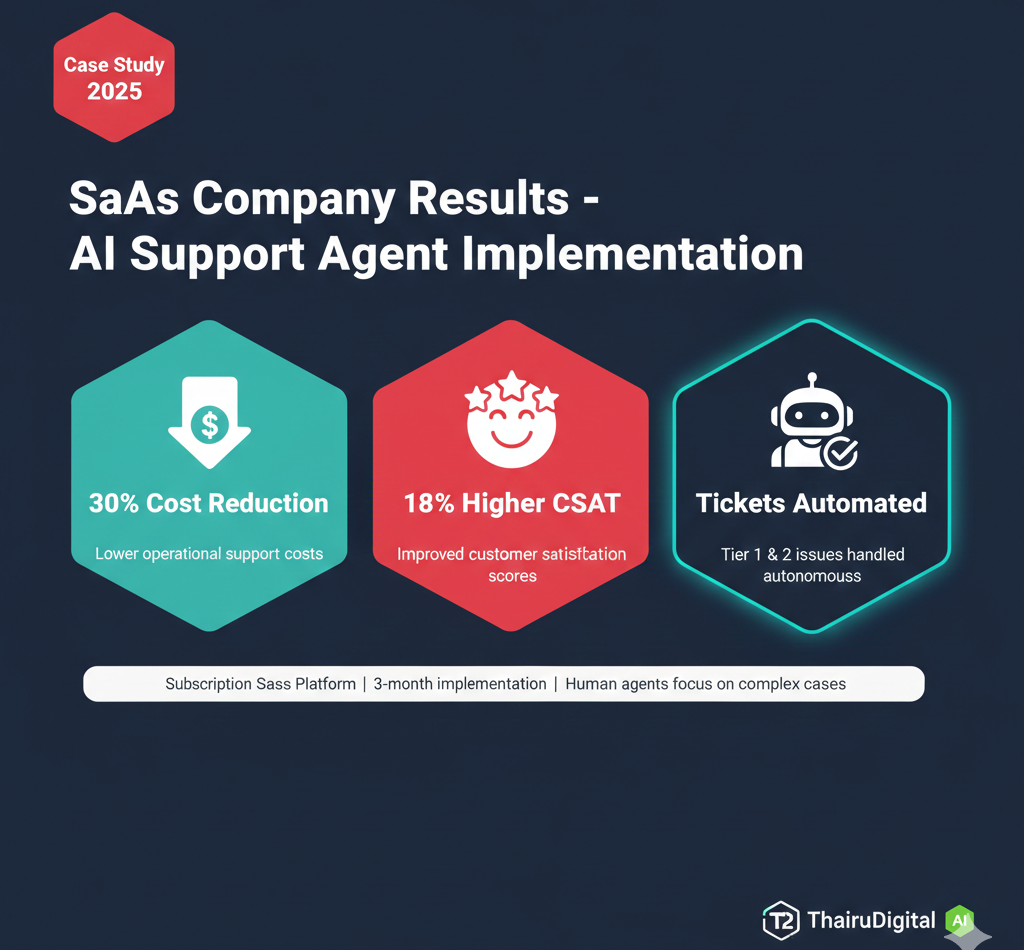
A subscription-based SaaS platform deployed AI customer support agents to handle Tier 1 and Tier 2 support. Within three months, support costs dropped by 30%, while customer satisfaction scores improved by 18%—proving that AI agents can enhance both efficiency and experience.
Key Takeaways for Business Owners
- I, a customer support agents are autonomous problem-solver, not a simple chatbot
- They integrate across systems to resolve issues end-to-end
- Businesses gain scalability, cost savings, and consistency
- Human agents remain essential for complex or sensitive cases
This foundation sets the stage for understanding how AI customer support agents deliver measurable business value, which we’ll explore next.
How Do AI Customer Support Agents Improve Support Operations?
AI customer support agents improve support operations by automating ticket handling, reducing response and resolution times, ensuring consistent service quality, and allowing businesses to scale support without increasing headcount.
From an operations perspective, AI agents act as a force multiplier—handling high volumes of repetitive requests while human agents focus on complex, high-impact interactions.
Faster Response and Resolution Times
Speed is one of the biggest drivers of customer satisfaction. AI customer support agents dramatically reduce delays by responding instantly and resolving issues without waiting for human availability.
AI agents achieve this by:
- Instantly understanding customer intent using NLP
- Accessing order, billing, or account data in real time
- Executing predefined actions such as refunds or resets
- Following up automatically until resolution
Example:
A SaaS company implemented AI agents to handle password resets, account access issues, and billing questions. Average first response time dropped from 2 hours to under 10 seconds, while resolution time decreased by 45%.
24/7 Customer Support Without Hiring More Staff
AI customer support agents operate continuously, enabling businesses to provide round-the-clock support without expanding their support teams.
This is especially valuable for:
- Global businesses with customers in multiple time zones
- E-commerce brands handling after-hours orders and returns
- SaaS platforms offering subscription-based services
Case Study:
An international e-commerce brand deployed AI agents to manage nighttime inquiries related to shipping, returns, and order tracking. Overnight ticket backlog dropped by 60%, and customer complaints about delayed responses declined significantly—all without adding new staff.
Reducing Support Workload and Agent Burnout
Repetitive support requests are a major cause of agent burnout. AI customer support agents reduce this burden by handling Tier 1 and many Tier 2 issues autonomously.
Common tasks AI agents take over include:
- Order status checks
- Subscription changes
- Refund requests
- FAQ-based inquiries
Human agents are then freed to focus on:
- Complex troubleshooting
- Emotional or high-stakes customer interactions
- Retention and upsell conversations
Example:
A subscription SaaS company offloaded 65% of incoming tickets to AI agents. Human agents reported higher job satisfaction, while churn decreased due to faster issue resolution.
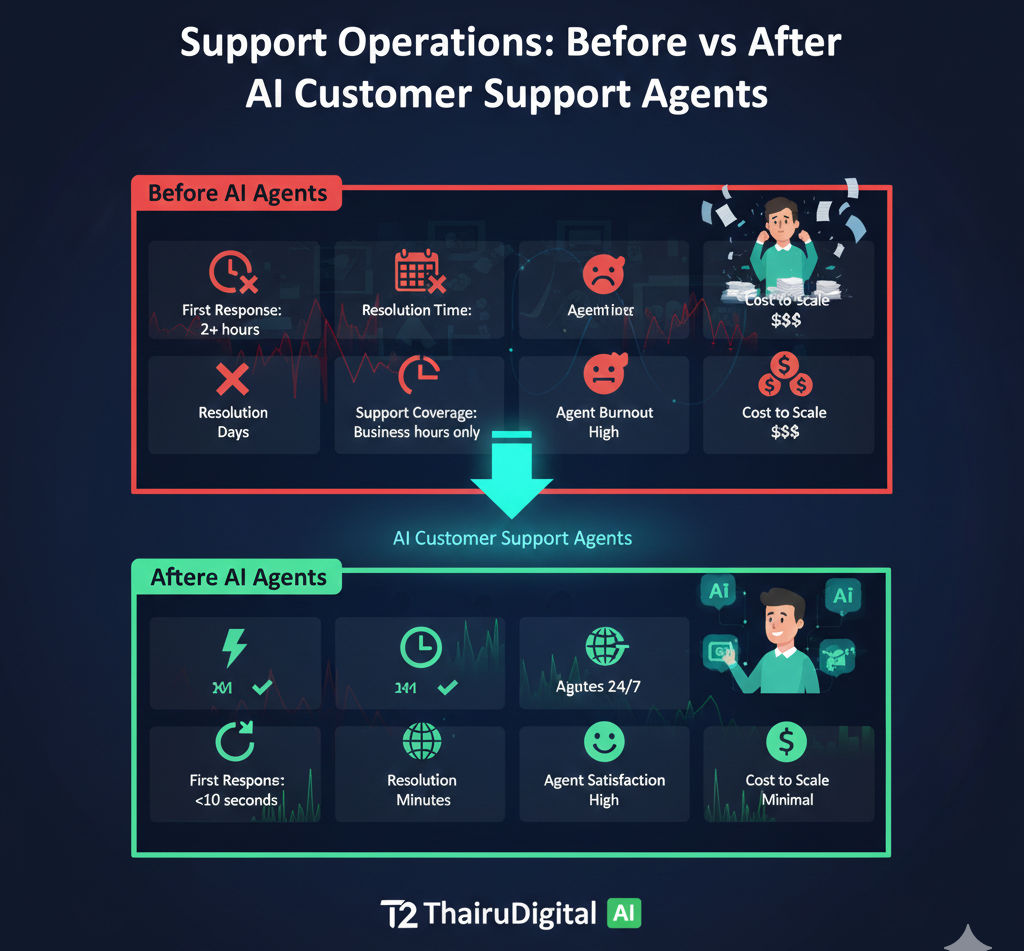
Table: Support Operations Before vs After AI Customer Support Agents
| Support Metric | Traditional Support Model | With AI Customer Support Agents |
| First Response Time | Minutes to hours | Instant or under 1 minute |
| Resolution Speed | Dependent on agent availability | Automated, real-time resolution |
| Support Coverage | Limited to business hours | 24/7 availability |
| Cost to Scale | High (more hires needed) | Low (software scales) |
Why This Matters for Business Owners
From a business perspective, AI customer support agents deliver:
- Lower operational costs
- Faster issue resolution
- Improved CSAT and retention
- Scalable support without linear hiring
More importantly, they transform support from a cost centre into a competitive advantage.
AI Agents vs Chatbots in Customer Support — What’s the Real Difference?
AI agents and chatbots serve different purposes in customer support. Chatbots are designed to respond to predefined questions, while AI customer support agents for businesses can understand context, make decisions, and complete multi-step tasks autonomously across multiple systems.
For business owners, this difference determines whether support replies to customers or actually resolves their problems.
Rule-Based Responses vs Autonomous Action
Chatbots rely on predefined scripts and decision trees. They respond only to questions they are programmed to recognize and often fail when conversations deviate from expected inputs.
AI customer support agents operate autonomously by:
- Interpreting customer intent using natural language understanding
- Accessing relevant systems such as CRMs, billing platforms, or order databases
- Executing actions like refunds, account updates, or escalations
- Adjusting behaviour based on past interactions
Example:
A chatbot may respond with an FAQ link when asked about a billing issue. An AI agent can verify the charge, identify an error, issue a refund, and notify the customer—without human involvement.
Context Awareness and Memory
One of the biggest limitations of chatbots is their lack of memory. They often treat each interaction as a new conversation.
AI customer support agents maintain contextual awareness, allowing them to:
- Remember previous interactions
- Reference earlier tickets or conversations
- Adapt responses based on customer history
Case Study:
A subscription-based SaaS company replaced chatbots with AI agents that retained customer context across email and live chat. Repeat inquiries dropped by 32%, and customer satisfaction scores improved due to fewer repetitive explanations.
Multi-Step Issue Resolution
Chatbots typically handle only single-step interactions. Once a request requires multiple actions, they either fail or escalate to a human agent.
AI agents are designed for end-to-end resolution, handling workflows such as:
- Identifying the issue
- Accessing account or order data
- Taking corrective action
- Confirming resolution with the customer
Example:
In an e-commerce setting, an AI agent can process a return request by validating eligibility, generating a return label, updating inventory, issuing a refund, and sending confirmation—without breaking the conversation flow.
Scalability and Business Impact
As businesses grow, chatbot limitations become more visible. They require constant manual updates, break under complex queries, and struggle with scale.
AI customer support agents scale more effectively because they:
- Learn from outcomes and improve over time
- Adapt to new products, policies, and workflows
- Reduce reliance on human intervention
Case Study:
An online marketplace using chatbots struggled with inconsistent responses during peak seasons. After adopting AI customer support agents, ticket backlog during high-traffic periods decreased by 45%, and resolution consistency improved across channels.
Why Business Owners Are Moving Beyond Chatbots
Business owners increasingly choose AI agents because they:
- Deliver faster and more accurate resolutions
- Reduce operational complexity
- Improve customer trust through consistency
- Scale support without linear hiring
Chatbots may still serve basic use cases, but AI customer support agents offer a long-term, scalable solution for businesses focused on growth and customer experience.
Key Takeaways
- Chatbots respond; AI agents resolve
- AI agents maintain context and execute actions
- Businesses gain scalability, consistency, and efficiency
- AI customer support agents provide higher ROI than traditional chatbots
What Customer Support Tasks Can AI Agents Handle Today?
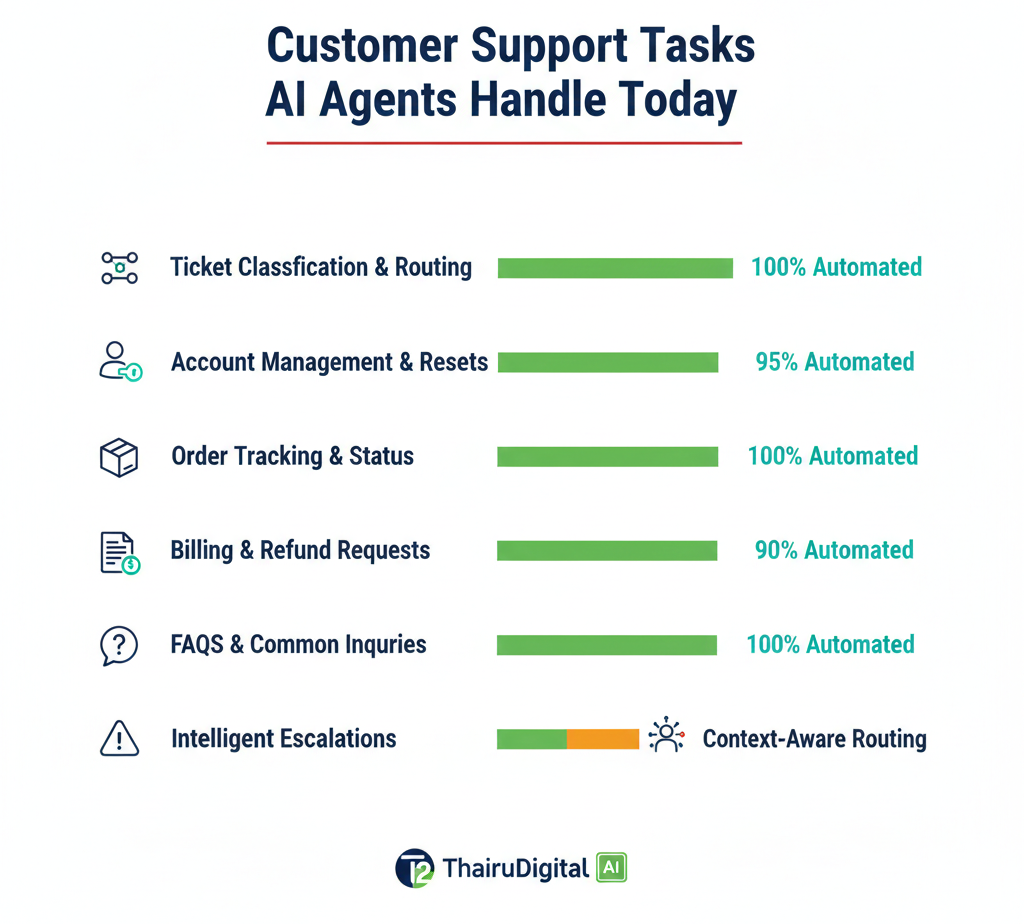
AI customer support agents for businesses can handle most Tier 1 and many Tier 2 customer support tasks, including ticket triage, account management, order-related issues, billing inquiries, and intelligent escalation—often without human intervention.
Modern AI agents are no longer limited to answering FAQs. They are capable of executing real actions across systems, making them practical frontline support operators.
Ticket Classification and Intelligent Routing
One of the most immediate benefits of AI customer support agents is their ability to classify and route tickets accurately.
AI agents can:
- Detect customer intent from free-form text
- Categorize tickets by urgency and topic
- Route complex issues to the right human team
- Prioritise high-value or at-risk customers
Example:
A SaaS platform implemented AI agents to auto-classify incoming tickets. Misrouted tickets dropped by 38%, and average handling time decreased because issues reached the right team faster.
Account Management and Self-Service Requests
AI agents are highly effective at handling account-related tasks that previously required manual intervention.
Common tasks include:
- Password resets and account recovery
- Subscription upgrades or downgrades
- Plan changes and billing cycle updates
- User profile and permissions management
Case Study:
A subscription-based business deployed AI customer support agents to manage account changes. Over 60% of account-related tickets were resolved automatically, reducing workload on human agents while improving response times.
Order, Billing, and Payment Support
For e-commerce and SaaS businesses, order and billing issues represent a large portion of incoming support volume.
AI customer support agents can:
- Check order and shipment status
- Detect billing errors
- Process refunds and cancellations
- Apply discounts or credits based on policy
Example:
An online retailer used AI agents to handle refund requests. The agents verified eligibility, issued refunds, and updated customers in real time, cutting resolution time from days to minutes.
Escalations and Exception Handling
AI agents don’t replace human judgment in sensitive cases—but they manage escalation intelligently.
AI agents:
- Detect frustration, urgency, or sentiment changes
- Escalate cases that require empathy or discretion
- Provide full context to human agents
- Follow up after escalation to ensure resolution
Case Study:
A fintech company used AI agents to monitor sentiment in customer conversations. High-risk cases were escalated automatically, reducing customer complaints and improving retention.
Table: Customer Support Tasks AI Agents Can Handle vs Human Agents
| Support Task | AI Customer Support Agents | Human Support Agents |
| Ticket classification & routing | Fully automated | Oversight only |
| FAQs and common inquiries | Fully automated | Rarely needed |
| Account changes & resets | Automated with approval rules | Complex exceptions |
| Order tracking & refunds | Automated end-to-end | Policy exceptions |
What This Means for Businesses
AI customer support agents allow businesses to:
- Resolve high-volume issues faster
- Reduce operational costs
- Improve consistency across support channels
- Scale without hiring large support teams
Human agents remain essential, but their role shifts toward complex problem-solving, customer retention, and relationship management.
Key Takeaways
- AI agents handle most Tier 1 and many Tier 2 tasks
- They reduce workload and improve resolution speed
- Escalation ensures humans stay in control when needed
- Businesses gain scalable, reliable support operations
Final Thoughts: AI Agents Are Essential for Customer Support
AI customer support agents are transforming how businesses handle customer inquiries. They automate repetitive tasks, resolve issues faster, and provide 24/7 support, allowing human agents to focus on complex, empathy-driven interactions. Unlike chatbots, AI agents learn from past interactions, act across systems, and escalate intelligently when needed.
For business owners, adopting AI agents means faster resolutions, lower costs, and consistent service quality. Early implementation gives a competitive advantage, helping companies scale support efficiently while improving customer satisfaction. In today’s environment, AI agents are no longer optional—they are essential tools for growth-focused businesses.
FAQ: AI Customer Support Agents for Businesses
Q1: What are AI customer support agents?
AI customer support agents are autonomous systems that can handle customer inquiries, resolve issues, and manage support workflows across multiple channels without constant human involvement. They go beyond chatbots by executing actions and learning from interactions.
Q2: Can AI agents fully replace human support teams?
No. AI agents handle repetitive or predictable tasks, but humans are still essential for complex, sensitive, or high-empathy interactions. The best approach is a hybrid model where AI handles routine requests and humans manage exceptions.
Q3: What tasks can AI agents handle in customer support?
AI agents can manage ticket classification, account changes, billing and refund requests, order tracking, FAQs, and escalate complex cases when necessary. They improve speed and consistency across these tasks.
Q4: How do AI agents differ from chatbots?
Chatbots respond to predefined queries, while AI agents understand context, act across multiple systems, learn from past interactions, and can execute multi-step workflows autonomously.
Q5: Are AI agents safe for handling customer data?
Yes, when deployed with proper security measures and compliance protocols. Most enterprise AI agents integrate with secure systems and follow privacy regulations like GDPR and CCPA.