
Introduction
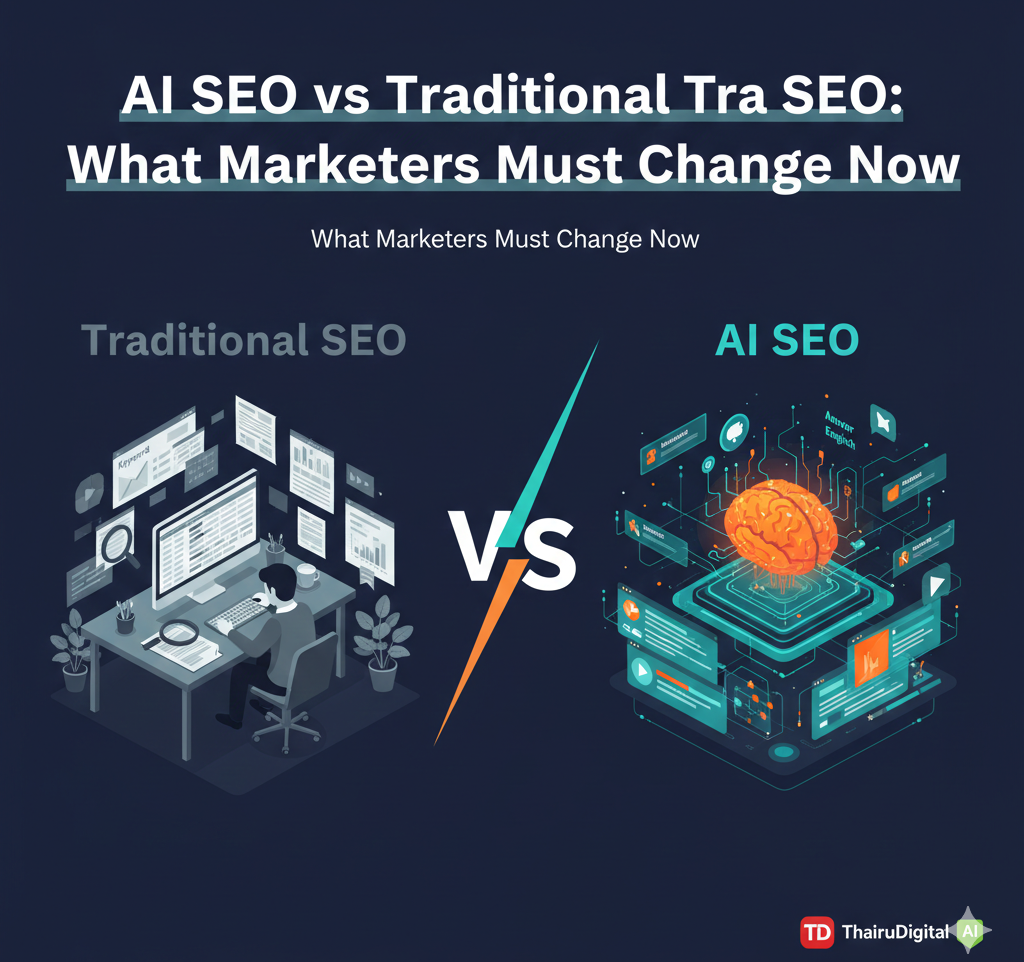
Search engine optimisation has changed more in the last three years than in the decade before. In 2026, marketers no longer optimise only for keywords and backlinks — they optimise for AI-driven search engines, answer engines, and user intent systems.
Traditional SEO focused on ranking pages.
AI SEO focuses on satisfying users instantly.
With Google, Bing, voice assistants, and AI answer engines reshaping search, marketers must adapt or risk invisibility. AI SEO introduces automation, prediction, and intent modelling into every part of optimisation.
In this guide, you’ll learn the key differences between AI SEO and traditional SEO — and what marketers must change right now to stay competitive.
What Is Traditional SEO?
Traditional SEO relies on manual strategies such as:
● Keyword research
● On-page optimisation
● Backlink building
● Technical SEO
● Content publishing
● Rank tracking
It focuses on:
● Matching keywords
● Ranking pages
● Optimising metadata
● Improving site structure
While still useful, traditional SEO alone is no longer enough in AI-powered search environments.
What Is AI SEO?
AI SEO uses artificial intelligence to automate, predict, and optimise SEO based on real user behaviour and search engine intelligence.
AI SEO includes:
● Intent analysis
● Content gap detection
● Predictive ranking models
● Automation workflows
● Answer engineoptimisation (AEO)
● Entity-based SEO
Instead of reacting to rankings, AI SEO predicts performance and adapts automatically.
Key Differences Between AI SEO and Traditional SEO

1. Keyword Matching vs Intent Understanding
Traditional SEO:
● Targets exact keywords
AI SEO:
● Understands user intent
● Focuses on questions and context
AI search systems no longer match words — they match meaning. Marketers must optimise for answers, not just phrases.
2. Manual Research vs Automated Intelligence
Traditional SEO:
● Manual audits
● Slow analysis
AI SEO:
● Automated data processing
● Real-time insights
AI scans millions of data points instantly, helping marketers make faster and smarter SEO decisions
3. Static Content vs Dynamic Optimisation
Traditional SEO:
● Publish and wait
AI SEO:
● Continuously optimise
● Adapt to behaviour change.s
AI SEO updates content based on performance, trends, and engagement — not just initial setup.
4. Ranking Pages vs Winning Answer Engines
Traditional SEO:
● Optimise for SERPs
AI SEO:
● Optimise for:
○ Featured snippets
○ Voice search
○ AI answers
○ Knowledge panels
Marketers must structure content so AI systems can extract and present answers instantly.
5. Guesswork vs Predictive SEO
Traditional SEO:
● Trial and error
AI SEO:
● Predicts:
○ Traffic potential
○ Click-through rate
○ Competition
○ Conversion value
SEO becomes a forecasting system, not a gamble.
What Marketers Must Change Now
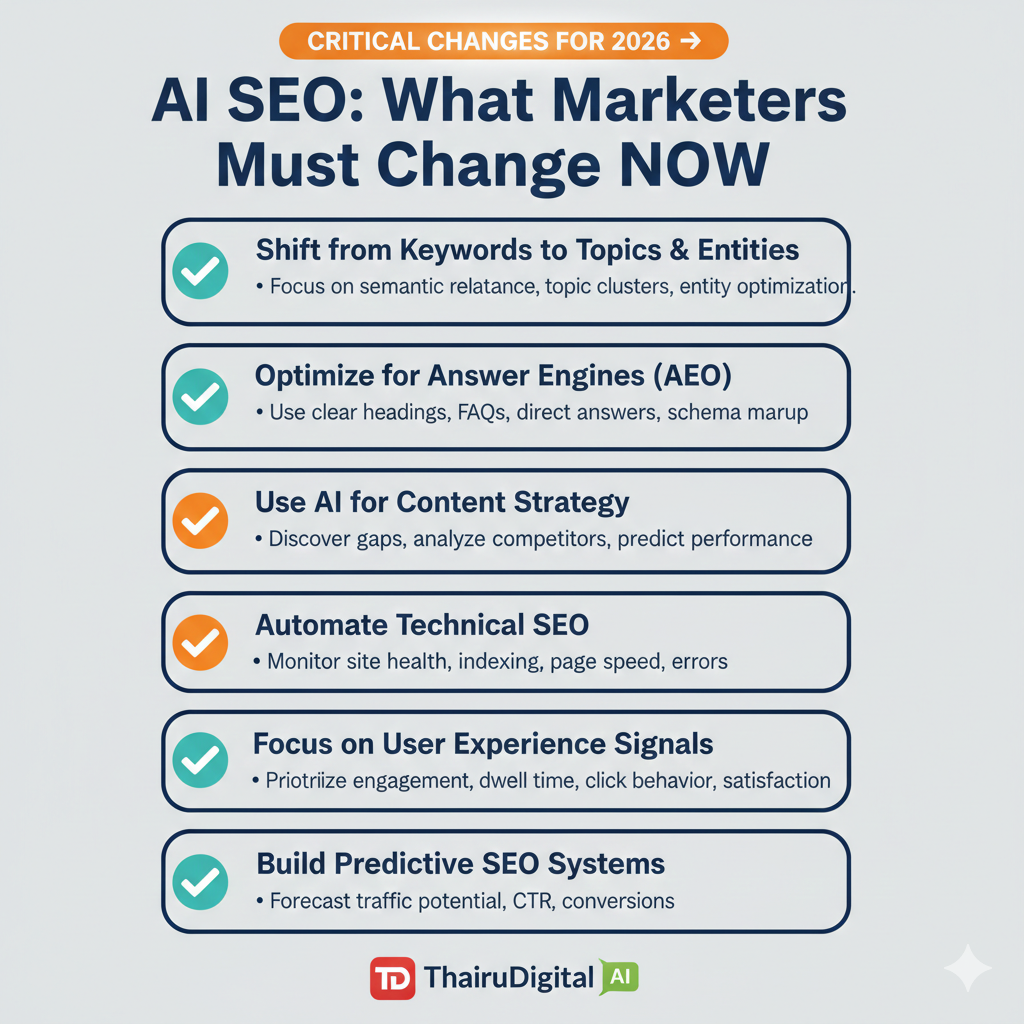
Shift from Keywords to Topics and Entities
Focus on:
● Semantic relevance
● Topic clusters
● Entity optimisation
This helps AI engines understand authority, not just word frequency.
✅ Optimise for Answer Engines (AEO)
Structure content with:
● Clear headings
● FAQs
● Direct answers
● Schema markup
So AI tools and voice assistants can extract your content easily
✅ Use AI for Content Strategy
Apply AI to:
● Discover content gaps
● Analyse competitors
● Predict performance
● Generate outlines
SEO becomes strategic, not reactive.
✅ Automate Technical SEO
AI can monitor:
● Site health
● Indexing
● Page speed
● Errors
Automation prevents SEO issues before they hurt rankings.
✅ Focus on User Experience Signals
AI SEO prioritises:
● Engagement
● Dwell time
● Click behaviour
● Satisfaction
SEO is now user experience engineering.
Benefits of Adopting AI SEO
Marketers who move to AI SEO gain:
● Faster ranking improvements
● Higher-quality traffic
● Better conversion rates
● Predictable growth
● Competitive advantage
AI SEO turns optimisation into a growth system.
How to Start Using AI SEO Today
Simple roadmap:
1. Audit your SEO with AI
2. Map user intent
3. Build topic clusters
4. Add FAQ + schema
5. Optimise for AEO
6. Automate monitoring
7. Improve continuously
Why AI SEO Is the Future
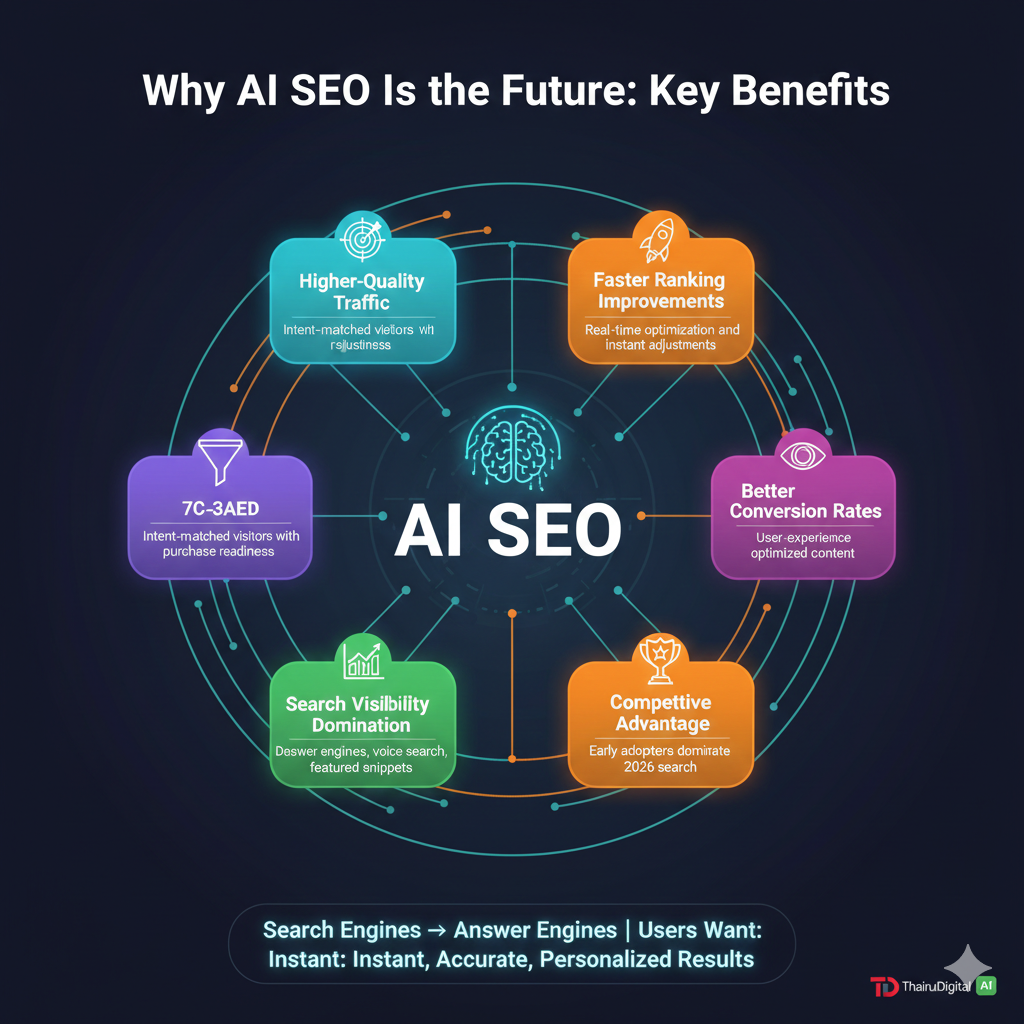
Search engines are becoming answer engines. Users want instant, accurate, and personalised results.
AI SEO aligns content with how search actually works in 2026 — through intelligence, automation, and intent modelling.
Those who adapt now will dominate visibility tomorrow.
Final Thoughts
Traditional SEO is no longer dead — but it is no longer enough.
Marketers must combine classic foundations with AI intelligence, predictive modelling, and search engine optimisation to stay competitive.
AI SEO is not optional. It is the future of search visibility.
FAQs
1. What is AI SEO?
AI SEO uses artificial intelligence to analyse, optimise, and predict SEO performance using intent, automation, and data modelling instead of manual guesswork.
2. Is traditional SEO still useful?
Yes, but it must be combined with AI SEO techniques like intent analysis, automation, and AEO to remain effective.
3. What is Answer Engine Optimisation (AEO)?
AEO focuses on structuring content so AI systems, voice search, and featured snippets can extract and display answers directly.
4. Can small businesses use AI SEO?
Absolutely. Many AI SEO tools are affordable and scalable for freelancers, agencies, and small teams.
5. Does AI SEO replace SEO experts?
No. AI supports experts by handling data and automation while humans focus on strategy and creativity.
Ready to upgrade your SEO for the AI era?
�� ThairuDigital helps brands transition from traditional SEO to AI-powered SEO strategies that drive traffic, visibility, and conversions. We combine smart automation with proven optimisation to keep you ahead in 2026 and beyond.
�� Visit ThairuDigital today and start dominating search with AI SEO.