
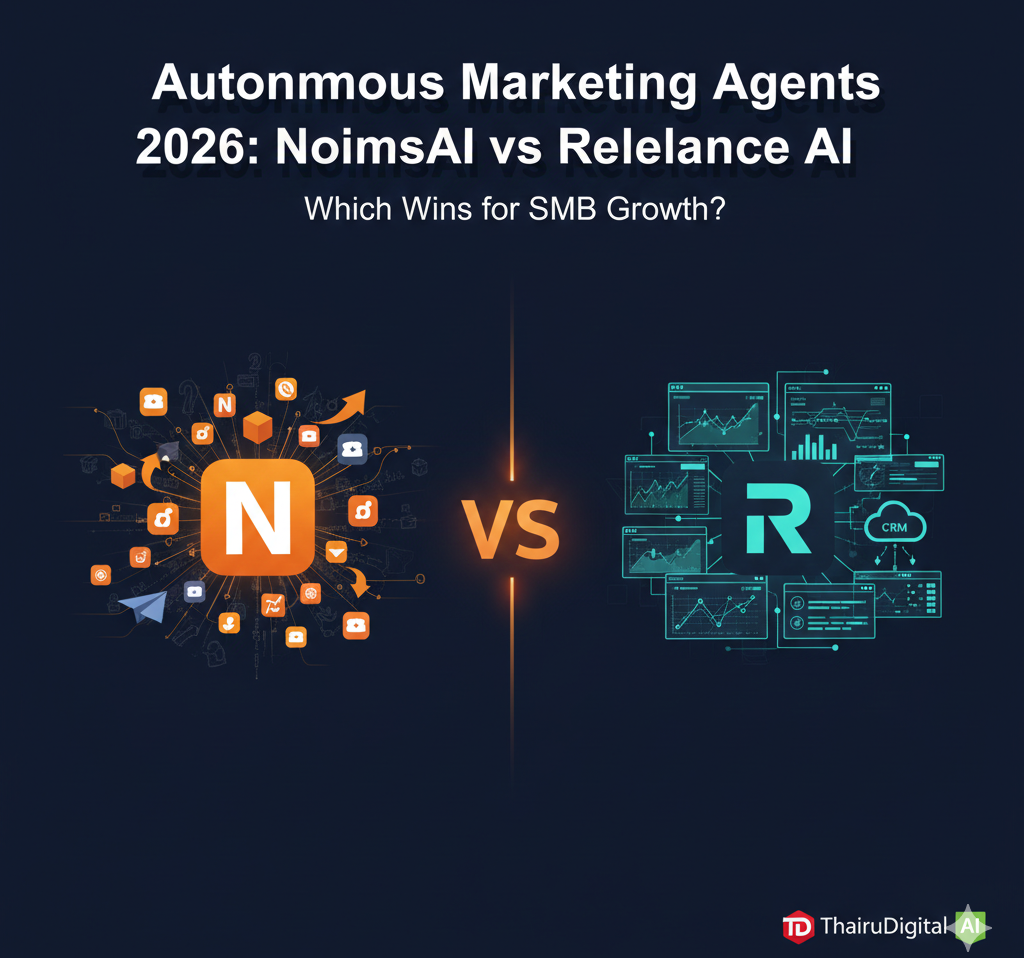
What Are Autonomous Marketing Agents in 2026?
Autonomous marketing agents in 2026 are AI-powered systems that independently plan, execute, optimise, and report on marketing campaigns with minimal human intervention. Unlike traditional marketing automation tools that follow predefined rules, these agents use reasoning, contextual memory, and performance feedback loops to make decisions dynamically.
For SMBs, this represents a shift from manual marketing management to AI-operated growth systems.
Instead of coordinating multiple tools, freelancers, and internal resources, businesses can deploy AI agents that manage:
- Content creation
- Publishing schedules
- Engagement responses
- Performance tracking
- Optimization cycles
The result is continuous marketing execution without constant oversight.
At a strategic level, autonomous marketing agents are becoming a growth multiplier for resource-constrained teams.
Evolution from Marketing Automation to Fully Autonomous Campaign Execution
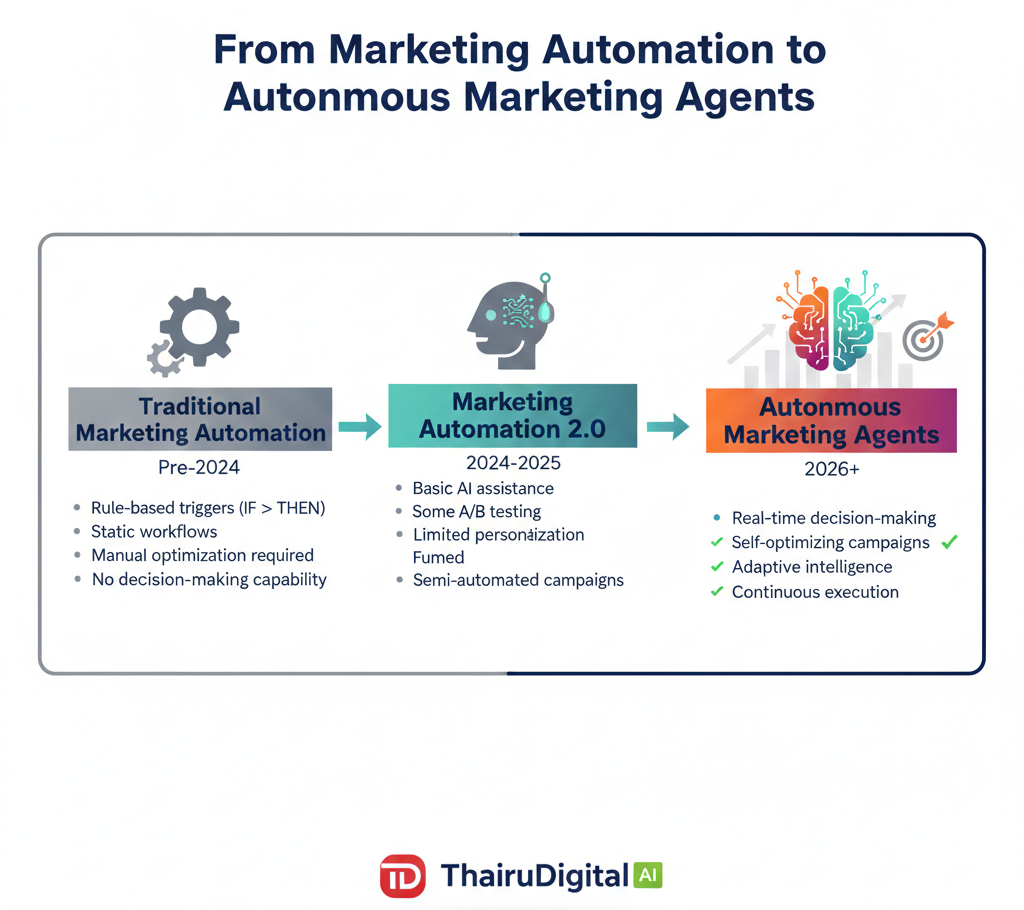
Marketing automation in the past focused on rule-based triggers:
- “If user downloads ebook → send email sequence”
- “If lead score > X → notify sales”
Autonomous agents go further. They:
- Analyze campaign performance in real time
- Adjust messaging based on engagement data
- Test variations automatically
- Reallocate focus to higher-performing channels
This evolution transforms marketing from reactive automation to adaptive intelligence.
In 2026, the difference between automation and autonomy is decision-making capability.
Core Capabilities of Modern AI Marketing Agents
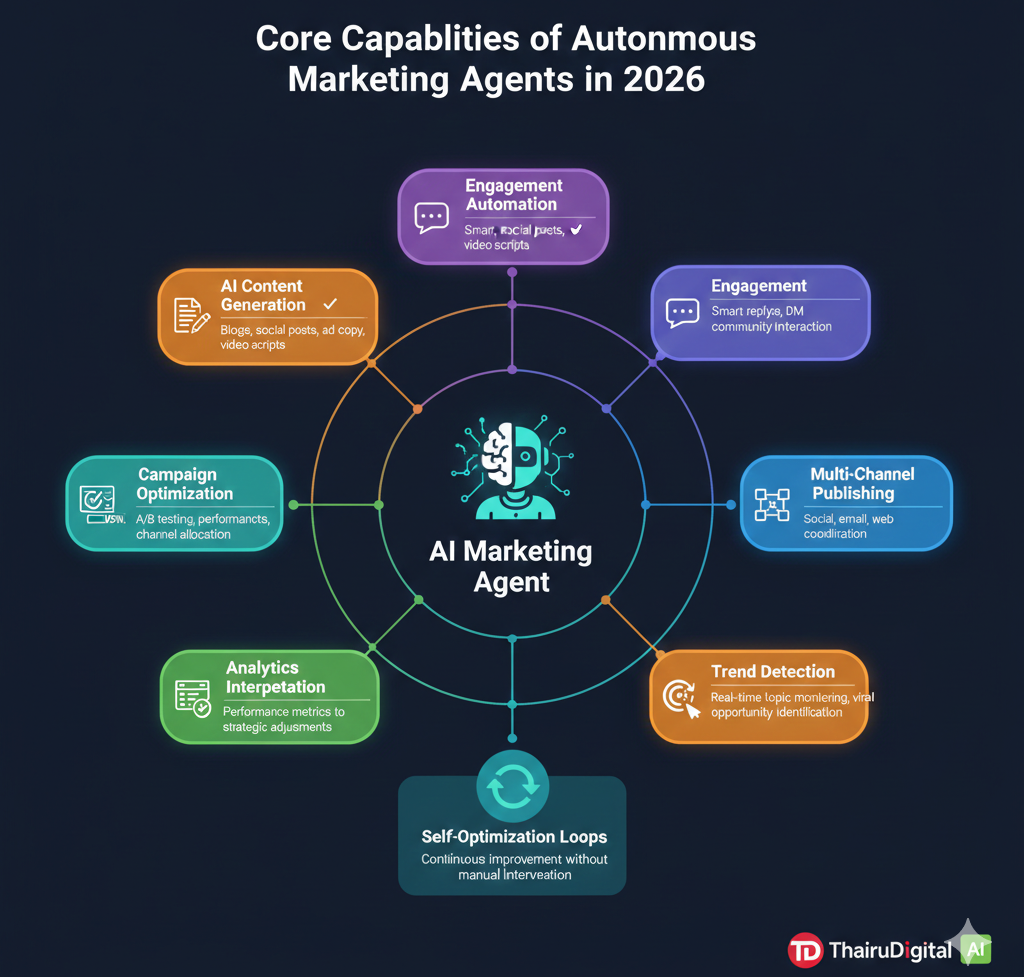
Modern autonomous marketing agents typically include:
- AI-Driven Content Generation
Blogs, social posts, captions, ad copy, video scripts, and landing page variations. - Engagement Automation
Smart replies to comments and DMs based on context and tone. - Campaign Optimisation Loops
Continuous A/B testing and performance adjustments. - Multi-Channel Publishing
Coordinated distribution across social media, email, and web platforms. - Analytics Interpretation
Translating performance metrics into strategic adjustments.
These capabilities allow SMBs to operate like fully staffed marketing departments — without equivalent payroll costs.
Why SMBs Are Rapidly Adopting Hands-Off Marketing Systems
SMBs face increasing pressure to:
- Publish more content
- Maintain consistent brand presence
- Generate predictable leads
- Compete with larger enterprises
However, hiring full in-house marketing teams is expensive and difficult to scale quickly.
Autonomous marketing agents solve this by delivering:
- Continuous content velocity
- Reduced management overhead
- Faster campaign iteration
- Improved ROI tracking
In 2026, the advantage is not just producing content — it’s deploying AI systems that operate marketing as an ongoing, self-optimising process.
The Role of AI in Viral Content and Engagement Automation
Viral growth is increasingly driven by algorithmic timing, trend detection, and audience responsiveness. Autonomous marketing agents monitor engagement signals and adjust outputs accordingly.
For example, an AI agent may:
- Detect high-performing topics
- Generate multiple content variations
- Prioritise distribution on the best-performing platform
- Engage with audience responses in real time
This creates a feedback loop where performance informs future content automatically.
This is the foundation for comparing platforms like NoimosAI and Relevance AI, where the real distinction lies in how intelligently and autonomously these systems operate.
What Makes NoimosAI a Strong Choice for Autonomous Marketing in 2026?

NoimosAI positions itself as a high-autonomy marketing execution engine designed to run content and engagement workflows with minimal human intervention. Its core appeal lies in simplifying marketing operations for founders, creators, and SMBs who want consistent growth without managing complex campaign structures manually.
Unlike flexible AI workflow builders, NoimosAI leans toward pre-configured campaign intelligence — meaning the platform is optimised for rapid deployment and fast content velocity.
For SMBs prioritising speed and visibility, this approach can be highly attractive.
Platform Architecture and Campaign Autonomy Model
NoimosAI is designed around autonomous campaign loops. Rather than asking users to build complex agent workflows, the platform typically focuses on:
- Content ideation based on trending signals
- Automated generation of posts and captions
- Scheduled publishing
- Engagement response automation
- Performance monitoring
The system emphasises reduced configuration friction. Users set objectives (growth, engagement, brand awareness), and the platform executes within those parameters.
This makes it especially appealing for founder-led businesses that want marketing running in the background.
Content Creation and Viral Growth Capabilities
NoimosAI’s growth engine centres heavily on viral-oriented content production. Its strength lies in:
- Trend-based content suggestions
- Short-form optimized outputs
- Hook-focused copy generation
- Rapid content batch creation
Because SMB growth in 2026 often depends on social algorithm momentum, NoimosAI’s design leans toward maximising content volume and discoverability.
This is particularly useful for:
- Personal brands
- Coaches and consultants
- Early-stage startups
- Social-first businesses
However, businesses requiring highly customised data workflows may find it less flexible than modular AI platforms.
Engagement Automation and Community Interaction
Beyond content creation, NoimosAI aims to automate audience interaction by:
- Generating context-aware replies
- Supporting DM automation
- Monitoring engagement spikes
- Encouraging follow-up interactions
This reduces the manual effort typically required to sustain social growth.
For SMBs without dedicated community managers, this can significantly increase response speed and consistency.
Best-Fit Business Profiles for NoimosAI
NoimosAI is generally best suited for:
- Founder-led SMBs seeking hands-off growth
- Brands prioritising content velocity over deep data customisation
- Social-first marketing strategies
- Companies looking for quick implementation
It may be less ideal for:
- Businesses requiring complex CRM integrations
- Teams wanting highly customizable AI workflows
Data-heavy B2B organizations
NoimosAI at a Glance
| Category | NoimosAI Strength |
| Deployment Speed | Fast setup, minimal configuration |
| Content Generation | High-volume, trend-focused output |
| Engagement Automation | Built-in automated responses |
| Custom Workflow Flexibility | Moderate |
| Best For | Founder-led, social-driven SMB growth |
NoimosAI’s value proposition is clear: simplify marketing execution and increase content velocity with minimal operational complexity.
What Makes Relevance AI a Strong Contender for SMB Marketing Growth in 2026?
Relevance AI approaches autonomous marketing from a fundamentally different angle than NoimosAI. Instead of emphasisingRelevance AI operates more like a modular AI builder than a plug-and-play content engine.
Businesses can:
- Create specialised AI agents
- Define workflows and task dependencies
- Integrate external tools (CRM, analytics, support systems)
- Set logic-based decision rules
This allows companies to design marketing systems that reflect their internal processes rather than adapting to predefined campaign templates.
The trade-off is complexity: implementation may require more planning compared to turnkey marketing platforms. Pre-configured campaign execution and rapid content velocity, Relevance AI positions itself as a customizable AI workflow orchestration platform.
For SMBs that prioritise data intelligence, structured automation, and cross-system coordination, Relevance AI offers deeper flexibility and strategic control.
In 2026, as marketing becomes increasingly data-driven, this architectural difference matters.
Platform Architecture and Custom Agent Configuration
Relevance AI operates more like a modular AI builder than a plug-and-play content engine.
Businesses can:
- Create specialised AI agents
- Define workflows and task dependencies
- Integrate external tools (CRM, analytics, support systems)
- Set logic-based decision rules
This allows companies to design marketing systems that reflect their internal processes rather than adapting to predefined campaign templates.
The trade-off is complexity: implementation may require more planning compared to turnkey marketing platforms.
Data-Driven Personalisation and Campaign Intelligence
Where NoimosAI leans toward content velocity, Relevance AI leans toward structured intelligence.
Its strengths include:
- Data enrichment workflows
- Customer segmentation logic
- Predictive scoring systems
- Behavioural pattern analysis
- Dynamic content adaptation based on user data
For B2B SMBs or companies managing large contact databases, this capability enables more personalized and performance-driven campaigns.
Instead of optimising for virality alone, Relevance AI optimises for measurable outcomes and customer lifecycle alignment.
Multi-Channel Automation and System Integrations
Relevance AI is built to connect systems — not just publish content.
It integrates with:
- CRM platforms
- Email automation tools
- Internal databases
- Analytics systems
- Support platforms
This allows AI agents to operate across departments, not just marketing.
For example:
- A lead engages with content
- The AI updates CRM scoring
- A personalised email is triggered
- Sales is notified based on the qualification logic
This creates a coordinated AI workflow instead of isolated campaign execution.
Strategic Fit for Different SMB Profiles
Relevance AI is generally best suited for:
- Data-driven SMBs
- B2B companies with structured funnels
- Teams needing workflow customisation
- Businesses prioritising CRM-aligned automation
It may be less ideal for:
- Founder-led brands wanting immediate plug-and-play execution
- Social-first growth strategies focused primarily on content volume
Relevance AI at a Glance
| Category | Relevance AI Positioning |
| Campaign Autonomy | Configurable, logic-based workflows |
| Content Focus | Data-driven personalization over volume |
| Engagement Automation | Workflow-triggered and CRM-aligned |
| Customization Depth | High |
| Ideal For | Structured, data-heavy SMB growth |
NoimosAI vs Relevance AI – Which Platform Delivers Better ROI for SMB Growth?
Choosing between NoimosAI and Relevance AI is not about which platform is “better” — it’s about which growth model aligns with your SMB’s operational maturity, data structure, and marketing objectives.
The key difference lies in execution philosophy:
- NoimosAI optimises for speed and content-driven visibility.
- Relevance AI optimises for structured, data-driven marketing orchestration.
Below is a strategic comparison across the dimensions that matter most for SMB ROI in 2026.
1. Campaign Autonomy Depth
NoimosAI provides strong pre-configured campaign loops that reduce setup friction. It is ideal for businesses that want AI to execute marketing with minimal customisation.
Relevance AI offers deeper workflow autonomy, but requires structured configuration. It enables multi-step decision systems connected to CRM and internal databases.
Strategic Insight:
If speed and simplicity are the priority → NoimosAI.
If long-term system intelligence is the goal → Relevance AI.
2. Content Velocity vs Personalisation Intelligence
NoimosAI excels at high-volume, trend-driven content production optimised for discoverability and engagement.
Relevance AI emphasises segmentation, behavioural triggers, and lifecycle marketing — prioritising relevance over raw output volume.
Strategic Insight:
Social-first brands benefit more from NoimosAI.
B2B and funnel-driven SMBs benefit more from Relevance AI.
3. Ease of Implementation
NoimosAI offers faster onboarding and lower technical barriers.
Relevance AI may require more strategic planning and workflow mapping, but enables more advanced automation once configured.
Strategic Insight:
Founders with limited technical resources → NoimosAI.
Teams with operational structure → Relevance AI.
4. Long-Term Scalability
NoimosAI scales well in content production and engagement growth.
Relevance AI scales better in complex system coordination, data enrichment, and CRM-based automation.
Strategic Insight:
Short-to-mid term growth acceleration → NoimosAI.
Mid-to-long term infrastructure growth → Relevance AI.
Strategic Comparison Matrix for SMB Decision-Making
| Growth Factor | NoimosAI | Relevance AI | Strategic Winner |
| Setup Speed | Very Fast | Moderate | NoimosAI |
| Content Velocity | High | Moderate | NoimosAI |
| Data Personalization | Basic–Moderate | Advanced | Relevance AI |
| CRM & Workflow Integration | Limited–Moderate | Strong | Relevance AI |
| Engagement Automation | Strong Social Focus | Workflow-Based | Depends on use case |
ROI Framing for SMB Leaders
For SMB growth in 2026, ROI depends on one question:
Are you optimising for visibility or operational intelligence?
- If your priority is building attention, brand awareness, and content momentum → NoimosAI may deliver faster visible returns.
- If your priority is building an AI-driven marketing system aligned with sales, CRM, and lifecycle automation → Relevance AI offers stronger long-term leverage.
The real winner depends on the growth architecture of your business.
Which Platform Should SMBs Choose Based on Their Growth Stage?

The decision between NoimosAI and Relevance AI becomes much clearer when viewed through the lens of business growth stage. Different stages require different levels of automation depth, customization, and operational structure.
Rather than asking which platform is better, SMB leaders should ask: What does my business need right now — speed or system intelligence?
Early-Stage SMBs: Prioritising Visibility and Momentum
Early-stage companies often struggle with one core challenge: attention.
At this stage, businesses need:
- Consistent content output
- Strong social presence
- Rapid audience growth
- Minimal operational complexity
NoimosAI is typically better suited here because it reduces setup friction and accelerates content velocity. Founder-led brands and small teams can deploy campaigns quickly without building complex automation frameworks.
For startups validating offers or building brand awareness, fast execution often matters more than deep personalization logic.
Strategic Fit: NoimosAI.
Growth-Stage SMBs: Balancing Visibility with Conversion
As SMBs move into growth mode, marketing shifts from pure awareness to conversion optimization.
At this stage, companies need:
- Lead qualification systems
- Funnel alignment with sales
- Audience segmentation
- Performance tracking beyond surface metrics
Here, the choice becomes more nuanced.
NoimosAI can continue supporting content and engagement, but Relevance AI begins to offer stronger advantages if the business has structured CRM data and defined sales processes.
If growth-stage SMBs are starting to build repeatable pipelines rather than just audience growth, Relevance AI may provide better long-term leverage.
Strategic Fit: Depends on operational maturity.
Scaling SMBs: Building Marketing Infrastructure
Scaling businesses face a different challenge: coordination and predictability.
They require:
- Integrated CRM workflows
- Behavioral segmentation
- Lifecycle automation
- Cross-channel orchestration
- Data-driven optimization
At this level, Relevance AI typically becomes the stronger choice. Its customizable agent workflows and system integrations allow marketing to align closely with sales and operations.
The focus shifts from “posting consistently” to “building intelligent growth systems.”
Strategic Fit: Relevance AI.
Founder-Led vs Operations-Led Businesses
Another way to frame the decision:
- Founder-led, content-driven brands often benefit from NoimosAI’s simplicity and speed.
- Operations-led, data-structured businesses benefit more from Relevance AI’s customization and orchestration depth.
This distinction is critical in 2026, where AI tools are abundant but strategic implementation determines ROI.
The Strategic Takeaway
If your SMB needs:
- Immediate visibility
- Fast deployment
- High content velocity
→ NoimosAI is likely the better short-term growth accelerator.
If your SMB needs:
- Structured automation
- CRM-aligned intelligence
- Long-term marketing infrastructure
→ Relevance AI provides stronger scalability.
Ultimately, the winning platform is the one aligned with your growth architecture — not just your current marketing workload.
What Are the Future Trends for Autonomous Marketing Agents Beyond 2026?

Autonomous marketing agents are evolving rapidly. In 2026, they are already capable of executing campaigns with limited oversight — but the next phase goes beyond execution. The future lies in self-optimizing, predictive, and multi-agent marketing ecosystems.
For SMBs, this shift will redefine what “lean marketing teams” look like.
Increasing Campaign Self-Optimisation
Today’s autonomous agents can adjust messaging and test variations. Tomorrow’s systems will autonomously restructure entire campaign strategies.
Future capabilities will include:
- Real-time budget reallocation across channels
- Automated pivoting based on trend detection
- Dynamic audience targeting updates
- Continuous funnel optimisation without manual review
Instead of waiting for marketers to interpret reports, agents will proactively adjust strategy based on performance thresholds.
This reduces reaction time and increases compounding growth.
AI-Led Personal Brand and Content Ecosystems
By late 2026 and beyond, autonomous marketing agents will increasingly manage personal brands and executive visibility.
This includes:
- Thought leadership content generation
- Cross-platform narrative alignment
- Automated engagement loops
- Reputation monitoring
For founder-led SMBs, AI agents will function as always-on digital brand managers — maintaining authority, consistency, and audience growth without daily manual input.
Predictive Content Performance Modelling
The next generation of marketing agents will not just analyse past performance — they will predict future outcomes.
Advancements will likely include:
- Predicting which content formats will trend
- Modelling engagement probability before publishing
- Forecasting campaign ROI scenarios
- Identifying churn risks through engagement behaviour
This shifts marketing from experimentation-heavy to probability-informed execution.
For SMBs, that means less guesswork and more calculated growth.
Expansion into Multi-Agent Marketing Systems
Single marketing agents are already powerful. The next phase involves coordinated AI teams.
Future systems will include:
- A Strategy Agent defining quarterly objectives
- A Content Agent producing assets
- An Engagement Agent managing a community
- A Data Agent optimising funnels
- A Revenue Agent aligning with sales goals
This mirrors enterprise-level marketing operations — but accessible to SMBs.
The real competitive advantage will not come from using one AI tool, but from orchestrating multiple intelligent agents into a cohesive growth system.
Strategic Implication for SMB Leaders
The trend is clear: marketing is moving from tool usage to AI infrastructure.
Businesses that adopt autonomous marketing agents early will benefit from:
- Faster execution cycles
- Lower operational overhead
- Continuous optimization
- Stronger data-driven decisions
By 2027, companies relying purely on manual marketing processes may struggle to compete with AI-augmented competitors operating at significantly higher velocity.
Final Thoughts
Autonomous marketing agents like NoimosAI and Relevance AI are redefining how SMBs approach growth in 2026. NoimosAI excels at speed, content velocity, and hands-off visibility, while Relevance AI delivers structured workflows, deep personalisation, and long-term operational intelligence. The right choice depends on your business stage, growth objectives, and resource structure. Forward-looking SMBs should embrace these AI agents not just as tools, but as strategic growth partners — laying the foundation for more predictive, coordinated, and ROI-driven marketing in the years ahead.
Frequently Asked Questions (FAQs)
1. What are autonomous marketing agents, and how do they differ from traditional marketing automation?
Autonomous marketing agents are AI-powered systems that independently plan, execute, and optimize campaigns with minimal human input. Unlike traditional automation, which follows static rules, autonomous agents continuously analyse performance, adapt strategies, and make decisions dynamically for maximum ROI.
2. How do NoimosAI and Relevance AI differ for SMB growth?
NoimosAI focuses on rapid content generation, hands-off social engagement, and speed-to-market, making it ideal for founder-led or early-stage SMBs. Relevance AI emphasises customizable workflows, CRM integration, and data-driven personalisation, suited for growth-stage or scaling SMBs with structured operational processes.
3. Can SMBs deploy these AI agents without technical expertise?
Yes, but the ease of deployment depends on the platform. NoimosAI is designed for plug-and-play use with minimal setup, while Relevance AI requires workflow mapping and configuration, offering more flexibility but a slightly steeper learning curve.
4. What future trends should SMBs prepare for with autonomous marketing agents?
Future trends include multi-agent orchestration, predictive content modelling, AI-managed personal brands, and fully self-optimising campaigns. SMBs adopting these agents early can gain a competitive advantage by automating growth, reducing operational overhead, and making data-driven decisions faster.
5. How can businesses measure the ROI of using autonomous marketing agents?
ROI can be tracked through key metrics like engagement rates, lead generation, conversions, customer acquisition cost, and time saved on manual marketing tasks. Comparing campaign performance before and after AI implementation provides clear insight into efficiency and growth impact.