
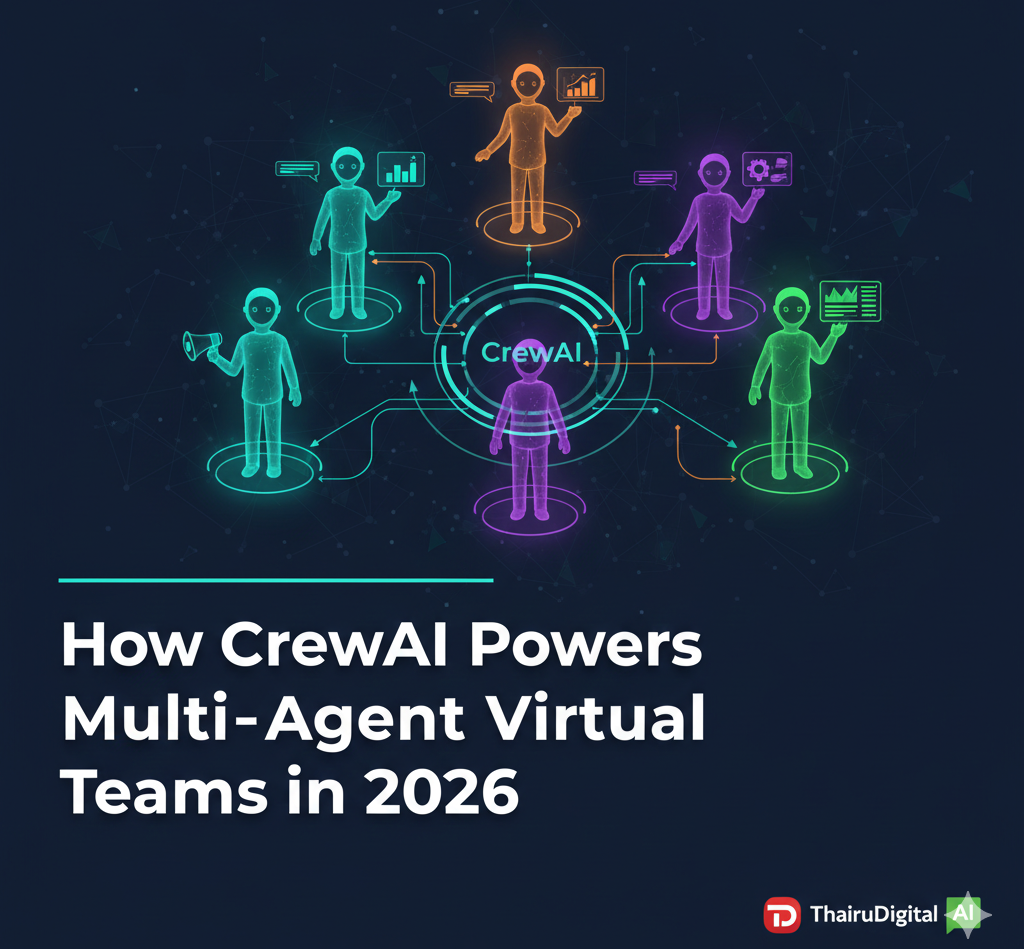
Multi-agent systems are redefining how mid-sized businesses operate in 2026. Instead of relying on a single AI tool, companies are deploying coordinated AI agents that collaborate like virtual teams. Platforms like CrewAI enable structured inter-agent workflows, allowing businesses to automate operations, marketing, project management, and customer service at scale. This guide explains how multi-agent systems work, why they matter for mid-sized companies, and how to implement them strategically for measurable ROI.
What Are Multi-Agent Systems and Why Are They Trending in 2026?

Multi-agent systems are coordinated networks of AI agents that work together as structured virtual teams. Instead of relying on a single AI assistant to complete isolated tasks, businesses deploy multiple specialised agents that collaborate, delegate responsibilities, and execute workflows collectively.
In 2026, this model is trending because mid-sized businesses are outgrowing simple automation tools. Growth now requires orchestration — not just task execution.
Definition of Multi-Agent Systems in a Business Context
In business environments, a multi-agent system consists of multiple AI agents assigned distinct roles, responsibilities, and decision boundaries.
Each agent:
- Has a specialised function (e.g., marketing analyst, CRM updater, operations coordinator)
- Communicates with other agents
- Operates within defined permissions
- Escalates complex decisions when necessary
Rather than having a single AI handle everything, agents operate like departments within a company.
The Shift from Single AI Tools to Coordinated AI Teams
Earlier AI adoption focused on standalone tools:
- Chatbots
- Email assistants
- Content generators
- CRM automations
While helpful, these tools operate in silos. They do not coordinate intelligently across systems.
The 2026 shift is toward agentic orchestration, where AI agents:
- Share context
- Pass tasks between one another
- Manage dependencies
- Optimise workflows automatically
Single tools automate tasks.
Multi-agent systems automate outcomes.
Why Mid-Sized Businesses Are Driving This Trend
Mid-sized businesses face increasing operational complexity:
- Multi-channel marketing
- Expanding sales pipelines
- Cross-department workflows
- Growing customer support demands
Hiring more coordinators increases payroll.
Multi-agent systems increase output without proportional headcount expansion.
At Thairu Digital, we are seeing scaling brands move toward coordinated AI teams to streamline marketing, CRM management, and operational workflows without overloading internal teams.
Example: Single Agent vs Multi-Agent System
| Feature | Single AI Tool | Multi-Agent System |
| Task Scope | Handles isolated tasks | Manages end-to-end workflows |
| Communication | Operates independently | Agents communicate and delegate |
| Decision-Making | Limited to one function | Distributed across specialised agents |
| Scalability | Requires additional tools | Expands by adding new agents |
| Business Impact | Improves efficiency | Transforms operations |
Why This Matters in 2026
Multi-agent systems represent the next stage of AI maturity. Instead of automating individual actions, businesses are now automating structured collaboration.
For mid-sized companies, this means:
- Faster execution
- Reduced operational bottlenecks
- Better cross-functional coordination
- Measurable productivity gains
And platforms like CrewAI are making this coordinated intelligence accessible without requiring enterprise-level infrastructure.
How Does CrewAI Enable Virtual AI Teams for Mid-Sized Businesses?
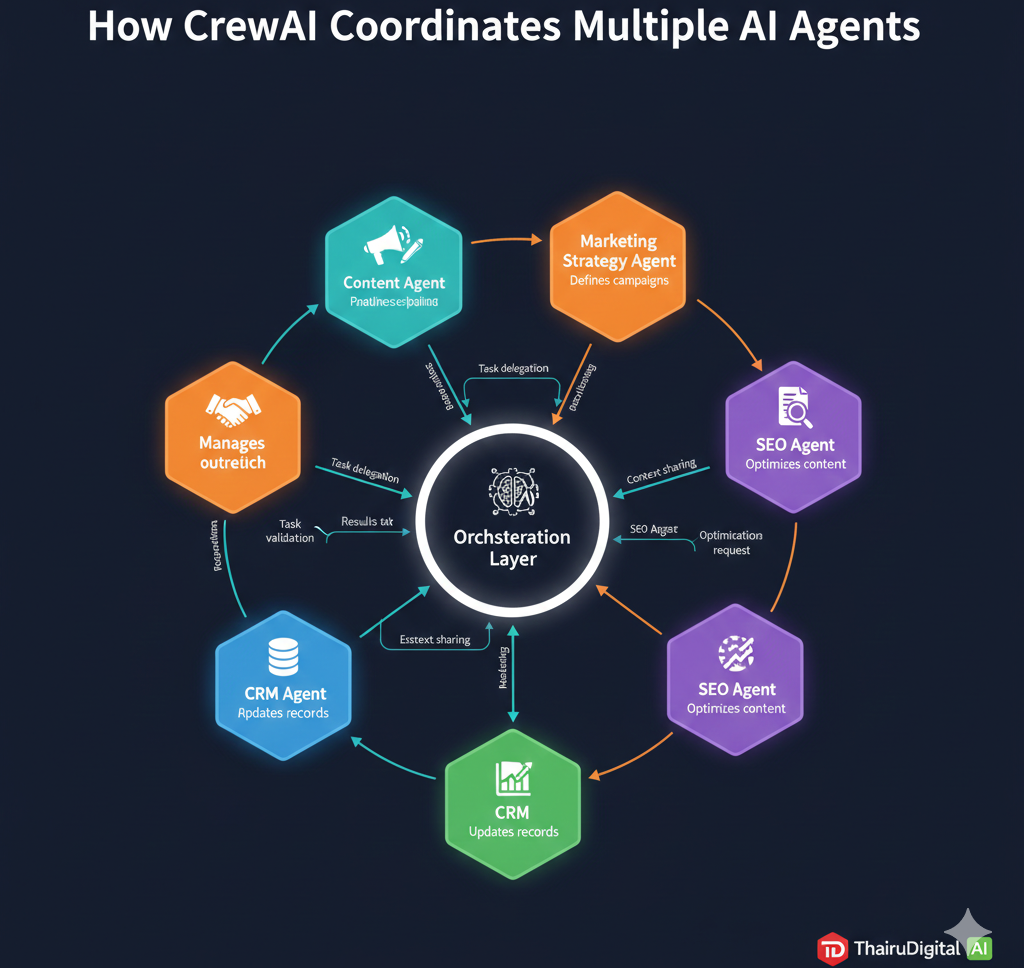
CrewAI is one of the leading orchestration frameworks enabling structured multi-agent collaboration. Instead of deploying isolated AI tools, CrewAI allows businesses to design role-based agents that communicate, delegate tasks, and execute workflows together as a coordinated virtual team.
For mid-sized businesses, this means moving beyond automated scripts into intelligent workflow orchestration — where AI agents operate like departments within your company.
At Thairu Digital, we view CrewAI not just as a tool, but as infrastructure for scalable AI operations.
CrewAI Architecture and Role-Based Agent Design
CrewAI operates on a role-driven architecture. Each agent is assigned:
- A defined role (e.g., Sales Strategist, Content Creator, Operations Coordinator)
- A specific goal
- Access permissions
- Tools or integrations it can use
- Constraints for decision-making
This structure mirrors real organisational design. Instead of one general AI trying to do everything, businesses create specialised agents with focused expertise.
For example:
- A Marketing Strategy Agent defines campaign goals.
- A Content Agent produces assets.
- An SEO Agent optimises them.
- An Analytics Agent evaluates performance.
Each agent contributes within its role, improving accuracy and execution quality.
Task Delegation and Inter-Agent Communication Framework
One of CrewAI’s most powerful capabilities is structured delegation.
Agents don’t operate in isolation — they:
- Pass context between each other
- Request outputs from specialised agents
- Validate results before progressing
- Escalate complex decisions when needed
This enables multi-step workflows such as:
- Lead enters CRM.
- Lead Scoring Agent evaluates quality.
- Outreach Agent drafts personalised email.
- CRM Agent logs activity.
- Forecasting Agent updates revenue projections.
This coordination reduces manual oversight and eliminates workflow gaps.
Instead of humans managing every step, the AI system manages itself within defined boundaries.
Workflow Orchestration Across Departments
Mid-sized businesses often struggle with cross-department coordination. Marketing, sales, operations, and support work in parallel but lack seamless synchronisation.
CrewAI allows businesses to design inter-agent workflows that bridge these gaps.
Example:
- Marketing Agent launches a campaign.
- Analytics Agent tracks engagement.
- Sales Agent receives qualified leads automatically.
- Customer Success Agent initiates onboarding.
This creates a continuous operational loop rather than disconnected actions.
At Thairu Digital, we implement CrewAI systems that align marketing, CRM, and operational processes into a unified AI workflow — reducing bottlenecks and improving response speed.
Integration with CRM, Marketing, and Operations Systems
CrewAI does not replace existing systems. Instead, it orchestrates them.
Agents can integrate with:
- CRM platforms
- Email systems
- Marketing automation tools
- Analytics dashboards
- Project management software
This makes CrewAI ideal for mid-sized businesses already using multiple platforms but lacking coordination between them.
Rather than adding more tools, CrewAI connects them through intelligent agents that manage context and execution across systems.
Why This Matters for Mid-Sarket Businesses in 2026
Mid-sized companies are too complex for simple automation — yet often lack enterprise-level orchestration infrastructure.
CrewAI fills that gap by enabling:
- Structured AI delegation
- Cross-functional coordination
- Reduced human micro-management
- Scalable operational intelligence
This is where AI shifts from being an assistant to becoming a virtual operational layer.
How Do Multi-Agent Workflows Improve Operational Efficiency?

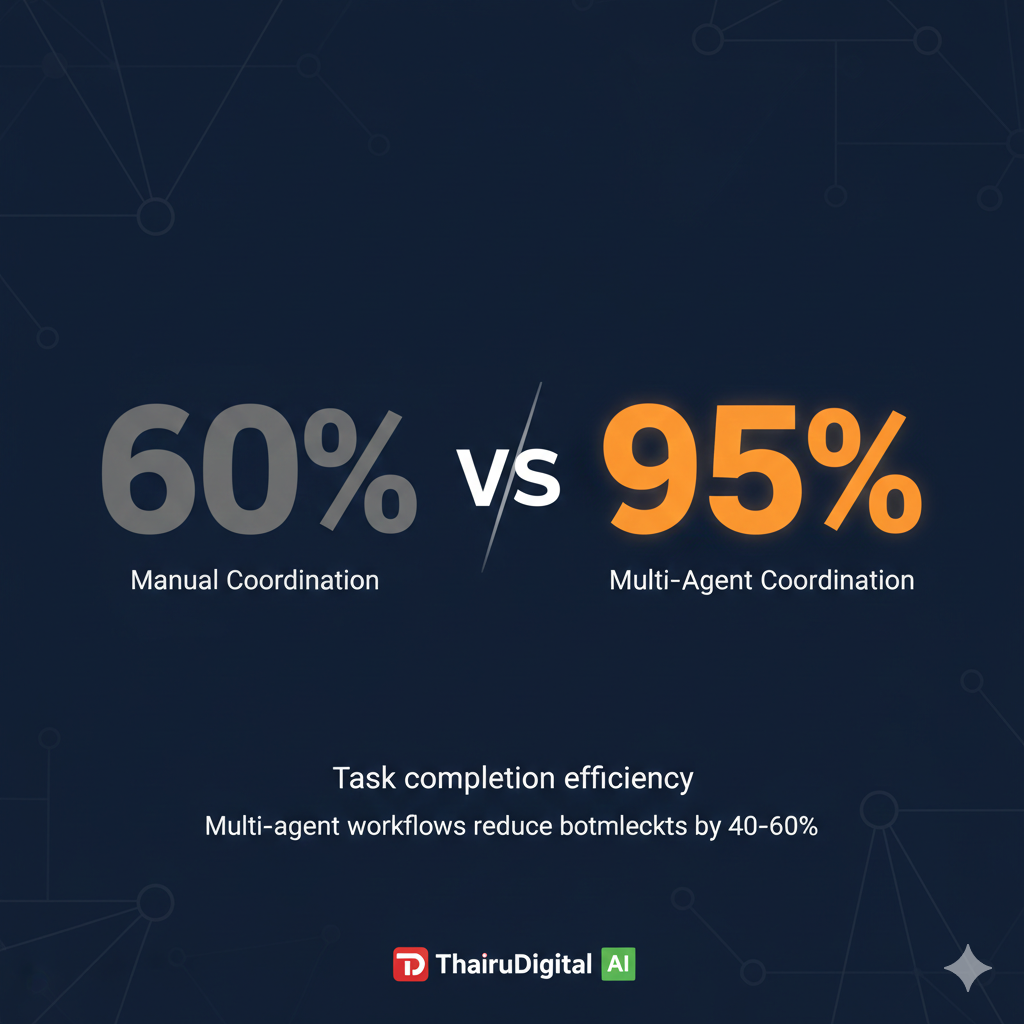
Multi-agent workflows improve operational efficiency by coordinating tasks across departments, reducing manual handoffs, and eliminating bottlenecks in complex processes. Instead of employees managing transitions between systems or teams, AI agents communicate and execute tasks seamlessly.
For mid-sized businesses, this shift reduces delays, improves accuracy, and accelerates decision-making.
At Thairu Digital, we implement multi-agent workflows specifically to reduce operational friction and create measurable time and cost savings across marketing, sales, and operations.
Coordinated Intelligence in Project Management
Project management in growing companies often suffers from communication gaps, missed deadlines, and dependency confusion.
Multi-agent systems solve this by assigning:
- A Planning Agent to define project scope
- A Task Allocation Agent to distribute responsibilities
- A Monitoring Agent to track progress
- A Reporting Agent to update leadership
Instead of relying on manual status meetings, agents automatically track milestones and escalate only when intervention is required.
Result: Fewer delays, improved transparency, and faster project completion cycles.
AI Agents Managing Sales and Marketing Pipelines
Marketing and sales alignment is one of the most common bottlenecks in mid-sized businesses.
With multi-agent coordination:
- A Marketing Agent generates and qualifies leads.
- A Lead Scoring Agent ranks prospects.
- An Outreach Agent initiates communication.
- A CRM Agent logs interactions.
- A Forecasting Agent updates pipeline projections.
Because agents share context, sales teams receive ready-to-convert leads rather than raw data.
Result: Shorter sales cycles and higher conversion rates.
Cross-Functional Automation Between Departments
Mid-sized businesses typically operate across multiple platforms and departments, but workflows are rarely synchronised.
Multi-agent systems enable:
- Automatic data sharing between departments
- Real-time updates across systems
- Reduced duplication of effort
- Seamless workflow continuation
For example:
A Customer Support Agent identifies recurring complaints.
A Product Insights Agent analyses patterns.
An Operations Agent adjusts internal processes.
A Marketing Agent updates messaging.
This creates operational intelligence instead of reactive problem-solving.
Reducing Bottlenecks Through Inter-Agent Collaboration
Bottlenecks often occur at transition points — when tasks move between departments or systems.
Multi-agent workflows eliminate these friction points by:
- Automating handoffs
- Managing dependencies
- Tracking completion status
- Escalating only true exceptions
Instead of waiting for email approvals or manual updates, agents coordinate instantly.
This significantly reduces:
- Delayed approvals
- Missed follow-ups
- Data entry errors
- Redundant work
Efficiency Impact Comparison
| Operational Area | Traditional Workflow | Multi-Agent Workflow | Efficiency Impact |
| Project Management | Manual tracking, meetings required | Automated milestone tracking and escalation | Faster completion cycles |
| Sales Pipeline | Manual lead handoff between teams | Automated scoring and outreach delegation | Higher conversion rates |
| Marketing Operations | Isolated campaign tools | Coordinated content, SEO, and analytics agents | Improved ROI optimisation |
| Customer Support | Reactive ticket handling | Pattern detection and proactive process updates | Reduced recurring issues |
| Cross-Department Workflows | Email-based coordination | Structured inter-agent delegation | Fewer bottlenecks |
Why This Matters for Mid-Sized Businesses
As companies grow, complexity increases faster than headcount.
Multi-agent workflows allow businesses to scale operations without scaling operational chaos.
Instead of hiring more coordinators, businesses deploy coordinated AI teams that:
- Improve speed
- Increase accuracy
- Reduce management overhead
- Provide data-backed insights
At Thairu Digital, we design multi-agent systems that don’t just automate tasks — they optimise entire workflows, turning AI into an operational advantage rather than a disconnected toolset.
What Is the Future of Multi-Agent Systems for Mid-Market Companies?
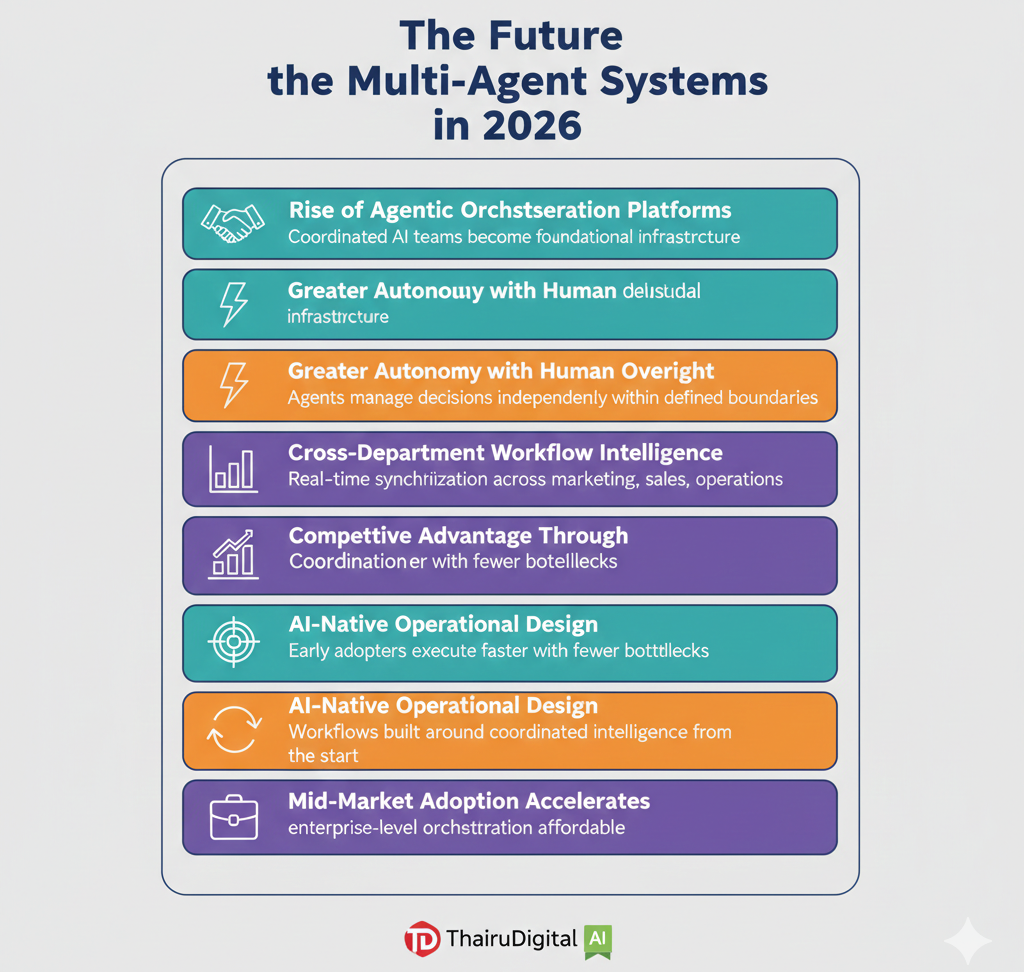
Multi-agent systems are moving from experimental frameworks to core operational infrastructure for mid-market companies. In 2026 and beyond, coordinated AI teams will become embedded in marketing, sales, operations, and customer experience workflows.
The future is not about adding more AI tools — it’s about orchestrating intelligent systems that work together seamlessly.
Rise of Agentic Orchestration Platforms
Agentic orchestration platforms like CrewAI are becoming foundational technology layers rather than optional add-ons. Instead of standalone AI assistants, businesses are deploying structured environments where agents collaborate, delegate tasks, and execute complex workflows.
This shift signals a move toward AI-native operations, where workflows are designed around coordinated intelligence from the start.
Increasing Autonomy with Human Oversight
Future multi-agent systems will operate with greater autonomy while maintaining human-defined boundaries. Agents will manage multi-step decisions independently, escalate exceptions intelligently, and continuously optimise performance based on feedback loops.
Human oversight will focus on strategy and governance — not micro-management.
This balance between autonomy and control will define successful AI adoption in mid-market environments.
Competitive Advantage of Coordinated AI Teams
Companies that adopt coordinated AI teams early will benefit from:
- Faster execution cycles
- Reduced operational bottlenecks
- Real-time cross-department alignment
- Data-driven decision-making
As competitors continue using disconnected tools, businesses leveraging multi-agent systems will operate with greater precision and speed.
At Thairu Digital, we see this as a strategic inflexion point — coordinated AI teams are becoming a differentiator, not just a productivity enhancer.
Strategic Implementation for Sustainable Growth
The long-term success of multi-agent systems depends on structured implementation. Businesses must define:
- Clear agent roles
- Access permissions
- Escalation rules
- Workflow boundaries
When deployed strategically, multi-agent systems enable sustainable growth without proportional increases in payroll or operational complexity.
For mid-market companies, the future belongs to those who move from automation to orchestration.
Final Thoughts
Multi-agent systems are no longer a futuristic concept — they are becoming the operational backbone of forward-thinking mid-market companies. As platforms like CrewAI make coordinated AI workflows more accessible, businesses now have the opportunity to move beyond isolated automation and build fully integrated virtual teams.
The real advantage lies not just in adopting AI, but in orchestrating it strategically. Companies that implement structured, role-based agent systems with clear oversight will unlock faster execution, smarter decision-making, and scalable growth.
Frequently Asked Questions (FAQs)
1. What is a multi-agent system in simple terms?
A multi-agent system is a setup where multiple AI agents work together as a coordinated team. Each agent has a specific role (e.g., research, analysis, execution), and they collaborate to complete complex tasks more efficiently than a single AI tool working alone.
2. How is CrewAI different from using one AI tool like ChatGPT?
CrewAI allows you to assign structured roles, goals, and workflows to multiple AI agents so they can collaborate on multi-step projects. Instead of asking one AI to do everything, you build a virtual team where each agent specializes in a defined function.
3. Are multi-agent systems suitable for mid-sized businesses?
Yes. Mid-sized businesses benefit significantly because they often need enterprise-level productivity without enterprise-level budgets. Multi-agent systems help automate operations, marketing, reporting, and project management without hiring large teams.
4. Do multi-agent systems replace human employees?
No. They are designed to augment human teams, not replace them. The most effective implementations combine AI coordination with human oversight, strategy, and decision-making to ensure quality and alignment with business goals.
5. What are the main benefits of implementing coordinated AI teams?
The key benefits include faster project execution, reduced operational costs, improved consistency, better cross-functional collaboration, and scalable automation that grows with the business.