
More strategic version:
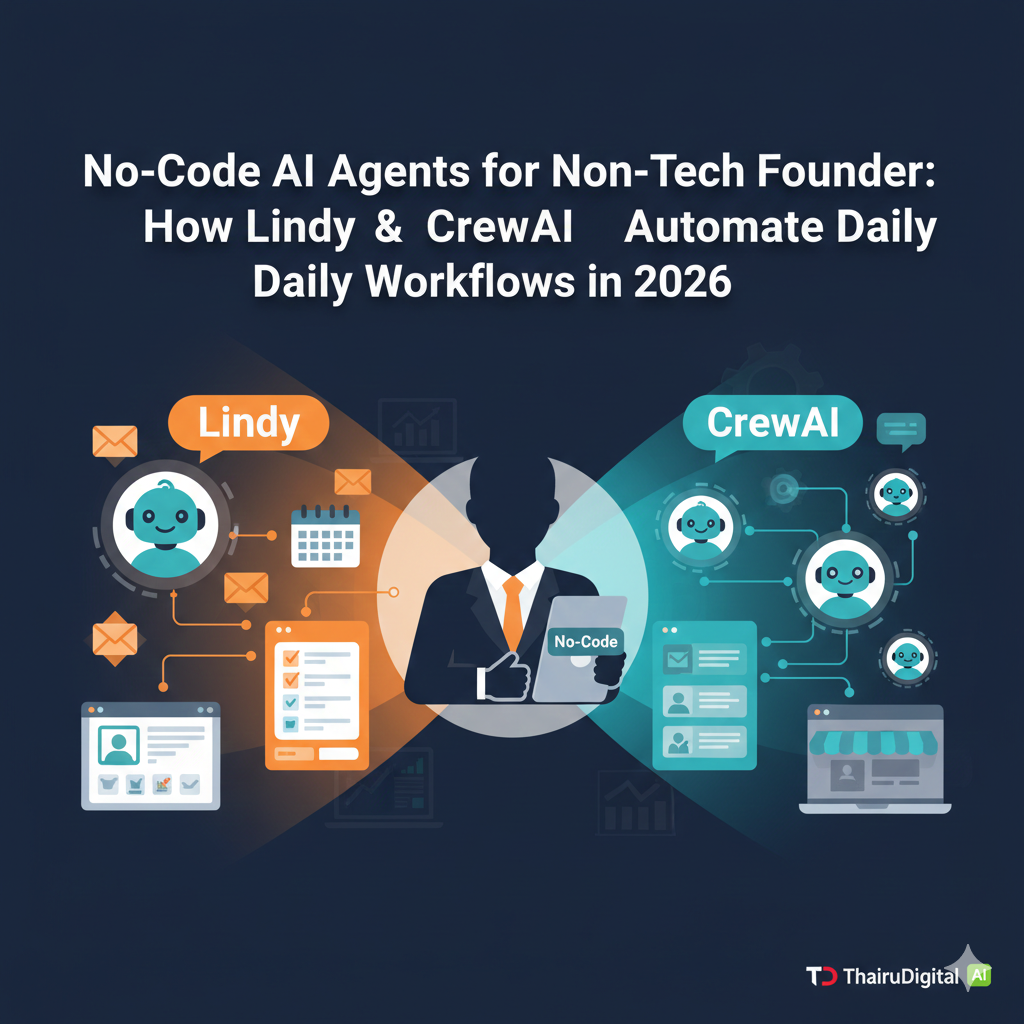
No-Code AI Agents are making advanced automation accessible to non-technical founders in 2026. Platforms like Lindy and CrewAI allow CEOs to automate daily workflows — from email and scheduling to multi-agent operational coordination — without writing code. Lindy excels at personal admin automation and context-aware task handling, while CrewAI enables structured multi-agent collaboration for broader business processes. For founders without dev teams, these tools provide a scalable path to AI-driven productivity and operational efficiency.
What Are No-Code AI Agents and Why Are They Trending in 2026?
No-Code AI Agents are AI-powered assistants that allow non-technical founders to automate daily workflows without writing code. Unlike traditional automation tools that require developer setup, no-code AI agents use natural language configuration and pre-built integrations to execute tasks across email, scheduling, CRM systems, and internal operations.
In 2026, these tools are trending because CEOs and small business owners want AI automation without hiring engineers. The demand for accessible, context-aware, and adaptive AI systems has grown rapidly as businesses seek to reduce operational overhead and increase productivity.
The Shift from Developer-Only AI to Founder-Friendly Automation
AI automation was once limited to companies with technical teams. Today, no-code platforms make it possible for founders to deploy AI agents using simple instructions and visual workflow builders.
This shift lowers the barrier to entry and allows non-technical entrepreneurs to compete with larger, tech-enabled companies.
What Makes an AI Agent “No-Code”?
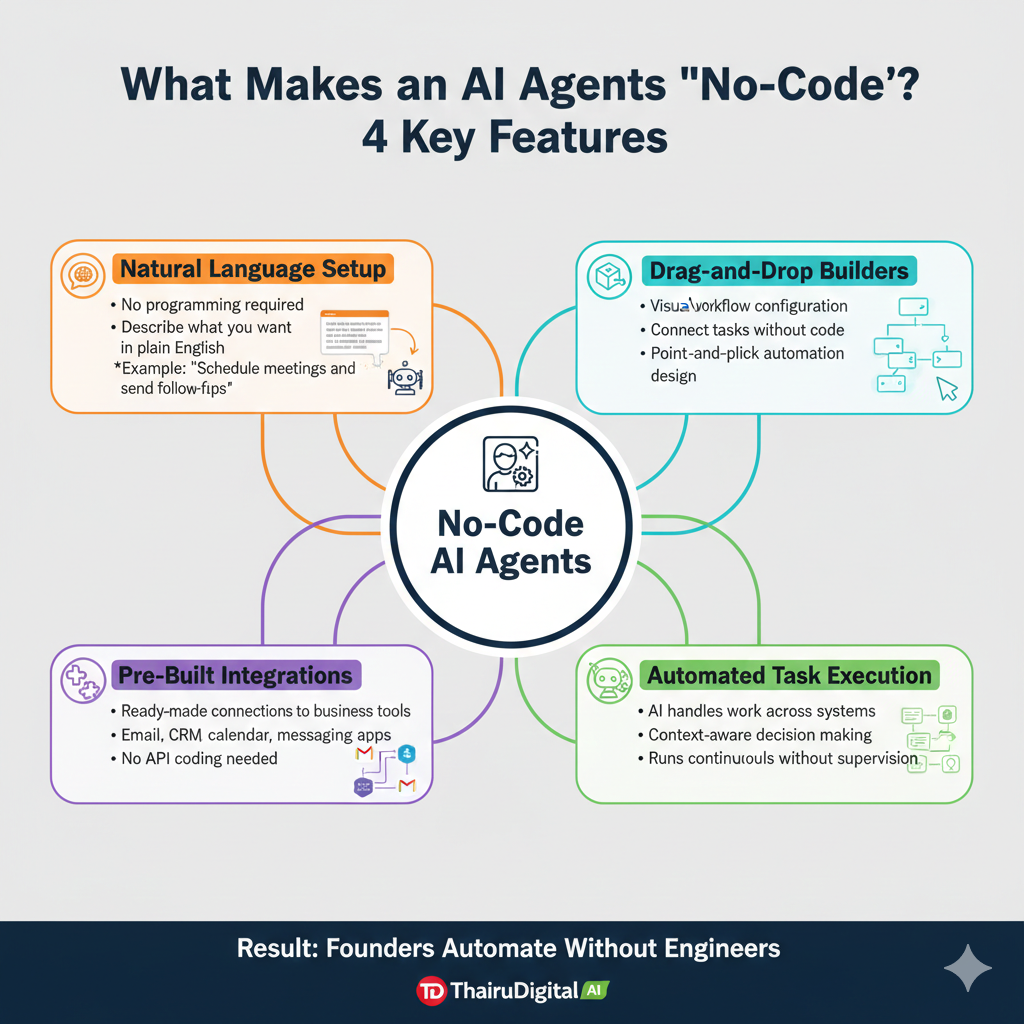
A no-code AI agent typically includes:
- Natural language setup (no programming required)
- Drag-and-drop workflow builders
- Pre-built integrations with business tools
- Automated task execution across systems
The goal is simplicity — enabling founders to automate workflows without technical complexity.
Why CEOs Without Dev Teams Are Adopting AI Agents
Non-tech founders are adopting no-code AI agents to:
- Automate repetitive admin tasks
- Manage inbox and scheduling
- Streamline internal operations
- Reduce hiring costs
- Increase decision-making efficiency
For SMB leaders in 2026, no-code AI agents are no longer experimental tools — they are becoming essential productivity infrastructure.
How Does Lindy Help Non-Tech Founders Automate Daily Workflows?
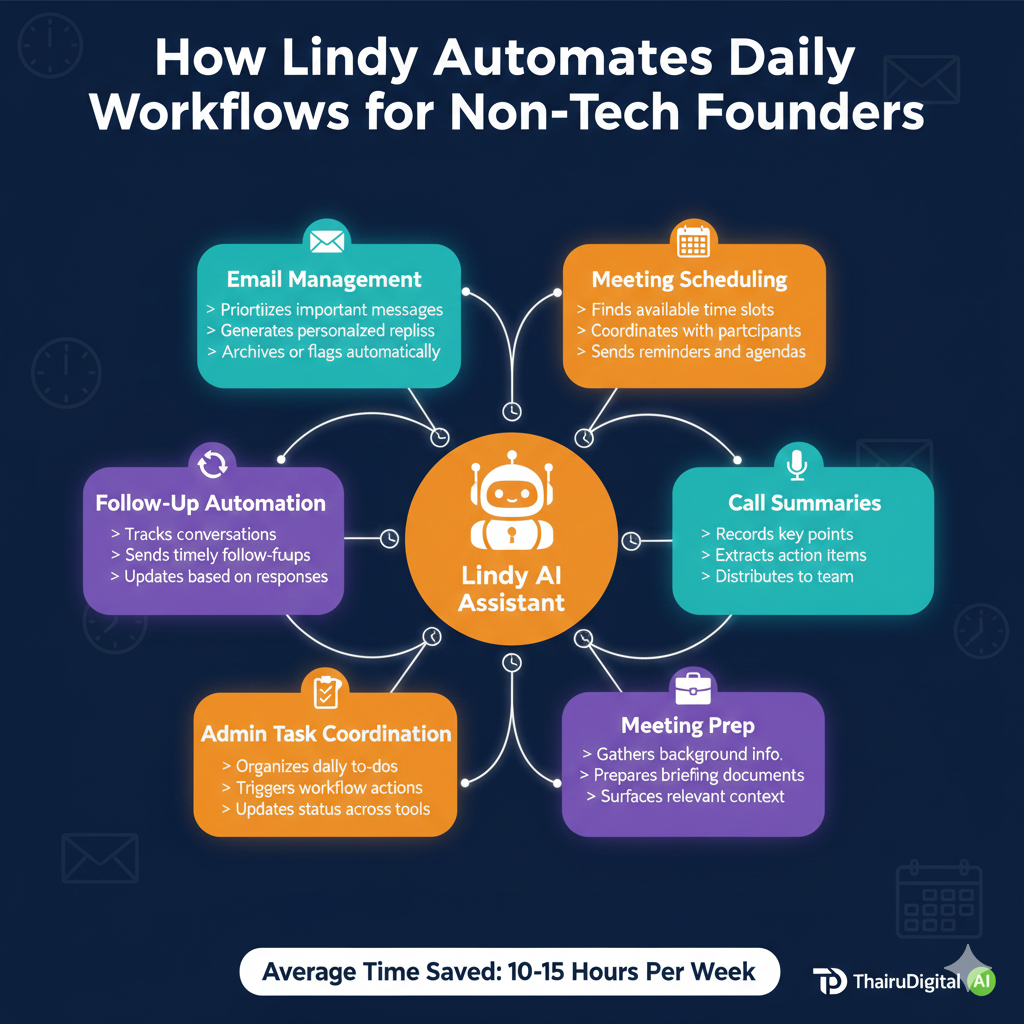
Lindy is designed as a no-code AI assistant that helps founders automate everyday business tasks using simple instructions instead of technical workflows. Its strength lies in personal productivity automation — acting like an AI executive assistant that operates across email, calendar, and communication tools.
For non-technical CEOs, Lindy removes the need for complex setup while still delivering context-aware task execution.
No-Code Setup with Natural Language Instructions
One of Lindy’s biggest advantages is its accessibility.
Founders can configure automations by describing what they want in plain language, such as:
- “Schedule meetings and send follow-up emails.”
- “Summarise important emails daily.”
- “Prepare meeting briefs before calls.”
This eliminates the need for coding or building complex logic trees. The focus is on usability and speed.
Automating Email, Scheduling, and Admin Tasks
Lindy primarily excels at handling repetitive administrative workflows, including:
- Inbox management and prioritization
- Meeting scheduling and coordination
- Automated follow-ups
- Call summaries and task extraction
- Internal reminders and workflow triggers
For busy CEOs, these small automations compound into significant time savings each week.
Context-Aware and Adaptive Task Handling
Unlike basic automation tools, Lindy can retain conversational context and adapt responses based on prior instructions. This makes it more than a rule-based system — it functions as an adaptive AI assistant.
For example, it can:
- Adjust meeting responses based on availability patterns
- Generate personalized replies
- Track ongoing conversations
- Modify follow-ups depending on engagement
This context-awareness is a major reason no-code AI agents are trending in 2026.
Best-Fit Founder Profiles for Lindy
Lindy is especially useful for:
- Solo founders and consultants
- Early-stage startup CEOs
- Service-based business owners
- Executives overwhelmed with admin tasks
It may be less suitable for businesses needing complex multi-agent orchestration across departments — which is where platforms like CrewAI become relevant.
Lindy at a Glance
| Category | Lindy Strength |
| Setup Complexity | Very Low (no-code, natural language) |
| Primary Focus | Email, scheduling, admin automation |
| Context Awareness | Strong conversational memory |
| Ideal User | Founder-led or solo businesses |
| Scalability | Personal workflow-focused |
How Does CrewAI Enable Multi-Agent Workflow Automation for Non-Tech Founders?
CrewAI approaches no-code AI agents from a different angle than Lindy. Instead of focusing on personal admin automation, CrewAI enables founders to create coordinated AI teams that handle structured business workflows.
While it originated as a more technical multi-agent framework, modern implementations and visual interfaces are making it increasingly accessible to non-technical founders who want more than just task automation.
CrewAI is about orchestration — not just assistance.
Understanding CrewAI’s Multi-Agent Architecture
CrewAI allows users to assign different AI agents specific roles, such as:
- Research Agent
- Content Agent
- Operations Agent
- Data Analysis Agent
- Customer Support Agent
Each agent has a defined responsibility, and they collaborate to complete broader workflows.
This creates a virtual AI team instead of a single assistant.
Creating Virtual AI Teams for Operations and Projects
With CrewAI, founders can automate more complex processes like:
- Market research → content creation → publishing
- Lead intake → qualification → CRM update
- Data analysis → insight summary → executive report
Instead of manually coordinating tasks between tools or team members, the agents communicate and pass outputs between each other.
This structure is especially useful for SMBs beginning to scale operations.
Orchestrating Context-Aware Agent Collaboration
CrewAI’s real strength lies in agent collaboration. Each AI agent can:
- Receive structured instructions
- Use outputs from other agents
- Follow multi-step workflows
- Adapt based on updated inputs
This makes it suitable for automating cross-functional processes rather than just individual tasks.
For non-tech founders, the value comes from building repeatable AI-powered systems once and letting them run.
When CrewAI Is the Better Choice
CrewAI is generally better suited for:
- Growing SMBs with defined processes
- Founders automating operations beyond admin tasks
- Businesses wanting AI-driven project workflows
- Teams preparing to scale without increasing headcount
It may require slightly more planning than Lindy, but it offers deeper automation potential.
Lindy vs CrewAI – Which No-Code AI Agent Platform Is Better for Non-Tech Founders
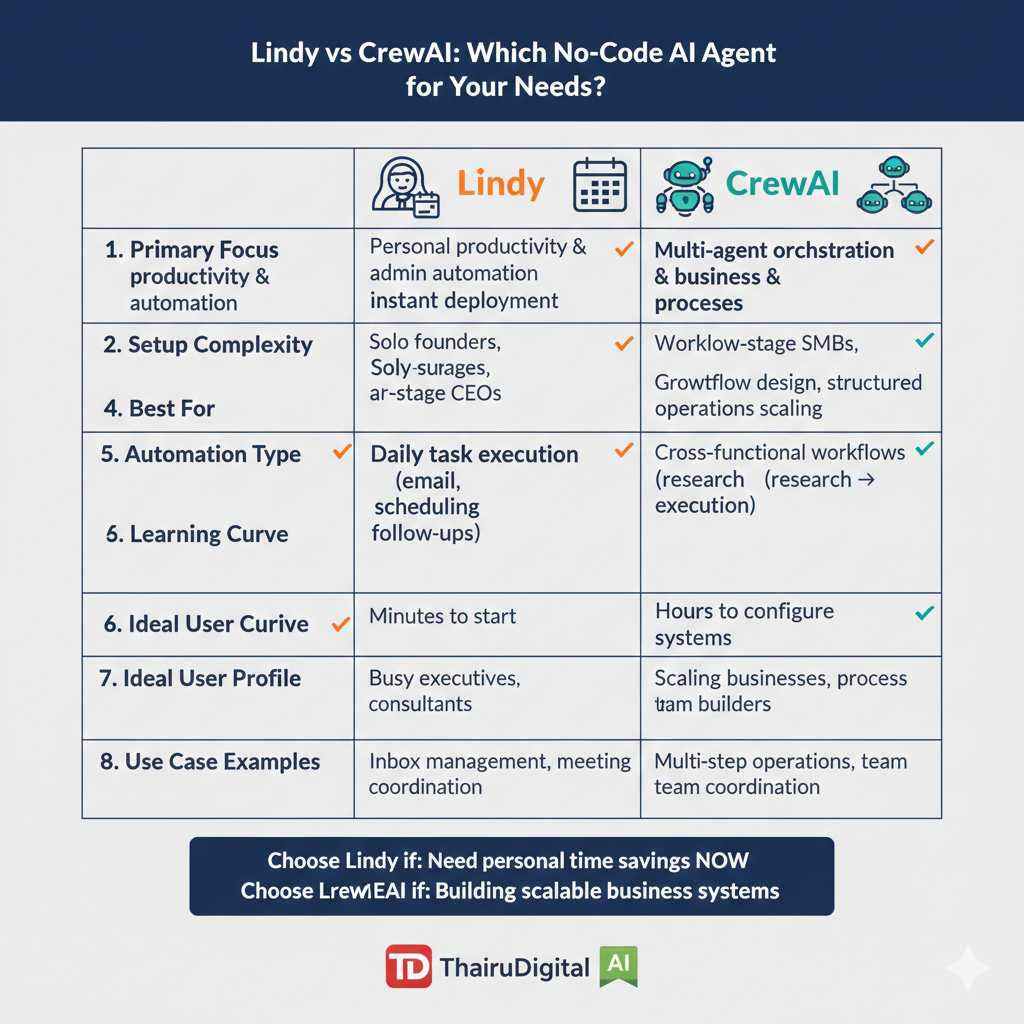
Choosing between Lindy and CrewAI depends on one core question:
Are you trying to automate your personal workload, or are you trying to automate your business systems?
Both platforms fall under the category of no-code AI agents, but they solve different operational problems for non-tech founders.
Ease of Setup and Accessibility
Lindy is built for immediate usability. Founders can deploy it quickly using natural language instructions without mapping complex workflows. It behaves like an AI executive assistant that integrates into daily routines with minimal configuration.
CrewAI, while increasingly accessible, requires more structured thinking. Founders must define roles, workflows, and task dependencies. It’s less about instant setup and more about intentional system design.
If simplicity and speed are the priority → Lindy has the advantage.
If structured automation is the goal → CrewAI offers deeper flexibility.
Personal Productivity vs Business Process Automation
Lindy excels at automating:
- Email management
- Meeting scheduling
- Follow-ups
- Summaries
- Administrative coordination
It reduces founder workload directly.
CrewAI excels at automating:
- Multi-step operational workflows
- Cross-functional processes
- Research-to-execution pipelines
- Team-level task orchestration
It reduces operational bottlenecks at the business level.
This is the key distinction: Lindy optimises the founder’s time, while CrewAI optimises the company’s systems.
Workflow Depth and Customisation
Lindy focuses on guided automation within defined use cases. It is powerful but primarily centred on daily productivity tasks.
CrewAI allows greater customisation by enabling multiple agents to collaborate. This makes it more adaptable for companies with structured SOPs or growing internal complexity.
As businesses scale, workflow depth becomes increasingly important.
Scalability as the Business Grows
For solo founders or early-stage businesses, Lindy may provide immediate ROI by freeing up hours each week.
However, as teams expand and processes become more layered, CrewAI’s multi-agent architecture can support more sophisticated automation across departments.
In short:
- Early-stage or solo founders → Lindy
- Growth-stage SMBs building operational systems → CrewAI
Strategic Takeaway
Both Lindy and CrewAI make AI accessible to non-tech founders — but they operate at different levels of automation maturity.
Lindy acts as a no-code AI assistant that handles daily execution.
CrewAI functions as a no-code AI infrastructure layer that coordinates structured workflows.
The best choice depends on whether your biggest constraint is personal bandwidth or operational complexity.
What Is the Future of No-Code AI Agents for CEOs and SMB Leaders?
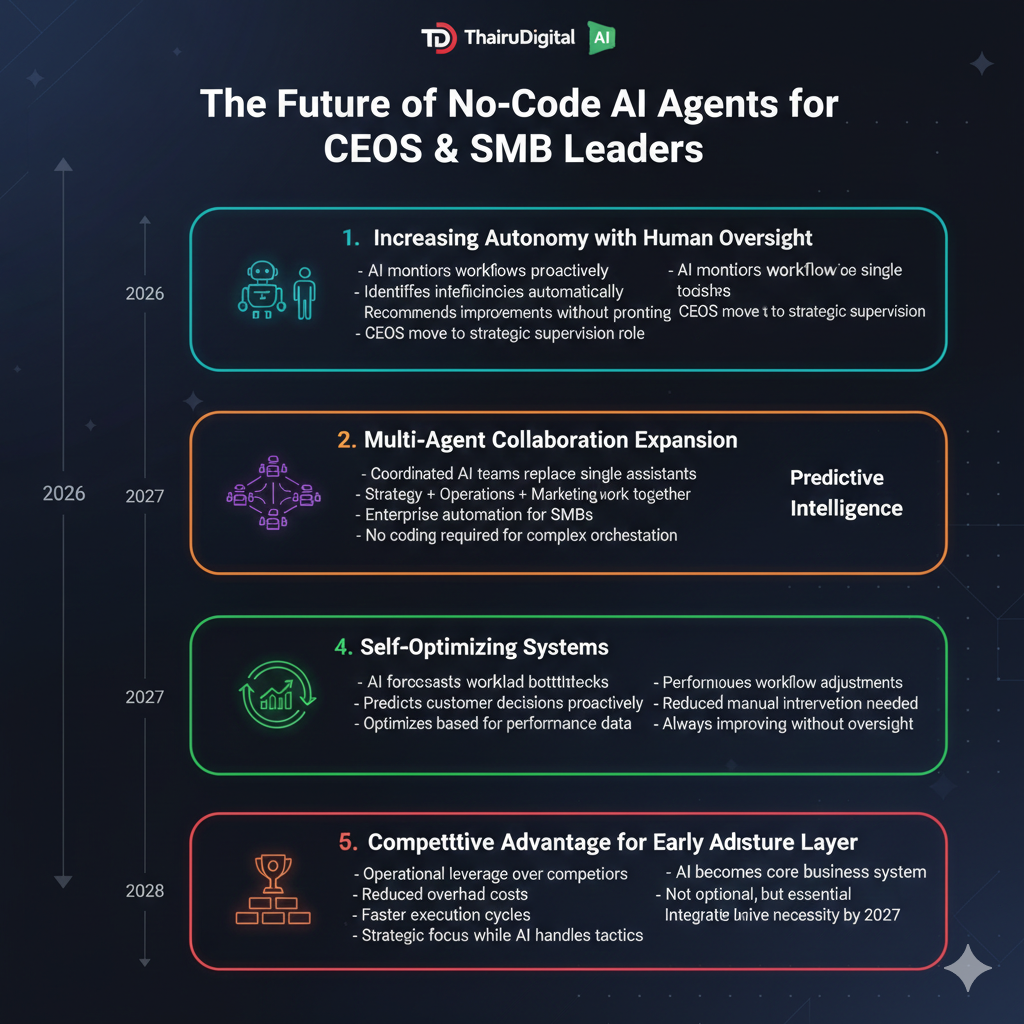
The future of no-code AI agents is moving beyond simple task automation toward intelligent, adaptive business systems. In 2026 and beyond, these agents will not only execute instructions but also anticipate needs, coordinate across workflows, and continuously optimise operations.
For CEOs and SMB leaders, this means AI will shift from being a productivity tool to becoming a strategic infrastructure layer.
Increasing Autonomy with Human Oversight
Future no-code AI agents will require fewer step-by-step instructions. Instead of reacting to commands, they will:
- Monitor workflows proactively
- Identify inefficiencies
- Recommend process improvements
- Trigger actions based on performance thresholds
However, human oversight will remain essential. CEOs will move into supervisory roles — setting objectives while AI agents handle execution.
This hybrid model will define executive productivity in the coming years.
Expansion of Multi-Agent Collaboration
Single AI assistants will evolve into coordinated AI teams.
Future systems will allow non-tech founders to deploy:
- Strategy agents
- Operations agents
- Marketing agents
- Data analysis agents
All collaborating without complex coding.
This multi-agent orchestration will make enterprise-level automation accessible to small and mid-sized businesses.
Predictive and Self-Optimising Business Assistants
The next generation of no-code AI agents will incorporate predictive intelligence.
Instead of waiting for input, they may:
- Forecast workload bottlenecks
- Predict customer churn
- Suggest hiring or outsourcing decisions
- Optimise scheduling based on performance data
This evolution will help CEOs make faster, data-backed decisions without relying entirely on manual reporting.
Competitive Advantage of Early Adoption
SMB leaders who adopt no-code AI agents early gain:
- Operational leverage
- Reduced overhead
- Faster execution cycles
- Increased strategic focus
As AI accessibility continues to improve, the real advantage will not come from having AI — it will come from implementing it strategically before competitors fully adapt.
For non-tech founders, no-code AI agents are becoming less of an experiment and more of a necessity for sustainable growth.
Final Thoughts
No-code AI agents like Lindy and CrewAI are redefining how non-technical CEOs and SMB leaders run their businesses. Lindy empowers founders to automate daily workflows and reclaim time, while CrewAI enables structured, multi-agent collaboration for scaling operations. Looking ahead, these tools will become increasingly autonomous, predictive, and collaborative, allowing founders to focus on strategy rather than manual execution. Early adoption of no-code AI agents is not just about efficiency — it’s a competitive advantage for SMBs ready to leverage AI-driven growth.
Frequently Asked Questions (FAQs)
1. What are no-code AI agents, and why are they important for non-tech founders?
No-code AI agents are AI-powered tools that automate workflows without requiring coding skills. They help non-technical founders streamline daily tasks, optimise operations, and improve productivity, making AI automation accessible to SMB leaders.
2. How do Lindy and CrewAI differ for SMB founders?
Lindy focuses on personal productivity automation, handling email, scheduling, and admin tasks for individual founders. CrewAI is designed for multi-agent orchestration, coordinating complex workflows across operations, marketing, and team-level tasks for growing SMBs.
3. Can non-technical CEOs implement no-code AI agents without IT support?
Yes. Platforms like Lindy and CrewAI are designed for non-technical users. Lindy offers natural language setup for simple workflows, while CrewAI uses visual interfaces to configure multi-agent collaboration without coding.
4. What are the future trends for no-code AI agents?
Future trends include predictive task management, multi-agent orchestration, self-optimising workflows, and context-aware automation. These developments allow SMB leaders to shift from manual oversight to strategic supervision.
5. How can founders measure the ROI of implementing no-code AI agents?
ROI can be measured through time saved, reduction in repetitive tasks, increased workflow efficiency, improved task completion rates, and the ability to scale operations without additional hires. Tracking these metrics helps CEOs evaluate the value of AI automation.