

AI agents for SMBs are no longer experimental tools—they are becoming a core operational layer for modern small and mid-sized businesses.
At Thairu Digital, we’re seeing SMBs actively replace junior hires with AI agents to eliminate onboarding delays, reduce execution risk, and scale operations without increasing headcount. Unlike entry-level roles that require constant supervision and ramp-up time, AI agents deliver immediate, predictable output across functions like customer support, marketing operations, sales administration, and internal workflows.
This shift isn’t about cutting corners—it’s about operational efficiency. As cost pressure and speed-to-market intensify in 2026, AI agents for SMBs are emerging as virtual workers that enable lean teams to execute faster, stay consistent, and grow without the fragility of traditional hiring models. This article explains why this transition is happening right now, which roles are being affected first, and how SMBs can adopt AI agents strategically without losing human oversight.
Why Are SMBs Replacing Junior Hires With AI Agents?
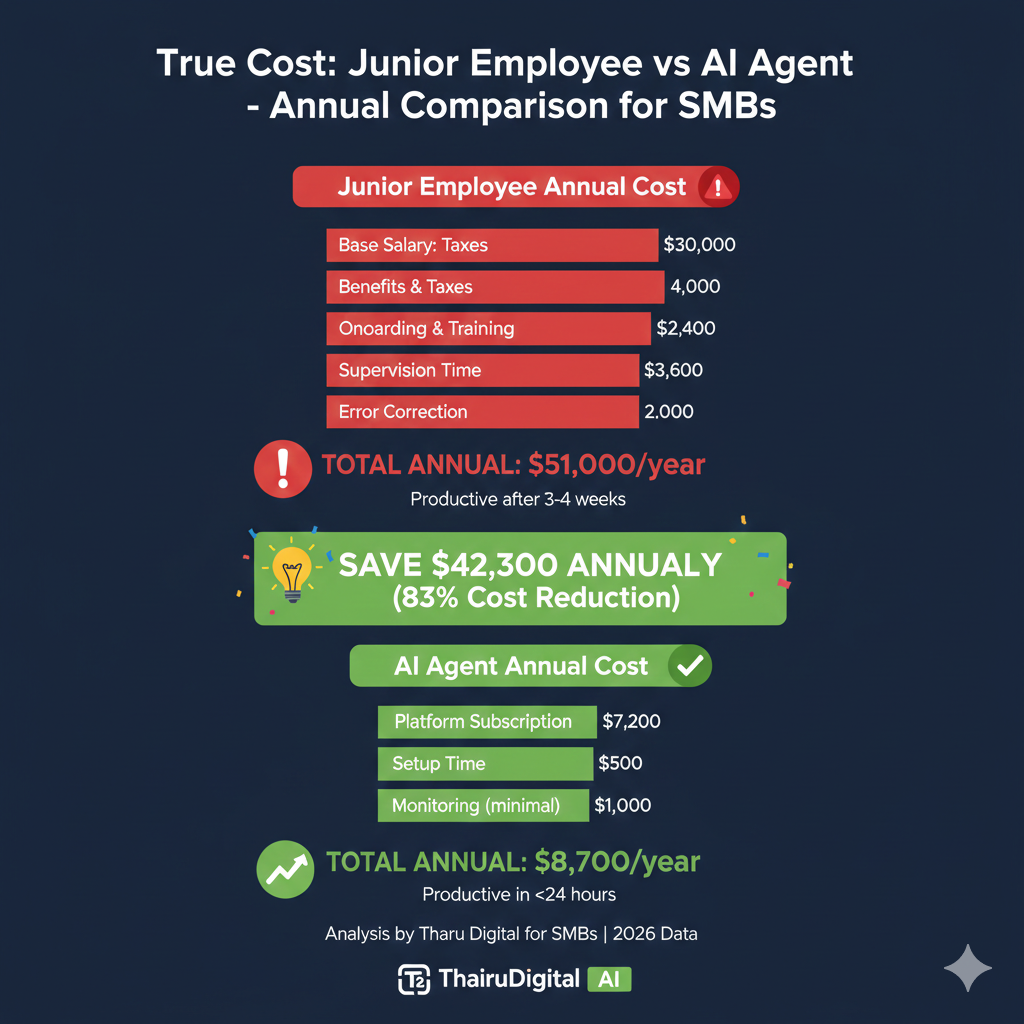
SMBs are increasingly replacing junior hires with AI agents because these virtual workers deliver immediate productivity without the delays of onboarding, training, or inconsistent performance. In a margin-sensitive environment, predictable execution, fast turnaround, and scalability outweigh the uncertain output of entry-level staff. At Thairu Digital, we’ve observed SMBs cutting operational bottlenecks by integrating AI agents for repetitive, rules-driven tasks—allowing teams to focus on high-value strategic work.
Rising Cost of Junior Hires vs Real Output
Junior hires often appear inexpensive on paper, but the true cost of employment goes beyond salary: benefits, training, supervision, and errors accumulate fast. For example:
- A $2,500/month junior marketing hire can cost $3,500/month when including onboarding, software, and error correction.
- AI agents like Lindy or Sintra provide marketing automation, lead follow-ups, and reporting for a fixed monthly fee (~$500–$700), often completing 3–5x more tasks than a single junior employee.
Use Case: A small e-commerce business replaced a junior marketing assistant with an AI agent for social media posting, email campaigns, and basic analytics. Within two weeks, campaign output doubled without additional oversight.
Training Debt and Supervision Overhead
Every junior hire carries a training debt—the cumulative hours spent teaching tools, workflows, and company standards. SMBs rarely have spare senior staff to coach entry-level employees, which slows growth. AI agents, however:
- Require minimal setup
- Follow predefined workflows consistently
- Scale instantly across tasks
Example: For customer support, a junior hire might need 3–4 weeks to learn ticketing systems and escalation rules, while an AI agent like NoimosAI can handle tickets immediately, escalating only the complex ones to human supervisors.
List: Key supervision burdens eliminated by AI agents
- Daily check-ins and progress tracking
- Correcting repeated mistakes
- Providing ongoing feedback on process adherence
- Monitoring performance metrics manually
Speed-to-Value Problem in Small Teams
Time-to-value is crucial for SMBs: every delayed task affects revenue, customer satisfaction, and market responsiveness. AI agents excel at fast execution and immediate ROI:
- Marketing campaigns launched instantly
- Customer support tickets are responded to 24/7
- Sales prospecting executed at scale
Use Case: A SaaS SMB deployed an AI agent to automate lead qualification. Tasks that previously took a junior employee a week were completed in under a day, freeing the founder to close deals instead of micromanaging.
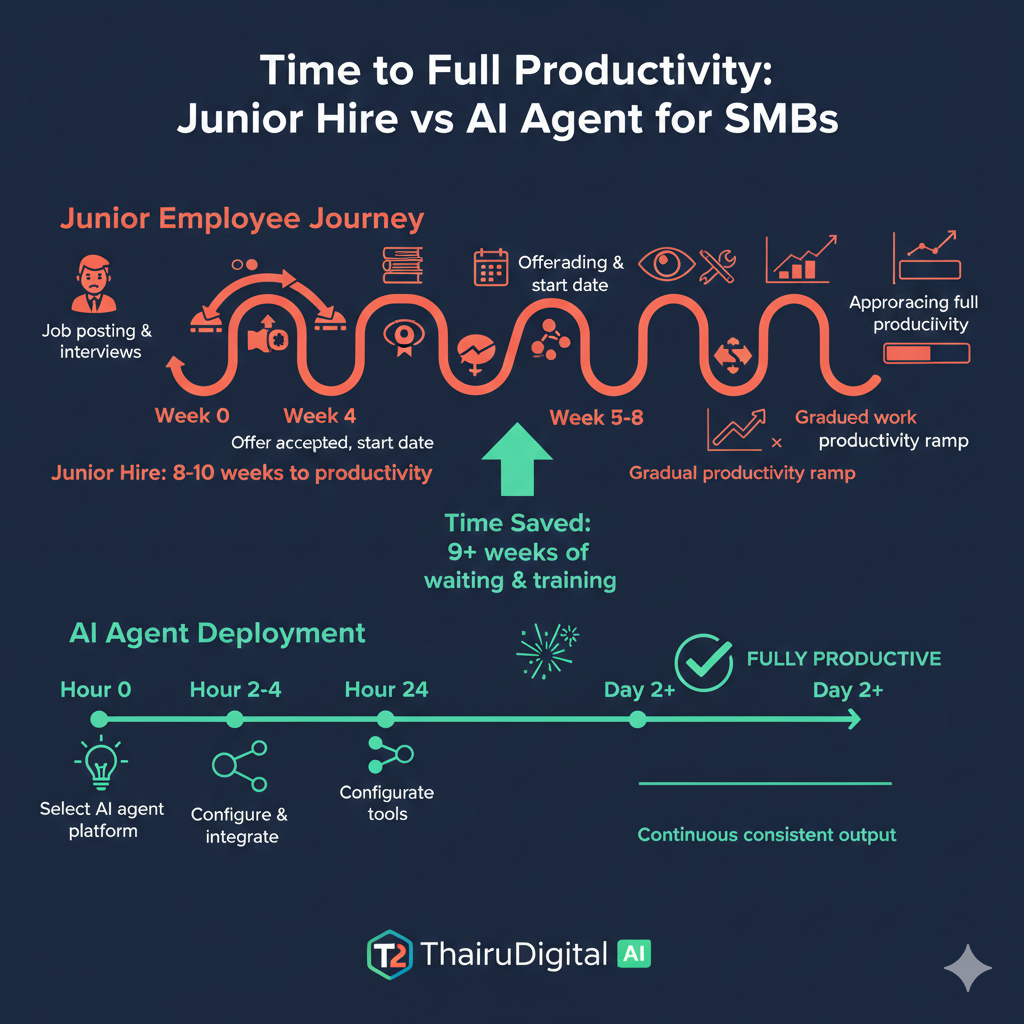
Junior Hire vs AI Agent (Time to Productivity)
| Factor | Junior Hire | AI Agent | Use Case Example |
| Onboarding Time | 2–4 weeks | <24 hours | Social media posting automation |
| Productivity Ramp-Up | Gradual, error-prone | Immediate, consistent | Lead qualification & email follow-ups |
| Cost (Monthly) | $2,500–$3,500 (salary + overhead) | $500–$700 subscription | Customer support ticket triage |
| Supervision Required | High | Low | Marketing reporting & campaign tracking |
| Task Flexibility | Limited without retraining | Scalable across workflows | Multi-department operational support |
How Do AI Agents Like Lindy, Sintra & NoimosAI Actually Work
Modern AI agents for SMBs operate as autonomous or semi-autonomous virtual workers, capable of executing repetitive and rules-based tasks across multiple tools, workflows, and communication channels. These agents use predefined logic combined with AI reasoning to make decisions, escalate issues, and maintain operational consistency. At Thairu Digital, we’ve seen SMBs deploy AI agents to handle marketing campaigns, lead management, customer support, and administrative tasks, dramatically reducing human oversight while maintaining accountability.
Task-Based vs Role-Based AI Agents
AI agents come in two primary configurations, each serving SMBs differently:
1. Task-Based AI Agents
- Focus on specific repetitive tasks (e.g., email follow-ups, social media posting, invoice processing)
- Ideal for short, high-frequency operations
- Quick to deploy and often subscription-based
Use Case: A small SaaS company used a task-based AI agent to manage lead follow-ups and triggered email campaigns. Within a week, response rates improved by 40% without adding headcount.
2. Role-Based AI Agents
- Operate as virtual employees covering an entire functional role (e.g., marketing assistant, customer support agent)
- Manage multiple related tasks autonomously
- Can escalate complex decisions to human supervisors when needed
Use Case: An e-commerce SMB deployed a role-based AI agent to manage both customer queries and order processing. The agent maintained 24/7 support coverage while allowing the human team to focus on strategy and growth initiatives.
Tool Integrations (CRM, Email, Calendars, Help Desks)
AI agents connect seamlessly to existing tools SMBs already use, reducing friction during deployment.
Integration Examples:
- CRM Tools: Automate lead scoring, follow-ups, and reporting
- Email & Messaging: Draft, schedule, and send emails at optimal times
- Calendars: Auto-schedule meetings, reminders, and team tasks
- Help Desk Platforms: Triage tickets, provide answers, and escalate issues
Use Case: A marketing agency integrated Sintra with their CRM and email platform. The AI agent automatically qualified leads, sent follow-up sequences, and updated the CRM in real-time—tasks that would have required 1–2 junior employees.
Guardrails, Permissions, and Escalation Logic
Deploying AI agents safely requires proper governance:
Key Practices:
- Guardrails: Define limits on task execution to prevent errors or overreach
- Permissions: Control access to sensitive data and operational systems
- Escalation Logic: Route complex or ambiguous tasks to human supervisors automatically
Use Case: An SMB using NoimosAI configured escalation rules so the AI could respond to routine support tickets but escalate technical queries to a senior team member. This ensured efficiency without compromising quality.
Are AI Agents Cheaper Than Hiring Junior Employees?
Yes. For SMBs, AI agents for SMBs are often significantly cheaper than hiring junior employees when factoring in salary, benefits, training, and supervision. Beyond cost savings, AI agents provide predictable output and scalability, allowing lean teams to execute more tasks without increasing headcount. At Thairu Digital, we’ve seen SMBs reduce operational costs by 60–80% by replacing routine junior-level tasks with AI agents while maintaining or improving productivity.
True Cost of a Junior Hire (Hidden Costs)
Junior hires often have hidden costs that SMBs overlook:
- Salary & benefits: Base pay plus health, retirement, and bonuses
- Training & onboarding: Weeks of senior time spent mentoring
- Errors & inefficiency: Cost of mistakes during ramp-up
- Software & tools: Licenses, hardware, and workspace
Use Case: A marketing startup budgeting for a $2,500/month junior hire realized total monthly cost exceeded $3,500 when including onboarding, tools, and error correction. AI agents could handle the same workload for $600/month.
Subscription-Based AI Agent Pricing Models
AI agents are typically fixed-cost subscriptions, making budgeting easier and ROI more predictable.
Advantages:
- Transparent monthly costs
- Immediate deployment—no ramp-up period
- No additional supervision for routine tasks
- Flexible scaling: add agents only when needed
Use Case: A small e-commerce SMB deployed Lindy for lead follow-ups, social media scheduling, and reporting at $500/month, replacing two junior employees who cost $7,000 combined (including overhead).
Cost Predictability vs Payroll Volatility
AI agents eliminate salary fluctuations, overtime, and turnover risk. SMBs can plan budgets confidently and scale operations without sudden payroll spikes.
List: Benefits of AI Agents for SMB Cost Management
- Predictable monthly expense
- No recruitment delays or replacement costs
- Instant scaling for seasonal peaks
- Reduced risk of performance variability
Junior Hire vs AI Agent (Cost Comparison)
| Factor | Junior Hire | AI Agent | Example Use Case |
| Monthly Cost | $2,500–$3,500 | $500–$700 | Marketing automation & lead follow-up |
| Onboarding Time | 2–4 weeks | <24 hours | Customer support ticket triage |
| Supervision Needed | High | Low | Social media campaign scheduling |
| Output Consistency | Variable | Predictable | Email marketing reporting |
| Scaling | Incremental, expensive | Easy, subscription-based | Multi-channel marketing execution |
Which SMB Roles Are Being Replaced First by AI Agents?
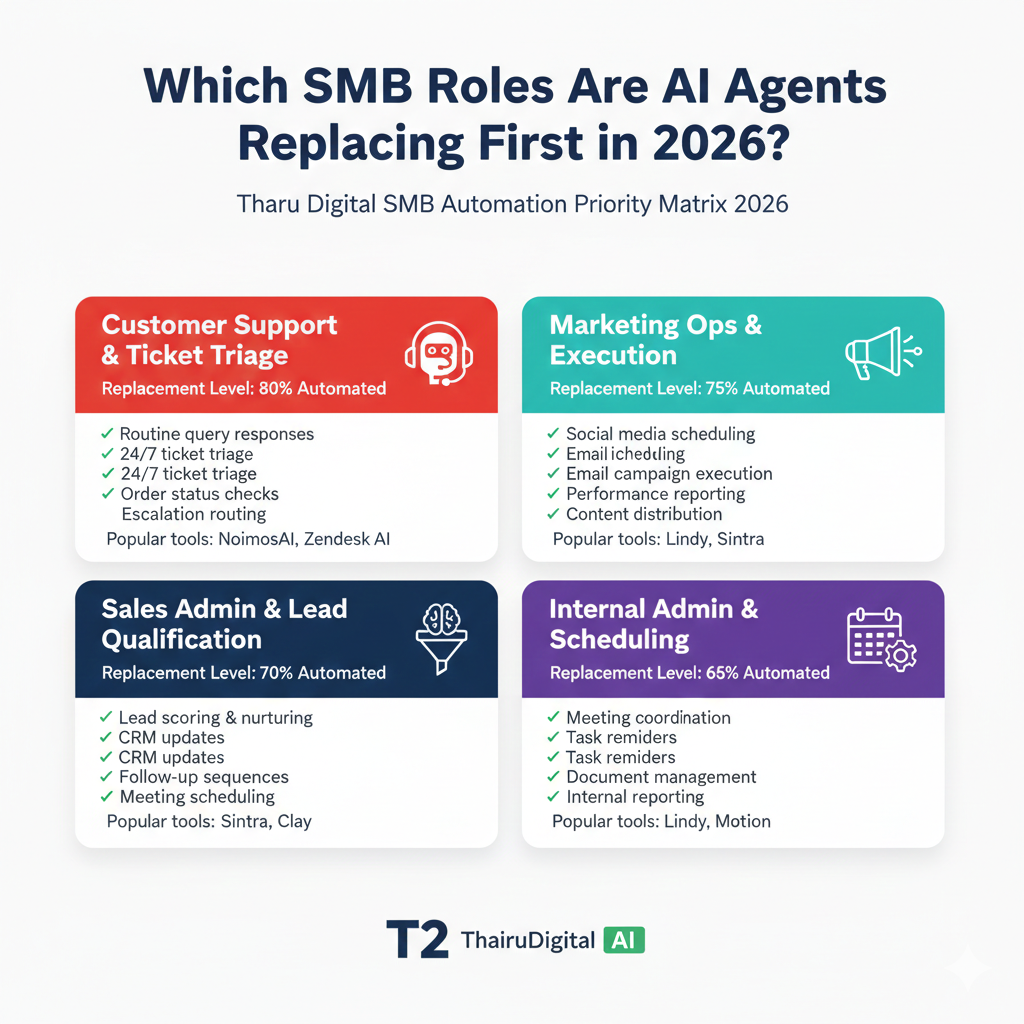
SMBs are initially replacing roles that involve repetitive, rules-driven tasks where output can be standardised and measured. AI agents for SMBs excel in areas like customer support, marketing operations, sales administration, and internal workflow management, enabling lean teams to maintain productivity without adding headcount. At Thairu Digital, we’ve observed SMBs strategically deploying AI agents in these functions first to maximise efficiency and ROI while preserving human resources for high-value decision-making.
Customer Support & Ticket Triage
Customer support is one of the most common early use cases for AI agents:
- AI agents can handle routine queries, escalate complex issues, and provide 24/7 response coverage.
- Response consistency improves customer satisfaction while reducing workload for human agents.
Use Case: An SMB e-commerce business deployed NoimosAI to handle order status questions and returns. Routine tickets were resolved instantly, freeing the human support team to address escalations and strategic improvements.
List: Benefits of AI Agents in Customer Support
- Fast and consistent responses
- Reduced human error
- 24/7 availability
- Lower operational cost
Marketing Execution & Reporting
Marketing ops often involve repetitive, time-sensitive tasks like posting, reporting, and analytics. AI agents automate these tasks efficiently:
- Scheduling social media content across channels
- Compiling campaign performance reports
- Managing automated email sequences
Use Case: A small SaaS startup used Lindy to run email marketing campaigns, track analytics, and generate weekly reports. Tasks that took a junior marketer 15 hours/week were completed autonomously by the AI agent in under 2 hours.
Sales Ops & Lead Qualification
AI agents are ideal for repetitive sales tasks:
- Qualifying leads via email or CRM systems
- Logging interactions and updates automatically
- Preparing follow-ups based on predefined rules
Use Case: An SMB B2B company implemented Sintra to qualify and nurture leads. Human sales reps focused only on closing deals, while the AI handled 80% of repetitive outreach, increasing conversion rates by 30%.
Internal Admin & Scheduling
Internal operations like scheduling, reminders, and document management are also being offloaded to AI agents:
- Automating recurring calendar tasks
- Preparing meeting agendas
- Maintaining internal dashboards and reports
Use Case: A consulting firm replaced a junior admin with an AI agent that scheduled meetings, tracked deadlines, and updated internal dashboards, cutting human supervision time in half.
When Should SMBs Still Hire Humans Instead of AI Agents?
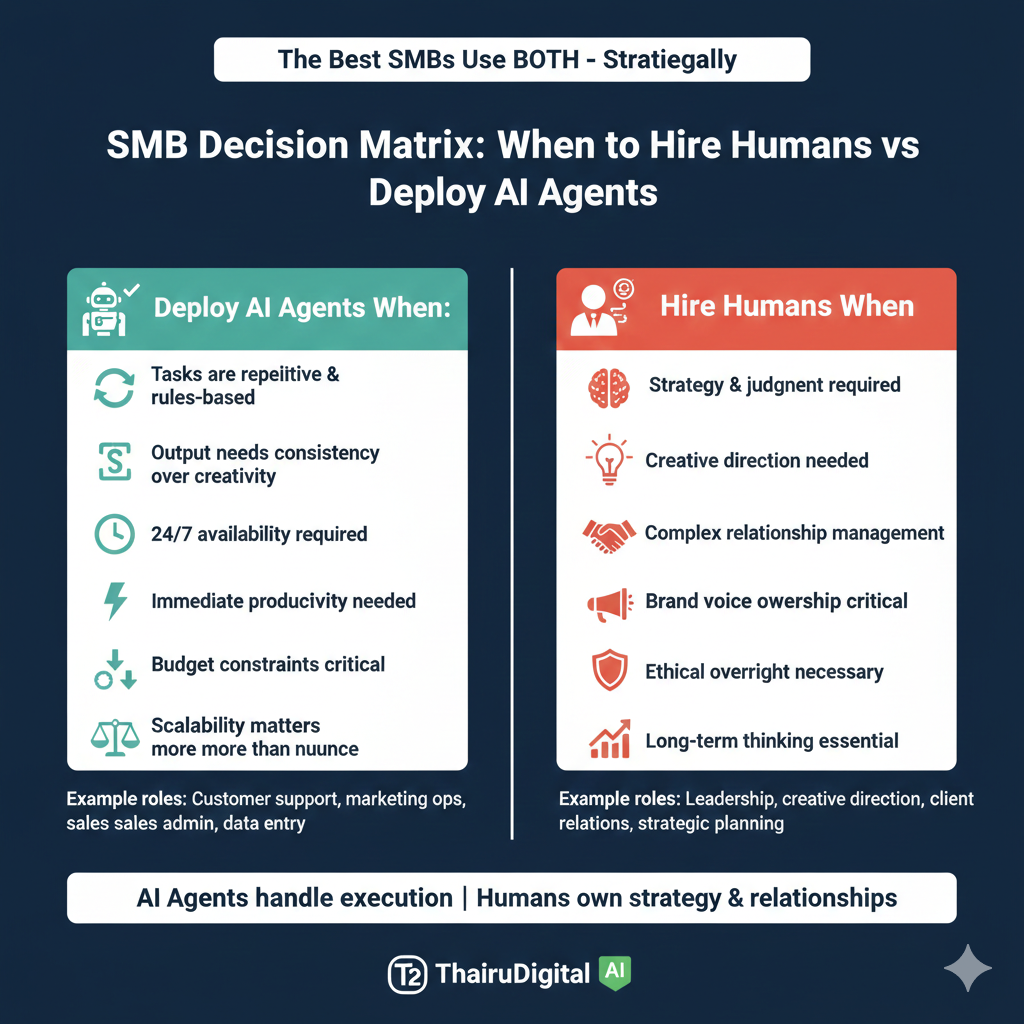
While AI agents for SMBs excel at repetitive, rules-based execution, there are still situations where human judgment, creativity, and relationship ownership are irreplaceable. The most effective SMBs in 2026 are not choosing between humans and AI—they are deliberately assigning each to the work they perform best. At Thairu Digital, we advise SMBs to keep humans in roles where context, nuance, and long-term thinking directly affect business outcomes.
Strategic Decision-Making and Business Judgment
AI agents operate within defined logic and data boundaries, which makes them excellent executors—but poor strategic owners. High-impact decisions such as pricing strategy, market positioning, partnerships, and long-term planning require human judgment informed by experience, intuition, and risk assessment.
Why humans still matter here:
- Strategy often involves incomplete or ambiguous data
- Decisions carry long-term brand and financial consequences
- Context shifts faster than predefined rules can adapt
Use Case: An SMB may use AI agents to gather competitive data and generate reports, but the final decision on market expansion or product positioning still sits with founders or senior leaders who understand nuance beyond metrics.
Brand Voice, Creative Direction, and Narrative Control
Although AI agents can generate content at scale, brand leadership and creative direction remain human responsibilities. Consistent brand voice, storytelling, and emotional resonance require a deep understanding of audience psychology and cultural context.
Where humans outperform AI agents:
- Defining brand tone and messaging frameworks
- Creating original campaign concepts
- Making judgment calls on sensitive or high-stakes communication
Use Case: At Thairu Digital, AI agents can execute content distribution, reporting, and optimization, but senior strategists define the messaging direction and narrative that shapes long-term brand authority.
Complex Client Relationships and Trust-Based Roles
Client-facing roles that rely on trust, empathy, and negotiation are still best handled by humans. While AI agents can support these roles with data and automation, they cannot fully replace relationship ownership.
Human-led responsibilities include:
- Managing high-value client accounts
- Navigating conflict or dissatisfaction
- Negotiating contracts and long-term engagements
Use Case: A professional services SMB may deploy AI agents to handle scheduling, reporting, and follow-ups, but account managers remain human to maintain trust and adapt communication dynamically.
Oversight, Governance, and AI Accountability
AI agents require human oversight to ensure ethical use, accuracy, and alignment with business goals. Someone must define guardrails, monitor performance, and intervene when automation fails or conditions change.
Human responsibilities in AI-driven teams:
- Defining escalation thresholds
- Auditing AI decisions and outputs
- Updating workflows as business needs evolve
Use Case: An SMB using AI agents for customer support assigns a human lead to monitor escalations, review edge cases, and refine workflows—ensuring efficiency without reputational risk.
Final Thoughts
The shift toward AI agents for SMBs isn’t a trend driven by hype—it’s a rational response to operational pressure. Small and mid-sized businesses are choosing predictability, speed, and scalability over the uncertainty of junior hires, especially for execution-heavy roles where consistency matters more than potential. AI agents are proving their value not by replacing humans wholesale, but by removing friction from day-to-day operations.
At Thairu Digital, our view is clear: the most resilient SMBs in 2026 will be those that design their teams around tasks, not titles. AI agents should own repetitive, rules-based work, while humans focus on strategy, creativity, and relationships. This approach allows businesses to scale without inflating payroll, reduce operational risk, and stay agile in increasingly competitive markets.
The question is no longer whether AI agents belong in SMB operations—it’s how deliberately they are deployed. Businesses that treat AI agents as core infrastructure, rather than experimental tools, will gain a measurable execution advantage. Those that don’t will continue to struggle with inefficiency, slow execution, and rising costs in a landscape that no longer rewards inefficiency.
Frequently Asked Questions (FAQ)
What are AI agents for SMBs?
AI agents for SMBs are autonomous or semi-autonomous virtual workers designed to execute repetitive, rules-based business tasks across tools and workflows. Unlike basic chatbots, AI agents can manage end-to-end processes such as customer support, lead qualification, marketing execution, and internal administration. They integrate with systems like CRMs, email platforms, and help desks to deliver consistent output with minimal human supervision.
Are AI agents replacing human jobs permanently?
AI agents are not replacing all human roles permanently—they are replacing specific tasks that are repetitive, predictable, and execution-heavy. In practice, most SMBs use AI agents to remove operational bottlenecks while retaining humans for strategy, creativity, and relationship-driven work. The shift is toward hybrid teams, where AI handles execution and humans focus on high-impact decision-making.
Can small businesses afford AI agents?
Yes. Most AI agents operate on subscription-based pricing models that are significantly cheaper than hiring junior employees. When factoring in salary, benefits, onboarding, training, and supervision, AI agents for SMBs often cost 60–80% less annually. This makes them accessible even to early-stage businesses that need operational efficiency without long-term payroll commitments.
What’s the difference between AI agents and chatbots?
Chatbots are designed to respond to predefined prompts or questions, usually within a single interface. AI agents, on the other hand, can execute multi-step workflows across multiple tools. They can take actions such as updating CRMs, sending emails, scheduling meetings, and escalating issues—making them far more suitable as virtual workers for SMB operations.
Which SMB departments benefit most from AI agents?
Departments with high volumes of repetitive work benefit the most. These typically include customer support, marketing operations, sales administration, and internal admin functions. AI agents for SMBs excel in environments where speed, consistency, and scalability matter more than subjective judgment, allowing human teams to focus on growth and strategy.
How secure are AI agents for business use?
AI agents can be secure when deployed with proper guardrails, permissions, and oversight. Most platforms allow businesses to control data access, define task limits, and implement escalation rules. At Thairu Digital, we recommend assigning human accountability for monitoring AI agent performance to ensure data security, compliance, and operational alignment.
How quickly can an SMB deploy an AI agent?
Most SMBs can deploy an AI agent within hours or days, depending on workflow complexity. Task-based agents can often be set up in under 24 hours, while role-based agents may take slightly longer due to integrations and permissions. This rapid deployment is one of the key reasons SMBs are adopting AI agents instead of traditional junior hires.